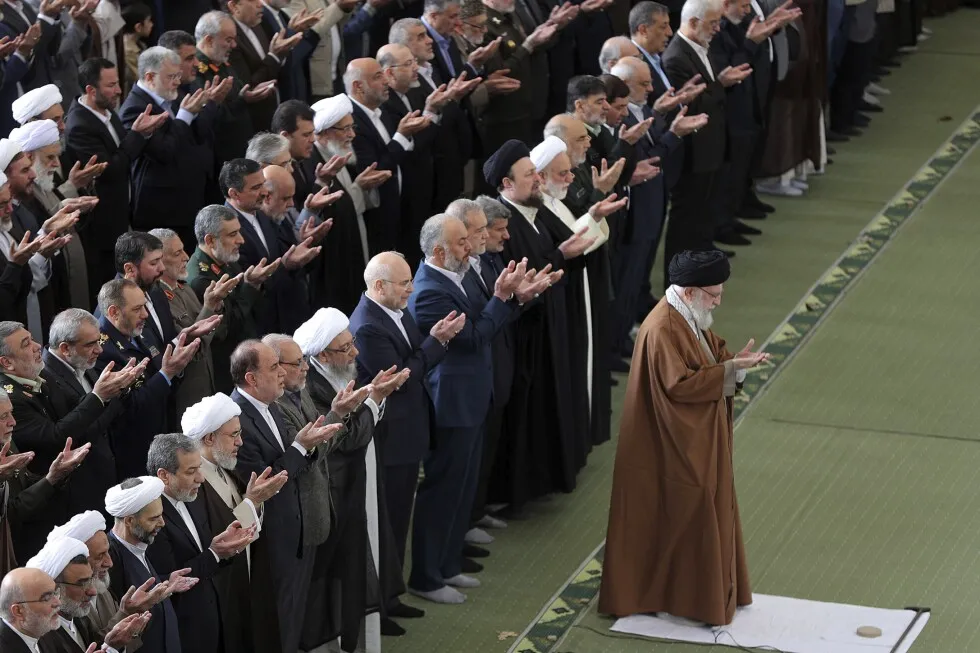
How succession works in Iran and who could be the country’s next supreme leader 1 of 2 | Ayatollah Ali Khamenei, who assembled theocratic power in Iran over the decades as its supreme leader and sought to turn it into a regional powerhouse, bringing it into confrontation with Israel and the United States over its nuclear program while crushing democracy protesters at home, has died, Iranian state media confirmed early Sunday. 2 of 2 | In this photo released by the official website of the office of the Iranian supreme leader, Supreme Leader Ayatollah Ali Khamenei leads an Eid al-Fitr prayer marking the end of the Muslim holy fasting month of Ramadan at the Imam Khomeini Grand Mosque in Tehran, Iran, Monday, March 31, 2025. (Office of the Iranian Supreme Leader via AP, File) 1 of 2 Ayatollah Ali Khamenei, who assembled theocratic power in Iran over the decades as its supreme leader and sought to turn it into a regional powerhouse, bringing it into confrontation with Israel and the United States over its nuclear program while crushing democracy protesters at home, has died, Iranian state media confirmed early Sunday. Add AP News on Google Add AP News as your preferred source to see more of our stories on Google. 2 of 2 In this photo released by the official website of the office of the Iranian supreme leader, Supreme Leader Ayatollah Ali Khamenei leads an Eid al-Fitr prayer marking the end of the Muslim holy fasting month of Ramadan at the Imam Khomeini Grand Mosque in Tehran, Iran, Monday, March 31, 2025. (Office of the Iranian Supreme Leader via AP, File) Add AP News on Google Add AP News as your preferred source to see more of our stories on Google. Updated [hour]:[minute] [AMPM] [timezone], [monthFull] [day], [year] DUBAI, United Arab Emirates (AP) — The death of Supreme Leader Ayatollah Ali Khamenei after almost 37 years in power raises paramount questions about Iran’s future. The contours of a complex succession process began to take shape the morning after Khamenei’s killing in an airstrike campaign by the United States and Israel.Here is what to know:Temporary leadership councilAs outlined in its constitution, Iran on Sunday formed a council to assume leadership duties and govern the country.The council is made up of Iran’s sitting president, the head of the country’s judiciary and a member of the Guardian Council chosen by Iran’s Expediency Council, which advises the supreme leader and settles disputes with parliament.Iran’s reformist president, Masoud Pezeshkian, and hard-line judiciary chief Gholamhossein Mohseni Ejei, are its members who will step in and “temporarily assume all the duties of leadership.” Panel of clericsThough the leadership council will govern in the interim, an 88-member panel called the Assembly of Experts “must, as soon as possible” pick a new supreme leader under Iranian law.The panel consists entirely of Shiite clerics who are popularly elected every eight years and whose candidacies are approved by the Guardian Council, Iran’s constitutional watchdog.That body is known for disqualifying candidates in various elections in Iran and the Assembly of Experts is no different. The Guardian Council barred former Iranian President Hassan Rouhani, a relative moderate whose administration struck the 2015 nuclear deal with world powers, from election for the Assembly of Experts in March 2024. Khamenei’s sonClerical deliberations about succession and machinations over it take place far from the public eye, making it hard to gauge who may be a top contender. Previously, it was thought that Khamenei’s protege, hard-line President Ebrahim Raisi, may try to take the mantle. However, he was killed in a May 2024 helicopter crash.That has left one of Khamenei’s sons, Mojtaba, a 56-year-old Shiite cleric, as a potential candidate, though he has never held government office. But a father-to-son transfer in the case of a supreme leader could spark anger, not only among Iranians already critical of clerical rule, but also among supporters of the system. Some may see it as un-Islamic and in line with creating a new, religious dynasty after the 1979 collapse of the U.S.-backed Shah Mohammad Reza Pahlavi’s government. There has been only one other transfer of power in the office of supreme leader of Iran, the paramount decision-maker since the country’s 1979 Islamic Revolution. In 1989, Grand Ayatollah Ruhollah Khomeini died at age 86 after being the figurehead of the revolution and leading Iran through its eight-year war with Iraq. This transition now comes after Israel launched a 12-day war against Iran in June 2025 as well.
SRCAssociated Press (AP)
LANGEN
LEANCenter
WORDS747
ENT10
SUN · 2026-03-01 · 12:53 GMTBRIEF NSR-2026-0301-20320
NSR-2026-0301-20320News Report·EN·Political Strategy
How succession works in Iran and who could be the country’s next supreme leader
Iranian state media confirmed the death of Supreme Leader Ayatollah Ali Khamenei. Following his death after almost 37 years in power, a leadership council was formed on Sunday to govern the country.
By
JON GAMBRELLAssociated Press (AP)Filed 2026-03-01 · 12:53 GMTLean · CenterRead · 3 min
Associated Press (AP)FIG 01
Reading time
3min
Word count
747words
Sources cited
0cited
Entities identified
10entities
Quality score
100%
§ 01
Briefing Summary
AI-generatedNEWSAR · AI
Iranian state media confirmed the death of Supreme Leader Ayatollah Ali Khamenei. Following his death after almost 37 years in power, a leadership council was formed on Sunday to govern the country. The council consists of Iran’s president, the head of the judiciary, and a member of the Guardian Council. Khamenei's death raises questions about Iran's future and the complex succession process. The article suggests Khamenei was killed in an airstrike campaign by the United States and Israel.
Confidence 0.90Claims 5Entities 10
§ 02
Article analysis
Model · rule-basedFraming
Political Strategy
National Security
Tone
Measured
AI-assessed
CalmNeutralAlarmist
Factuality
0.80 / 1.00
Factual
LowHigh
Sources cited
0
No named sources
FewMany
§ 03
Key claims
5 extracted01
Khamenei's death follows an airstrike campaign by the United States and Israel.
factualnull
Confidence
1.00
02
An 88-member panel called the Assembly of Experts must pick a new supreme leader.
factualnull
Confidence
1.00
03
The council is made up of Iran’s sitting president, the head of the country’s judiciary and a member of the Guardian Council.
factualnull
Confidence
1.00
04
Iran formed a council to assume leadership duties and govern the country.
factualnull
Confidence
1.00
05
Ayatollah Ali Khamenei has died, Iranian state media confirmed early Sunday.
factualIranian state media
Confidence
1.00
§ 04
Full report
3 min read · 747 words§ 05
Entities
10 identifiedKey playerOppositionContextPositiveNeutralNegative
Locations5
§ 06
Keywords & salience
10 termssupreme leader
1.00
iran
1.00
ayatollah ali khamenei
0.90
succession
0.90
leadership council
0.80
theocratic power
0.70
expediency council
0.60
guardian council
0.60
nuclear program
0.60
united states
0.50
§ 07
Topic connections
Interactive graph Network visualization showing 51 related topics
View Full Graph Person Organization Location Event|Click node to navigate|Edge numbers = shared articles