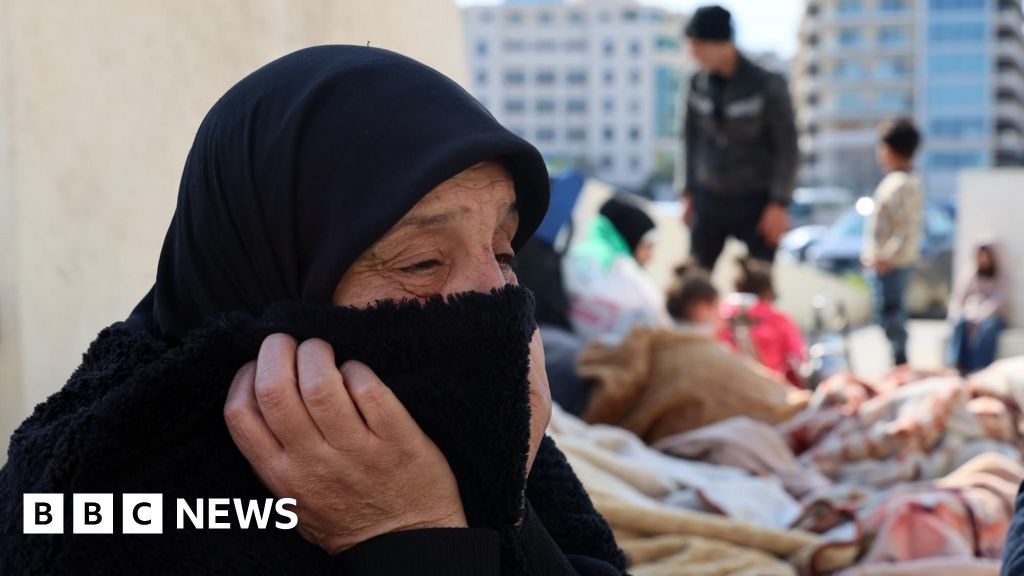
17 minutes agoHugo BachegaMiddle East correspondent, Tel AvivReutersIsrael's military says it has struck dozens of Hezbollah targets across Lebanon, including Beirut's southern suburbsThe Iranian-backed group Hezbollah has fired rockets from Lebanon into Israel for a second day while the Israeli military has sent troops into the south of the country, as Lebanon is dragged into the war between US, Israel and Iran. Israel has also carried out air strikes that have killed dozens of people, according to Lebanese health officials.On Monday, after the regional conflict spread to Lebanon, thousands of residents fled villages in the south and, in Beirut, displaced families gathered in the city's Martyrs' Square and on the promenade along the Mediterranean.Hezbollah's actions were largely symbolic, but Israel's retaliation came with force.Air strikes hit southern Lebanon, the eastern Bekaa Valley, and the southern suburbs of Beirut, known as the Dahieh - the heartlands of Hezbollah and of Lebanon's Shia community. And now, the Israeli military says it has expanded its military presence in southern Lebanon, indicating that this could be a prolonged operation.EPAAt least 30,000 people have been displaced in Lebanon, according to the UNThis new cycle of violence was all too predictable. For months, Israeli officials had signalled an escalation of their campaign against Hezbollah. Despite a ceasefire that ended a devastating 13-month war in 2024, Israel had continued with its bombing of Lebanon almost every day, saying the group was trying to rebuild its capabilities. Hezbollah, however, had remained quiet, aware that any move would inevitably be met with a powerful retaliation.Hezbollah's decision to respond led to a swift backlash from many Lebanese, a reflection of the diminished standing of a once-dominant group in a country exhausted by conflicts.Underlining the recent shift in the balance of power, the Lebanese government announced a ban on Hezbollah's military activities and demanded the group hand over its weapons to the state. And in a strongly worded statement that symbolised a shared frustration, Prime Minister Nawaf Salam said Hezbollah's attack showed disregard for the "will of the majority of Lebanese".ReutersHezbollah said it launched rockets and drones into Israel to avenge the killing of Iran's supreme leaderHezbollah, whose name means "Party of God" in Arabic, was created in the 1980s in response to Israel's occupation of Lebanon during the 15-year Lebanese civil war. Their latest conflict started when Hezbollah began firing rockets and missiles at Israeli positions a day after Israel launched its military response in Gaza to the Hamas-led attacks on 7 October 2023. (Hezbollah is proscribed as a terrorist organisation in the US, the UK and other countries.)The war that followed was catastrophic for Lebanon and Hezbollah. The group's top leaders were assassinated, including long-time chief Hassan Nasrallah, many of its fighters killed, and part of its formidable arsenal destroyed. The conflict ended with a ceasefire deal in November 2024. Hezbollah was battered and isolated, blamed for a conflict which many, including some supporters, described as a miscalculation that brought only suffering to a country that was already deep in crisis.This year, as tensions between the US and Iran mounted and President Donald Trump deployed what he described as an "armada" to the Middle East, threatening to strike Iran, concerns grew in Lebanon. For decades, Tehran invested billions of dollars in Hezbollah as part of an alliance of proxies in the Middle East it calls the "Axis of Resistance". With Iran vowing to turn any attack into a regional conflict, the Lebanese government warned Hezbollah against getting involved. In turn, according to reports, the group reassured the authorities that it would not intervene. But, in the end, possibly under pressure from its patron, it did.For some time, there have been whispers of divisions inside Hezbollah about the way forward, as President Joseph Aoun pushes ahead with a disarmament plan laid out in the ceasefire agreement. Armed resistance is an essential part of the group's identity - its flag includes a hand holding an assault rifle - and, so far, Hezbollah has resisted calls to discuss the future of its weapons. Aoun has rejected the use force, warning that this could antagonise the Shia community and reignite sectarian divisions in a country .ReutersIsrael's military said it was creating a buffer in Lebanon "between our residents and any threat"It is unclear what is left of Hezbollah's arsenal or of its fighting force and, with Israeli Defence Minister Israel Katz describing the group's Secretary General, Naim Qassem, as a "marked target for elimination", some see this as a suicidal mission by the group.The escalation in Lebanon means a second front for Israel in the war in Iran, as it continues to carry out frequent air strikes on Iran alongside the US. In both countries, there is no clear stated objective or timeline, though in Lebanon it is likely that Israel's aim is to permanently neutralise any military threat from Hezbollah and possibly force Lebanon into agreeing a new deal. The Israeli military's chief of staff has said Hezbollah will suffer a "devastating blow".The expansion of Israel's ground invasion in south of Lebanon has raised fears of a wider campaign, similar to the one in 2024. Despite the ceasefire deal, which was brokered by the US and France, the Israeli military had remained in five locations inside Lebanon and enforced a de facto buffer zone along the border. Thousands of additional Lebanese soldiers had also been deployed there. Some are now being forced to retreat."Hezbollah is trapped – precisely where the Israelis want it to be," Michael Young, senior editor at the Carnegie Middle East Center in Beirut, wrote in the Diwan blog. "Nothing can now stop Israel's intention to hit Hezbollah and its community hard, completing what was started in 2024."Last November, I visited southern Lebanese communities that remained in ruins - international donors have refused to fund reconstruction in part because of the impasse over disarmament - and saw that some people were already challenging long-held views. Hezbollah's move has been angrily denounced by critics as reckless. But it is possible that even some followers will ask what exactly the group is trying to achieve.
SRCBBC News - World
LANGEN
LEANCenter
WORDS1 014
ENT8
TUE · 2026-03-03 · 15:42 GMTBRIEF NSR-2026-0303-21027
NSR-2026-0303-21027News Report·EN·Conflict
Battered and isolated, Hezbollah drags Lebanon into another war
Hezbollah has fired rockets from Lebanon into Israel for a second day, prompting a strong Israeli response, including air strikes and troop deployments to southern Lebanon. The conflict has drawn Lebanon into the war between the US, Israel, and Iran.
BBC News - WorldFiled 2026-03-03 · 15:42 GMTLean · CenterRead · 5 min
BBC News - WorldFIG 01
Reading time
5min
Word count
1 014words
Sources cited
4cited
Entities identified
8entities
Quality score
100%
§ 01
Briefing Summary
AI-generatedNEWSAR · AI
Hezbollah has fired rockets from Lebanon into Israel for a second day, prompting a strong Israeli response, including air strikes and troop deployments to southern Lebanon. The conflict has drawn Lebanon into the war between the US, Israel, and Iran. At least 30,000 people have been displaced in Lebanon, according to the UN. Hezbollah's actions were largely symbolic, but Israel's retaliation came with force. The Lebanese government has announced a ban on Hezbollah's military activities and demanded the group hand over its weapons to the state. Hezbollah reportedly launched rockets and drones into Israel to avenge the killing of Iran's supreme leader, sparking widespread condemnation from many Lebanese who view the group as out of touch with public opinion.
Confidence 0.90Sources 4Claims 5Entities 8
§ 02
Article analysis
Model · rule-basedFraming
Conflict
Political Strategy
Tone
Mixed Tone
AI-assessed
CalmNeutralAlarmist
Factuality
0.70 / 1.00
Factual
LowHigh
Sources cited
4
Well sourced
FewMany
§ 03
Key claims
5 extracted01
Hezbollah said it launched rockets and drones into Israel to avenge the killing of Iran's supreme leader
quoteHezbollah
Confidence
1.00
02
The Lebanese government announced a ban on Hezbollah's military activities.
factualReuters
Confidence
1.00
03
At least 30,000 people have been displaced in Lebanon.
statisticUN
Confidence
1.00
04
Hezbollah has fired rockets from Lebanon into Israel for a second day.
factualReuters
Confidence
1.00
05
Israel's military says it has struck dozens of Hezbollah targets across Lebanon.
factualIsrael's military
Confidence
1.00
§ 04
Full report
5 min read · 1 014 words§ 05
Entities
8 identifiedKey playerOppositionContextPositiveNeutralNegative
People1
Organizations1
§ 06
Keywords & salience
9 termshezbollah
1.00
lebanon
0.90
israel
0.90
conflict
0.80
air strikes
0.70
military operation
0.60
displaced
0.50
regional conflict
0.50
iranian-backed group
0.40
§ 07
Topic connections
Interactive graph Network visualization showing 51 related topics
View Full Graph Person Organization Location Event|Click node to navigate|Edge numbers = shared articles