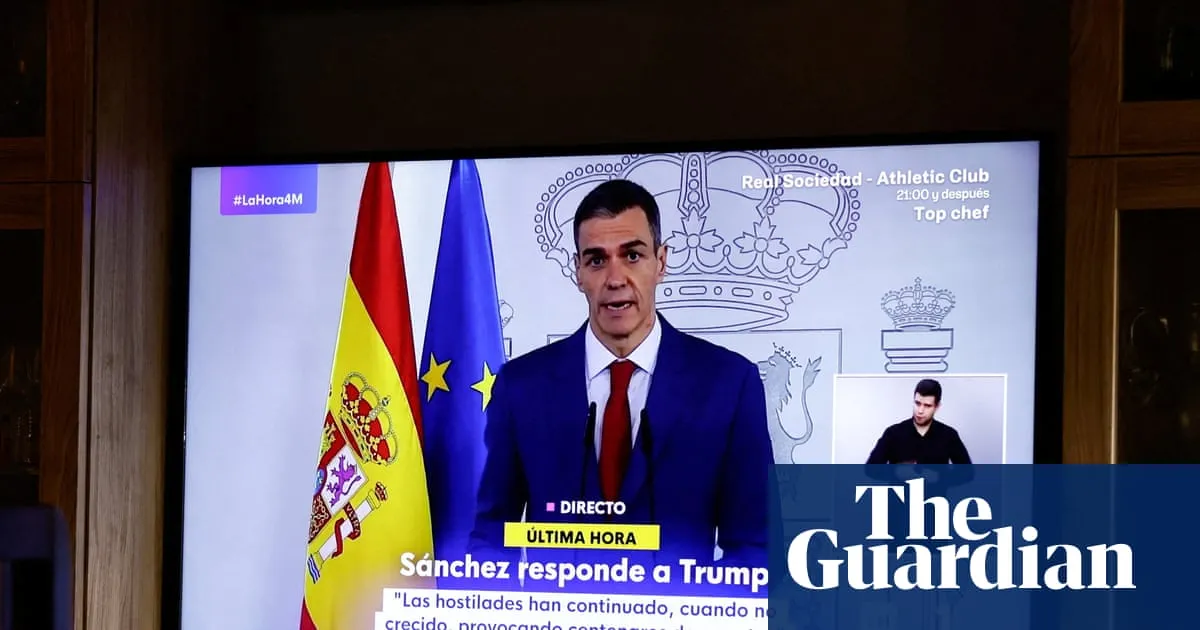
The Spanish prime minister, Pedro Sánchez, has responded to Donald Trump’s extraordinary threat to cut off all trade with Spain over his government’s refusal to facilitate the US’s ongoing attacks against Iran, comparing the growing conflict in the Middle East to playing “Russian roulette with the destiny of millions”.Sánchez, who has been one of the most vociferous European critics of Israel’s conduct in Gaza, said his government’s position on the widening instability could be summed up in three words: “No to war.”In a section of the speech that appeared to directly address Trump’s threats to end all trade with Spain, the prime minister said his country would “not be complicit in something that is bad for the world – and that is also contrary to our values and interests – simply out of fear of reprisals from someone”.On Tuesday, Trump had rounded on Madrid for refusing the US permission to use jointly operated bases in southern Spain to continue its attacks in Iran. “Spain has been terrible,” Trump said during a meeting with the German chancellor, Friedrich Merz, adding that he had told the Treasury secretary, Scott Bessent, to “cut off all dealings” with the European country.In his address on Wednesday, Sánchez called on the US, Israel and Iran to stop their war before it was too late, saying: “You can’t respond to one illegality with another because that’s how humanity’s great disasters begin.”He added: “You can’t play Russian roulette with the destiny of millions … Nobody knows for sure what will happen now. Even the objectives of those who launched the first attack are unclear. But we must be prepared, as the proponents say, for the possibility that this will be a long war, with numerous casualties and, therefore, with serious economic consequences on a global scale.”He pointedly invoked the 2003 invasion of Iraq, which was supported by his conservative predecessor José María Aznar, as a warning of the looming dangers. Sánchez said that while that war ostensibly had been intended “to eliminate Saddam Hussein’s weapons of mass destruction, to bring democracy, and to guarantee global security”, it had instead “unleashed the greatest wave of insecurity our continent has suffered since the fall of the Berlin Wall”.Sánchez said a government’s prime responsibility was to protect and improve the lives of its citizens – and not to use geopolitics to cynical ends or to profit from war. “It is absolutely unacceptable that those leaders who are incapable of fulfilling this duty use the smokescreen of war to hide their failure and, in the process, line the pockets of a select few – the same ones as always; the only ones who profit when the world stops building hospitals and starts building missiles,” he said.During his meeting with Merz, Trump criticised Spain once again for refusing to accept Nato’s proposal for member states to increase their defence spending to 5% of their GDP. “Everybody was enthusiastic about it – Germany, everybody – and Spain didn’t do it,” Trump said. “And now Spain said we can’t use their bases – and that’s OK. We could use their bases; if we wanted, we could just fly in and use it [sic]. Nobody’s going to tell us not to use it. But we don’t have to. But they were unfriendly.”Merz said later he had told Trump privately that Spain could not be excluded from a trade agreement reached between Brussels and Washington last year. “I said that Spain is a member of the European Union and we negotiate about tariffs with the United States only together or not at all,” he said. “There is no way to treat Spain particularly badly.”Spain’s position has also been defended by the European Commission, which said: “The commission will ensure that the interests of the European Union are fully protected. We stand in full solidarity with all member states and all its citizens and, through our common trade policy, stand ready to act if necessary to safeguard EU interests.”Teresa Ribera, a former Spanish deputy prime minister who serves as the EU’s green transition chief, said the EU’s external trade was negotiated as a bloc and the commission was the relevant authority on the issue. “At this moment, it isn’t possible to establish trade reprisals or separate trade relations … I think the most surprising thing about this fact is that the American federal government is aware of this,” she told Spain’s Cadena Ser radio on Wednesday.
SRCThe Guardian - World News
LANGEN
LEANCenter-Left
WORDS738
ENT12
WED · 2026-03-04 · 10:14 GMTBRIEF NSR-2026-0304-21301
NSR-2026-0304-21301News Report·EN·Diplomatic
‘No to war’: Sánchez doubles down after Trump threat to cut off trade with Spain
Spanish Prime Minister Pedro Sánchez has publicly rejected potential trade repercussions threatened by Donald Trump following Spain's refusal to support US actions against Iran. Trump criticized Spain for denying the US use of jointly operated bases for attacks in Iran, suggesting a complete cessation of trade between the two countries.
Sam Jones in MadridThe Guardian - World NewsFiled 2026-03-04 · 10:14 GMTLean · Center-LeftRead · 3 min
The Guardian - World NewsFIG 01
Reading time
3min
Word count
738words
Sources cited
3cited
Entities identified
12entities
Quality score
100%
§ 01
Briefing Summary
AI-generatedNEWSAR · AI
Spanish Prime Minister Pedro Sánchez has publicly rejected potential trade repercussions threatened by Donald Trump following Spain's refusal to support US actions against Iran. Trump criticized Spain for denying the US use of jointly operated bases for attacks in Iran, suggesting a complete cessation of trade between the two countries. Sánchez responded by stating Spain would not compromise its values or global well-being out of fear. He urged the US, Israel, and Iran to de-escalate the conflict, warning against repeating the mistakes of the 2003 Iraq invasion. Sánchez emphasized his government's priority is the safety and prosperity of its citizens, not profiting from geopolitical conflicts.
Confidence 0.90Sources 3Claims 5Entities 12
§ 02
Article analysis
Model · rule-basedFraming
Diplomatic
National Security
Tone
Measured
AI-assessed
CalmNeutralAlarmist
Factuality
0.70 / 1.00
Factual
LowHigh
Sources cited
3
Well sourced
FewMany
§ 03
Key claims
5 extracted01
Trump told Treasury Secretary Scott Bessent to “cut off all dealings” with Spain.
quoteDonald Trump
Confidence
1.00
02
Sánchez compared the conflict in the Middle East to playing “Russian roulette with the destiny of millions”.
quotePedro Sánchez
Confidence
1.00
03
Spain refused the US permission to use jointly operated bases in southern Spain to continue its attacks in Iran.
factualArticle
Confidence
0.90
04
Trump criticized Spain for refusing to accept NATO’s proposal to increase defense spending to 5% of GDP.
factualArticle
Confidence
0.90
05
Donald Trump threatened to cut off all trade with Spain over its refusal to facilitate US attacks against Iran.
factualArticle
Confidence
0.90
§ 04
Full report
3 min read · 738 words§ 05
Entities
12 identifiedKey playerOppositionContextPositiveNeutralNegative
People5
§ 06
Keywords & salience
9 termsno to war
1.00
middle east conflict
0.90
attacks against iran
0.80
trade war
0.80
us-spain relations
0.70
economic consequences
0.60
international relations
0.60
geopolitics
0.50
political criticism
0.50
§ 07
Topic connections
Interactive graph Network visualization showing 51 related topics
View Full Graph Person Organization Location Event|Click node to navigate|Edge numbers = shared articles