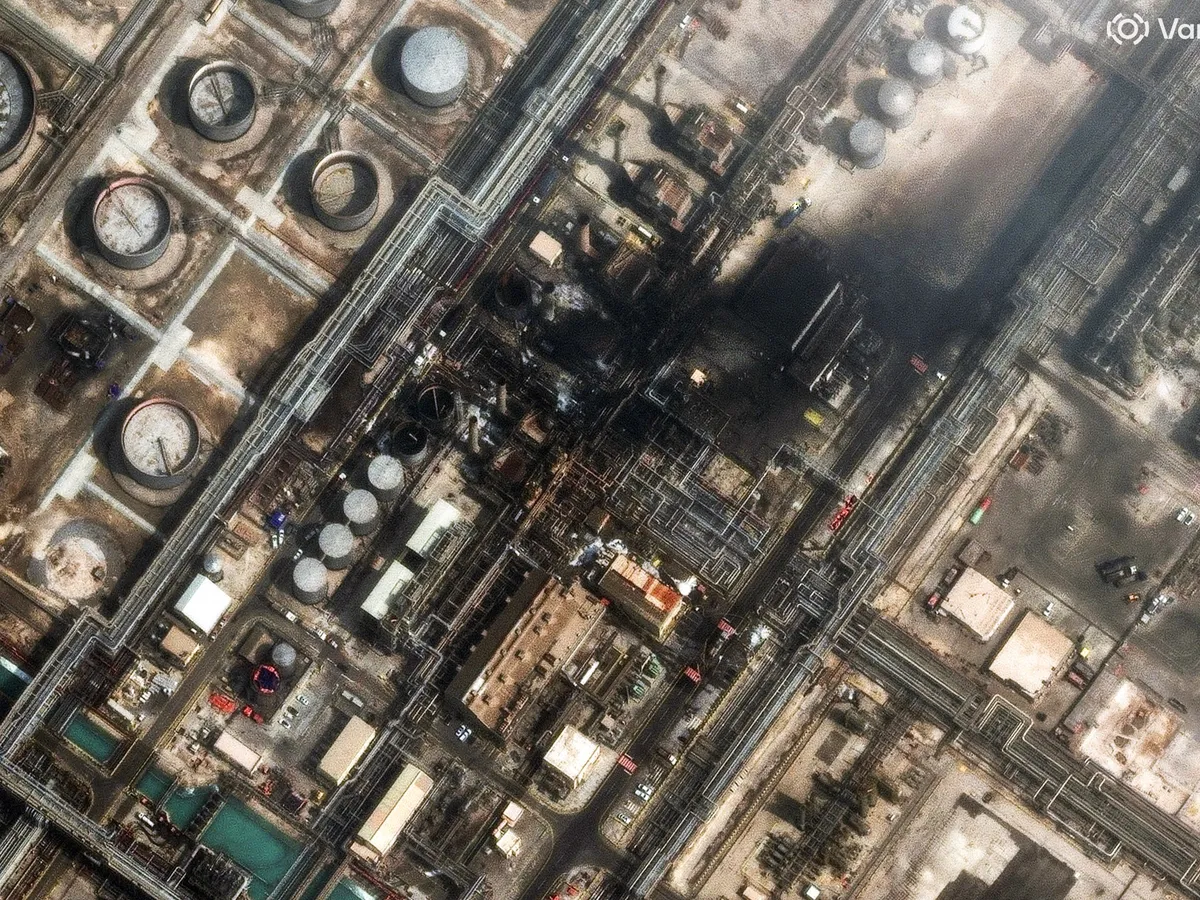
The Gulf States didn’t want this war, and they’re the ones Iran needs to mediate an end to the conflict. Instead, Iran is serving Israel’s interests by attacking its Arab neighbours.This satellite image provided by Vantor shows damage after a drone attack at Ras Tanura oil refinery, in Saudi Arabia, Monday, March 2, 2026 [Satellite image ©2026 Vantor/AP Photo]Senior Researcher at the Center for Conflict and Humanitarian Studies.Published On 7 Mar 2026When the United States and Israel launched their coordinated assault on Iran in the early hours of February 28, 2026, an operation Washington has named “Operation Epic Fury”, the Gulf States did not cheer. They watched with dread.For years, they had invested enormous diplomatic capital in preventing precisely this moment. They had engaged Tehran, maintained embassies, and offered repeated assurances that their territories would not serve as launchpads against the Islamic Republic.That Iran’s response has been to turn its missiles on these same neighbours is not only a strategic miscalculation of historic proportions, but is also a profound moral and legal failure that risks poisoning relations for generations to come.A record of genuine restraintThe Gulf Cooperation Council (GCC) states did not arrive at this crisis as Iran’s enemies. They arrived as reluctant bystanders, having spent years threading a needle between Washington and Tehran with deliberate, often thankless, care.Saudi Arabia chose dialogue in 2019 and pursued a full diplomatic rapprochement with Tehran. That process culminated in the landmark 2023 Chinese-brokered normalisation agreement and the reopening of embassies. Riyadh’s bet was that engagement, not confrontation, was the path to stability. Even as the current crisis mounted, Saudi Arabia explicitly confirmed to Iranian authorities that it would not permit its airspace or territory to be used to target Iran. The kingdom’s word was given. It was not honoured in return.Qatar had invested years in mediation, serving as the indispensable interlocutor between Hamas and Israel, and between Iran and the United States. Doha hosted indirect nuclear talks and pleaded for diplomatic solutions when few others would.Oman, for its part, served as the quiet conduit for the very negotiations that, as recently as the eve of the war, held out the slim hope of a deal. Oman’s Foreign Minister Badr Albusaidi voiced optimism that peace was “within reach” on the day before the bombs fell.Across the GCC, governments gave repeated and public assurances to Iran and to the world that their territories would not be used to launch attacks against the Islamic Republic. These assurances were credible. They were substantive commitments backed by years of diplomatic engagement.Iran itself tacitly acknowledged their sincerity: On March 5, Tehran issued a notable public expression of appreciation to Saudi Arabia for upholding its commitment not to allow its territory to be used against Iran. That acknowledgement makes Iran’s actions all the more contradictory and indefensible.For these are not the actions of hostile neighbours. These are the actions of states that understood the neighbourhood they lived in and chose, repeatedly, the hard road of diplomacy.The response that shocked the regionIran’s response has repaid years of Gulf good faith with a barrage more ferocious than anything directed at the countries that launched the war. Official statistics show that in the early days of the war, Iran fired more than twice as many ballistic missiles and approximately 20 times more drones at Gulf States than at Israel. Three people were killed and 78 were injured in the UAE alone; Saudi Arabia’s largest refinery was set ablaze; major airports across the Gulf were targeted; and Qatar’s Ras Laffan, a pillar of global liquefied natural gas (LNG) supply, was struck.The closure of the Strait of Hormuz, through which a fifth of the world’s oil and a significant share of global LNG passes daily, sent immediate shockwaves through international markets. Iranian threats of attacks brought commercial shipping through the passage to a near-standstill, severing the artery that connects Gulf energy producers to the economies of Asia, Europe and beyond. With Saudi, Emirati and Qatari exports frozen in place and insurance markets in freefall, the spectre of a prolonged closure raised alarms not seen since the tanker wars of the 1980s, pushing the world measurably closer to an economic shock that no recovery playbook is designed to absorb.Illegal, counterproductive and unacceptableIran’s attacks on Gulf sovereign territory are not merely strategically misguided; they are illegal under international law. The Gulf States are not parties to the conflict between Iran, Israel and the United States. They did not authorise military operations against Iran from their soil. Targeting civilian infrastructure, airports, hotels, refineries and ports in states that are not combatants violates fundamental principles of international humanitarian law, including the prohibition on attacks against civilian objects and the requirement of distinction between military and civilian targets.Tehran has sought to justify the attacks by arguing that the presence of US military bases on Gulf soil makes those states legitimate targets. This logic does not hold. The GCC states gave ironclad assurances to Iran, continuously and emphatically, both before the war and up to its very eve, that their territories would not be used to attack Iran. The GCC’s own extraordinary ministerial statement of March 1, 2026, made this explicit, noting that the attacks came “despite numerous diplomatic efforts by GCC countries to avoid escalation and their confirmation that their territories will not be used to launch any attack on the Islamic Republic of Iran”.The joint GCC-European Union ministerial meeting of March 5 repeated this point. Iran’s own Deputy Foreign Minister Hamid Ghanbari told Al Jazeera that Iran “regrets any humanitarian loss caused by the current military escalation”, an implicit recognition that the attacks have caused harm that cannot be sanitised by strategic framing.Qatar, whose outreach to Iran was among the most sustained and sincere of any Gulf state, issued what officials described as the strongest condemnation in the country’s history, calling the strikes “reckless and irresponsible.” The GCC Ministerial Council, convening in an emergency extraordinary session on March 1, issued a sweeping collective condemnation describing the attacks as “heinous” and a “serious violation of these countries’ sovereignty, good neighbourly principles, and a clear breach of international law and the UN Charter”.The Council affirmed that member states “will take all necessary measures to defend their security and stability”, including the option of self-defence, language of a gravity rarely heard from the Gulf’s diplomatic establishment. The unanimity and sharpness of that collective voice reflect the depth of the betrayal felt across the region.The strategic logic Iran is operating on – that attacking Gulf States will pressure Washington to end the war – is not only flawed in practice, it actively serves Israeli interests. By spreading the conflict to the Gulf, Tehran is doing precisely what Israel could not do alone: steering the war away from the Israeli-Iranian axis and transforming it into a confrontation between Iran and its Arab neighbours.Every missile fired at Dubai or Doha or Riyadh shifts the narrative, pulls the Gulf States deeper into a conflict they sought to avoid, and weakens the very actors most capable of mediating a way out. This is a strategic miscalculation of the first order. The interest of the wider region lies in preventing Israel from emerging as the unchallenged hegemon of the Middle East, a scenario that becomes more likely, not less, the more Iran pushes its Arab neighbours out of their potential role as honest brokers and into the arms of a deeper security alignment with Washington. Iran, in targeting the Gulf, is not resisting the new regional order; it is inadvertently constructing it.
SRCAl Jazeera
LANGEN
LEANCenter
WORDS1 254
ENT12
SAT · 2026-03-07 · 01:05 GMTBRIEF NSR-2026-0307-22217
NSR-2026-0307-22217Analysis·EN·Diplomatic
Iran’s strikes on the Gulf: Burning the bridges of good neighbourliness
Following a coordinated US-Israeli assault on Iran ("Operation Epic Fury") on February 28, 2026, Iran has launched missile attacks on Gulf states. These states, including Saudi Arabia, Qatar, and Oman, had invested in diplomacy and de-escalation with Iran, even offering assurances their territories wouldn't be used for attacks.
Sultan Al-KhulaifiAl JazeeraFiled 2026-03-07 · 01:05 GMTLean · CenterRead · 6 min
Al JazeeraFIG 01
Reading time
6min
Word count
1 254words
Sources cited
2cited
Entities identified
12entities
Quality score
100%
§ 01
Briefing Summary
AI-generatedNEWSAR · AI
Following a coordinated US-Israeli assault on Iran ("Operation Epic Fury") on February 28, 2026, Iran has launched missile attacks on Gulf states. These states, including Saudi Arabia, Qatar, and Oman, had invested in diplomacy and de-escalation with Iran, even offering assurances their territories wouldn't be used for attacks. Saudi Arabia had normalized relations with Iran in 2023 and confirmed it wouldn't allow its territory to be used against Iran. Qatar had mediated between Iran, the US, and Hamas/Israel, while Oman facilitated negotiations. The author argues that Iran's attacks are a strategic miscalculation and a moral failure that could damage relations for years, especially given the Gulf states' efforts to avoid conflict.
Confidence 0.90Sources 2Claims 5Entities 12
§ 02
Article analysis
Model · rule-basedFraming
Diplomatic
Conflict
Tone
Mixed Tone
AI-assessed
CalmNeutralAlarmist
Factuality
0.60 / 1.00
Mixed
LowHigh
Sources cited
2
Limited
FewMany
§ 03
Key claims
5 extracted01
On March 5, Tehran issued a public expression of appreciation to Saudi Arabia for upholding its commitment not to allow its territory to be used against Iran.
factualarticle
Confidence
1.00
02
Oman’s Foreign Minister Badr Albusaidi voiced optimism that peace was “within reach” on the day before the bombs fell.
quotearticle
Confidence
1.00
03
Saudi Arabia explicitly confirmed to Iranian authorities that it would not permit its airspace or territory to be used to target Iran.
factualarticle
Confidence
1.00
04
The United States and Israel launched a coordinated assault on Iran on February 28, 2026, called “Operation Epic Fury”.
factualarticle
Confidence
1.00
05
Saudi Arabia chose dialogue in 2019 and pursued a full diplomatic rapprochement with Tehran.
factualarticle
Confidence
0.90
§ 04
Full report
6 min read · 1 254 words§ 05
Entities
12 identifiedKey playerOppositionContextPositiveNeutralNegative
Locations8
§ 06
Keywords & salience
10 termsiran
1.00
gulf states
0.90
diplomatic relations
0.80
conflict
0.70
mediation
0.70
saudi arabia
0.60
israel
0.50
united states
0.50
operation epic fury
0.40
gcc
0.40
§ 07
Topic connections
Interactive graph Network visualization showing 51 related topics
View Full Graph Person Organization Location Event|Click node to navigate|Edge numbers = shared articles