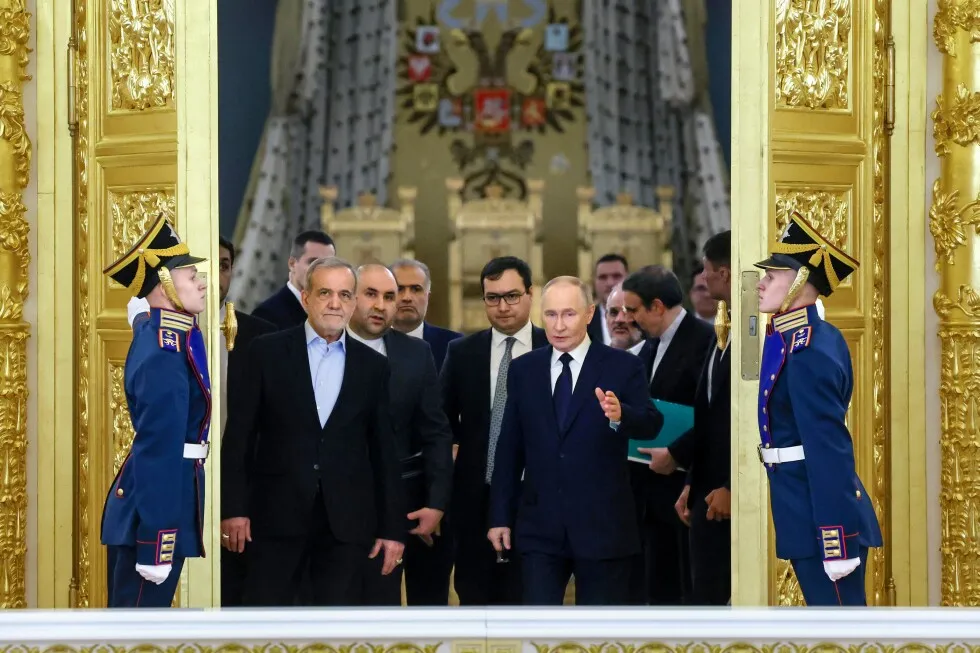
Russia sits back as the Iran war escalates, expecting long-term gains 1 of 5 | Iranian President Masoud Pezeshkian, center left, and Russian President Vladimir Putin, center right, arrive at a ceremony following their talks at the Kremlin in Moscow, Russia, on Jan. 17, 2025. (Vyacheslav Prokofyev, Sputnik, Kremlin Pool Photo via AP, File) 2 of 5 | Smoke rises behind the Azadi (Freedom) monument in Tehran, Iran, on March 3, 2026, following the U.S.-Israeli military attack. (Davoud Ghahrdar/ISNA via AP, File) 3 of 5 | Government supporters gather in mourning after state TV announced the death of Iranian Supreme Leader Ayatollah Ali Khamenei, in Tehran, Iran, on March 1, 2026. (AP Photo/Vahid Salemi, File) 4 of 5 | A black plume of smoke rises from a warehouse in the industrial area of Sharjah City following reports of Iranian strikes in Dubai, United Arab Emirates, on March 1, 2026. (AP Photo/Altaf Qadri, File) 5 of 5 | In this picture released by the official website of Iranian Supreme Leader Ayatollah Ali Khamenei, he and Russian President Vladimir Putin greet each other on July 19, 2022, during a meeting in Tehran, Iran. (Office of the Iranian Supreme Leader via AP, File) 1 of 5 Iranian President Masoud Pezeshkian, center left, and Russian President Vladimir Putin, center right, arrive at a ceremony following their talks at the Kremlin in Moscow, Russia, on Jan. 17, 2025. (Vyacheslav Prokofyev, Sputnik, Kremlin Pool Photo via AP, File) Add AP News on Google Add AP News as your preferred source to see more of our stories on Google. 2 of 5 Smoke rises behind the Azadi (Freedom) monument in Tehran, Iran, on March 3, 2026, following the U.S.-Israeli military attack. (Davoud Ghahrdar/ISNA via AP, File) Add AP News on Google Add AP News as your preferred source to see more of our stories on Google. 3 of 5 Government supporters gather in mourning after state TV announced the death of Iranian Supreme Leader Ayatollah Ali Khamenei, in Tehran, Iran, on March 1, 2026. (AP Photo/Vahid Salemi, File) Add AP News on Google Add AP News as your preferred source to see more of our stories on Google. 4 of 5 A black plume of smoke rises from a warehouse in the industrial area of Sharjah City following reports of Iranian strikes in Dubai, United Arab Emirates, on March 1, 2026. (AP Photo/Altaf Qadri, File) Add AP News on Google Add AP News as your preferred source to see more of our stories on Google. 5 of 5 In this picture released by the official website of Iranian Supreme Leader Ayatollah Ali Khamenei, he and Russian President Vladimir Putin greet each other on July 19, 2022, during a meeting in Tehran, Iran. (Office of the Iranian Supreme Leader via AP, File) Add AP News on Google Add AP News as your preferred source to see more of our stories on Google. Updated [hour]:[minute] [AMPM] [timezone], [monthFull] [day], [year] Moscow (AP) — As U.S. and Israeli missiles and bombs rain on Iran, Russia has responded with words of indignation but no visible action to support its Middle Eastern ally.That cautious stance is driven by President Vladimir Putin’s focus on Ukraine and his apparent hope that the Iran war will play into Moscow’s hands by boosting its oil revenues and eroding Western support for Kyiv.Putin sent his condolences to Iran’s President Masoud Pezeshkian, condemning the killing of Iranian Supreme Leader Ayatollah Ali Khamenei last weekend as a “cynical violation of all norms of human morality and international law.”While Moscow’s failure to help another ally after the 2024 ouster of former Syrian ruler Bashar Assad and January’s U.S. arrest of Venezuelan leader Nicolas Maduro highlighted the limits to its influence, the Kremlin expects to reap benefits from the Iran war. Russia already is profiting from a surge in energy prices over the war’s disruptions to tanker traffic through the Strait of Hormuz and damage to energy facilities in Gulf countries. If hostilities escalate, a continued windfall would help fill Moscow’s coffers to finance military operations in Ukraine and patch the budget deficit.The Kremlin also hopes the Iran war will distract global attention from Ukraine, deplete Western arsenals and force the U.S. and its NATO allies to reduce military support for Kyiv. A swift Russian rebukeHours after the war began Feb. 28, the Russian Foreign Ministry denounced the U.S. and Israeli attack on Iran as a “deliberate, premeditated, and unprovoked act of armed aggression against a sovereign and independent U.N. member state, in direct violation of the fundamental principles and norms of international law.”A week into the war, Putin had a call with Pezeshkian, saying Moscow wants to see a quick end to hostilities. But before that, he had a series of calls with Gulf leaders in an apparent bid to cement ties with the countries that are increasingly important for Moscow as part of the OPEC+ grouping controlling global oil prices and key trade partners helping bypass Western sanctions. The Kremlin said Putin will convey to Tehran the Gulf leaders’ “deep concern about the strikes on their infrastructure” and “make every effort to facilitate at least minor easing of tensions.” In a subsequent call with his Iranian counterpart, Russia’s Foreign Minister Sergey Lavrov “underscored the priority of ensuring the safety of civilians and protecting civilian infrastructure in all the countries of the region.”Mark Galeotti, an expert on Russian politics who heads the Mayak Intelligence consultancy, noted that “Russia has actually been quite an effective operator within the Middle East.” He said that as the war escalates, many regional powers may have reason “to look a little bit more to Moscow.” Uneasy partnersWhile Moscow and Tehran signed a “comprehensive strategic partnership” treaty in January 2025, their relationship had a troubled past and remained tinged with rivalry.Even though Russia and Iran shared opposition to the Western-led “rules-based order,“ “Iran was always something of a strategic frenemy” to Russia, Galeotti said in a recent podcast.Tensions ran high between Moscow and Tehran during the Cold War, when Shah Mohammad Reza Pahlavi was a staunch U.S. ally. When Ayatollah Ruhollah Khomeini led the 1979 Islamic Revolution, branding the U.S. as the “Great Satan,” he labeled the Soviet Union as the “Lesser Satan.”Russia-Iran ties warmed quickly after the USSR’s 1991 breakup as Moscow became an important trade partner and helped build Iran’s first nuclear power plant in Bushehr. When Syria’s civil war erupted in 2011, Russia and Iran pooled efforts to shore up Assad’s government but failed to prevent the swift collapse of his rule in December 2024.After Putin sent troops into Ukraine in February 2022, Tehran provided Russia with Shahed drones and later licensed their production in Russia.But even as it has built ties with Iran, Russia also has remained friendly with Israel, angering many in the Iranian leadership who were suspicious of Moscow’s intentions. “Russia’s relationship with Iran, despite the latter’s staunch opposition to the U.S., has always been complex and challenging,” Moscow-based military analyst Sergei Poletaev said in a commentary.When the U.S. and Israel struck Iran in June 2025, Russian officials underlined that their “strategic partnership” didn’t envisage mutual military assistance in case of aggression.Asked Thursday whether Moscow could go beyond rhetoric and provide Iran with weapons, Kremlin spokesman Dmitry Peskov responded that it has received no such requests from Tehran.On Friday, two officials familiar with U.S. intelligence told The Associated Press that Russia has provided Iran with information that could help Tehran strike American warships, aircraft and other assets in the region. The people, who were not authorized to comment publicly on the sensitive matter and spoke on the condition of anonymity, cautioned that the U.S. intelligence has not uncovered that Russia is directing Iran on what to do with the information.Peskov said Friday that Russia is “in dialogue with the Iranian side, with representatives of the Iranian leadership, and will certainly continue this dialogue.” Pressed on whether Russia has provided any military or intelligence assistance to Tehran since the war’s start, he refrained from comment.Little damage seen to Putin’s authorityWhile Khamenei’s killing revived talk of Russia’s failure to protect an ally, some observers warned against exaggerating the damage to Putin’s authority.Galeotti noted that Russia and Iran “were always very pragmatic allies rather than anything else.”“Iran is a rival for authority in the Middle East and indeed within the South Caucasus,” he said. “If this regime doesn’t actually fall, but has its wings clipped, from Russia’s point of view that actually might make it a rather more amenable temporary strategic partner.”China — a key customer for Iranian oil — will likely boost imports of Russian crude as hostilities expand. After pressuring India to halt its imports of Russian oil, the U.S. on Thursday issued a 30-day waiver allowing its refineries to buy those supplies currently at sea. Turkey could boost its natural gas imports from Russia if supplies from Iran are disrupted.Sam Greene, a professor at King’s College London, also observed that “the idea that Putin suffers when he loses allies — whether Assad, Maduro or Khamenei — exists entirely in the heads of Western analysts and has no basis in observable fact.”There’s zero evidence “that he cares, that it affects his authority at home or his legitimacy abroad,” he said in a post on X.The Putin-Trump relationshipPutin will not risk his relationship with U.S. President Donald Trump to help Iran, Greene said, arguing that “as miffed as Putin might be personally, he’s not going to throw his relationship with Trump under the bus.”The president, he said, “is Putin’s greatest source of leverage over Europe. He’ll keep his eye on the ball.”As the U.S. and its allies quickly use up their arsenals of Patriot interceptors to fend off Iranian missiles targeting Israel and the Gulf countries, Russia can only be gleeful over the scenario.“A prolonged conflict would not only draw attention away from Ukraine but would also redirect crucial resources like missile defense systems to the Persian Gulf,” Poletaev said.Noted Galeotti: “The more Patriots that get used up in this conflict ... the fewer available to the Americans generally and more uncomfortable they will feel about passing or selling any of them to the Ukrainians.”—-Aamer Madhani in Washington contributed.
SRCAssociated Press (AP)
LANGEN
LEANCenter
WORDS1 697
ENT11
SUN · 2026-03-08 · 11:53 GMTBRIEF NSR-2026-0308-22534
NSR-2026-0308-22534News Report·EN·Political Strategy
Russia sits back as the Iran war escalates, expecting long-term gains
The article suggests that Russia is observing the escalating conflict involving Iran, anticipating potential long-term benefits. Events depicted in the article include a meeting between the Iranian President and Vladimir Putin in Moscow in January 2025.
By
VLADIMIR ISACHENKOVAssociated Press (AP)Filed 2026-03-08 · 11:53 GMTLean · CenterRead · 7 min
Associated Press (AP)FIG 01
Reading time
7min
Word count
1 697words
Sources cited
0cited
Entities identified
11entities
Quality score
100%
§ 01
Briefing Summary
AI-generatedNEWSAR · AI
The article suggests that Russia is observing the escalating conflict involving Iran, anticipating potential long-term benefits. Events depicted in the article include a meeting between the Iranian President and Vladimir Putin in Moscow in January 2025. The article also references a U.S.-Israeli military attack in Tehran in March 2026, as well as reports of Iranian strikes in Dubai around the same time. The death of Iranian Supreme Leader Ayatollah Ali Khamenei is also mentioned as occurring in early March 2026. Russia's strategy appears to be one of non-intervention, possibly calculating that the conflict will ultimately strengthen its geopolitical position.
Confidence 0.90Claims 5Entities 11
§ 02
Article analysis
Model · rule-basedFraming
Political Strategy
Conflict
Tone
Mixed Tone
AI-assessed
CalmNeutralAlarmist
Factuality
0.60 / 1.00
Mixed
LowHigh
Sources cited
0
No named sources
FewMany
§ 03
Key claims
5 extracted01
Russia has responded with words of indignation but no visible action
factual
Confidence
0.90
02
U.S. and Israeli missiles and bombs rain on Iran
factual
Confidence
0.90
03
Russia sits back as the Iran war escalates, expecting long-term gains
prediction
Confidence
0.80
04
Government supporters gather in mourning after state TV announced the death of Iranian Supreme Leader Ayatollah Ali Khamenei, in Tehran, Iran, on March 1, 2026
factual
Confidence
0.70
05
Iranian strikes in Dubai, United Arab Emirates, on March 1, 2026
factual
Confidence
0.70
§ 04
Full report
7 min read · 1 697 words§ 05
Entities
11 identifiedKey playerOppositionContextPositiveNeutralNegative
People3
§ 06
Keywords & salience
7 termsiran war
0.90
russia
0.80
long-term gains
0.70
escalation
0.60
military attack
0.50
middle east
0.50
iranian strikes
0.40
§ 07
Topic connections
Interactive graph Network visualization showing 51 related topics
View Full Graph Person Organization Location Event|Click node to navigate|Edge numbers = shared articles