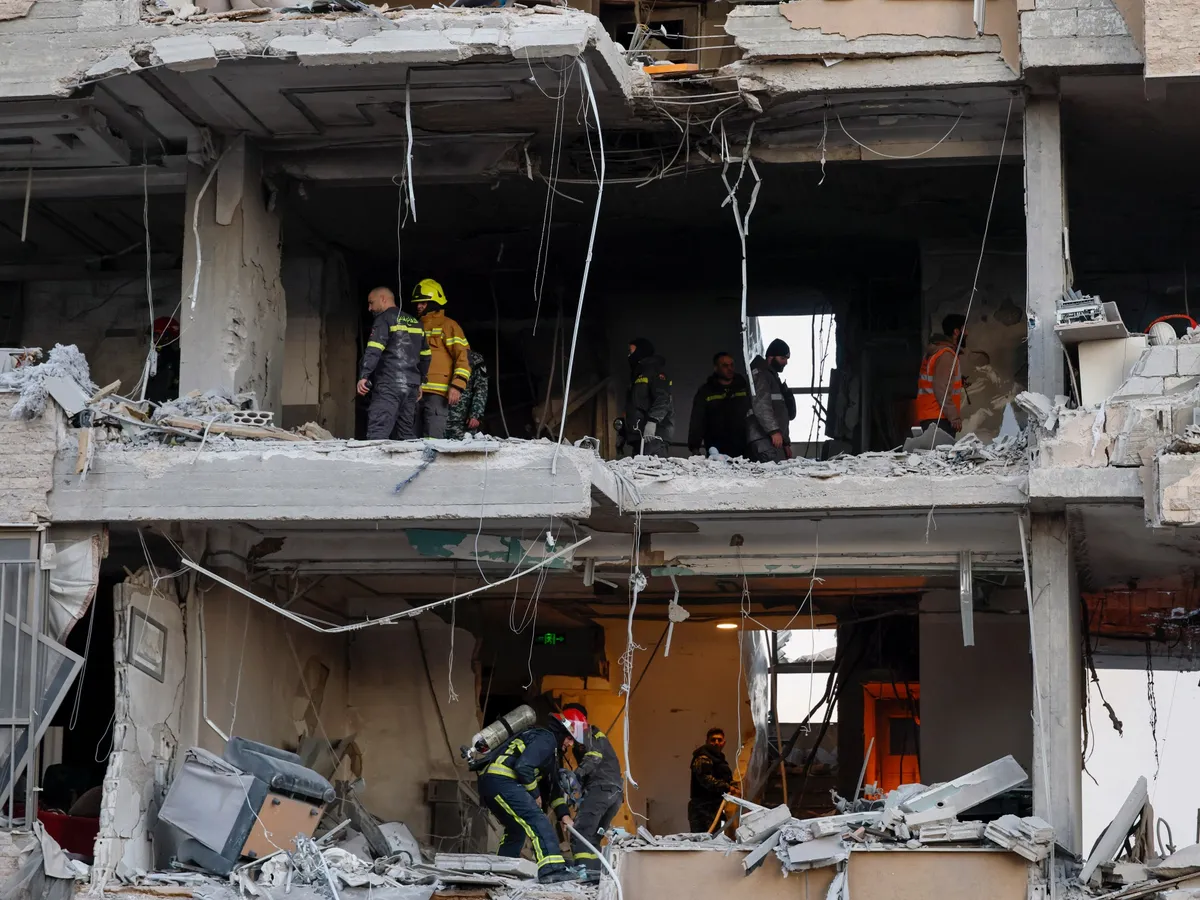
The strike in central Beirut hit a multistorey building in Aisha Bakkar and appears to be another attempted assassination, with no prior warning from Israel.Emergency services inspect the damage after an Israeli attack on an apartment in the Aisha Bakkar neighborhood of Beirut, Lebanon March 11, 2026 [Wael Hamzeh/EPA]Published On 11 Mar 2026Israel has continued its relentless bombardment of Lebanon, hitting a residential building in central Beirut, as well as targeting a town in the eastern Bekaa Valley, as this punishing front in the wider regional war, sparked by the United States and Israel attacking Iran, has displaced nearly 700,000 people.The strikes early on Wednesday killed at least one person in Zlaya, in Bekaa, with information on the number of casualties from the central Beirut strike still unconfirmed.Recommended Stories list of 4 itemslist 1 of 4Lebanon stadium turned into shelter for forcibly displacedlist 2 of 4Israel launches new wave of attacks across Lebanonlist 3 of 4What is the Hezbollah-linked financial institution Al-Qard Al-Hassan?list 4 of 4Israeli air strike targets building in south Lebanonend of listIsrael and the Lebanese group Hezbollah have traded heavy fire during the ongoing conflict, but the suffering has been hugely disproportionate. At least 570 people have been killed in Lebanon since Israel renewed widespread attacks on the country last Monday. Israel has so far had two soldiers killed in Lebanon, with several people injured in Israel from Hezbollah rockets.Wednesday’s strike in Beirut hit a multistorey building in the Aisha Bakkar area and appears to be another attempted assassination, reported Al Jazeera’s Zeina Khodr from Beirut.“We understand many people who live in this building are now in hospital. We are getting reports there have been deaths and injuries in this strike,” she said.Khodr explained that the building is not a Hezbollah stronghold or in an area where the group has influence, but is located in a densely populated residential area.“People here are in a state of shock,” she said, “the feeling is that there’s nowhere safe, there’s no front line.”According to Heidi Pett, also reporting for Al Jazeera from the site, the strike destroyed “one or two floors” of the building instead of levelling it entirely, adding that there is no information yet on who the target was.“The building is still on fire. There are at least two apartments on fire, one on top of the other, and the damage is really extensive.”Israel carried out this strike with absolutely no warning, she said.“This is a part of Beirut where people thought that they were going to be safe. Displaced families who fled Dahiyeh [in the southern suburbs after Israeli threats] have been sheltering here, some sleeping in the streets,” said Pett.No letup in bombings in LebanonAccording to Lebanon’s National News Agency, there were several deadly attacks in the country overnight on Wednesday, including in the southern suburbs of Beirut.Additionally, two Israeli air strikes hit the village of Hanaway, in the Tyre (Sour in Arabic) district, killing three civilians, including a paramedic, according to the Ministry of Public Health.An Israeli attack killed one person and wounded eight others in the al-Housh area of Tyre, the ministry said.Two people were also killed in an Israeli attack on the town of Zawtar al-Sharqiyah, the NNA reported.Several people were wounded in an Israeli drone attack on a cafe in al-Housh and on a house in the town of al-Shahabiya, Tyre.The ministry said four others were wounded in an attack on the town of Tibnin, in the Bint Jbeil district.On Wednesday, France said it will provide 60 metric tons of humanitarian aid for Lebanon.“We have decided is to triple the volume of aid that will arrive this week. This aid will reach … 60 tons of humanitarian aid for the Lebanese, including sanitation kits, hygiene kits, mattresses, lamps, and also a mobile medical post,” French Foreign Minister Jean-Noel Barrot said in an interview with French radio TF1.United Nations spokesperson Stephane Dujarric has called for “immediate de-escalation” in Lebanon, noting that Israeli forced displacement orders have affected hundreds of thousands of people.“Our humanitarian colleagues report that nearly the entire population of people living in areas south of the Litani River, parts of Baalbek governorate and the Bekaa Valley, and large sections of Beirut’s southern suburbs are now caught up in hostilities,” Dujarric told reporters at a media briefing in New York late on Tuesday.According to the Lebanese government, some 760,000 people have been registered as displaced since the outbreak of the war.
SRCAl Jazeera
LANGEN
LEANCenter
WORDS739
ENT12
WED · 2026-03-11 · 07:22 GMTBRIEF NSR-2026-0311-23432
NSR-2026-0311-23432News Report·EN·Conflict
Israel pounds Lebanon, targets residential building in central Beirut
On March 11, 2026, Israel continued its bombardment of Lebanon, striking a residential building in the Aisha Bakkar area of central Beirut and a town in the Bekaa Valley. The Beirut strike, which appears to be an attempted assassination, caused deaths and injuries, with the number of casualties still unconfirmed.
Al Jazeera StaffAl JazeeraFiled 2026-03-11 · 07:22 GMTLean · CenterRead · 3 min
Al JazeeraFIG 01
Reading time
3min
Word count
739words
Sources cited
4cited
Entities identified
12entities
Quality score
100%
§ 01
Briefing Summary
AI-generatedNEWSAR · AI
On March 11, 2026, Israel continued its bombardment of Lebanon, striking a residential building in the Aisha Bakkar area of central Beirut and a town in the Bekaa Valley. The Beirut strike, which appears to be an attempted assassination, caused deaths and injuries, with the number of casualties still unconfirmed. The strike in Bekaa killed at least one person. These attacks are part of a wider regional conflict sparked by attacks on Iran, which has displaced nearly 700,000 people in Lebanon. Since renewed widespread attacks began last Monday, at least 570 people have been killed in Lebanon, while Israel has suffered two soldier deaths. The targeted building in Beirut is located in a densely populated residential area, not a Hezbollah stronghold.
Confidence 0.90Sources 4Claims 5Entities 12
§ 02
Article analysis
Model · rule-basedFraming
Conflict
Human Rights
Tone
Mixed Tone
AI-assessed
CalmNeutralAlarmist
Factuality
0.70 / 1.00
Factual
LowHigh
Sources cited
4
Well sourced
FewMany
§ 03
Key claims
5 extracted01
Israel carried out this strike with absolutely no warning.
quoteHeidi Pett, Al Jazeera
Confidence
0.90
02
At least 570 people have been killed in Lebanon since Israel renewed widespread attacks.
statistic
Confidence
0.90
03
The punishing front in the wider regional war has displaced nearly 700,000 people.
statistic
Confidence
0.90
04
Israel pounds Lebanon, targets residential building in central Beirut.
factual
Confidence
0.90
05
The strike in central Beirut hit a multistorey building in Aisha Bakkar and appears to be another attempted assassination.
factual
Confidence
0.80
§ 04
Full report
3 min read · 739 words§ 05
Entities
12 identifiedKey playerOppositionContextPositiveNeutralNegative
Organizations2
§ 06
Keywords & salience
9 termsisraeli strikes
0.90
lebanon
0.90
beirut
0.80
residential building
0.70
regional war
0.60
civilian casualties
0.60
displaced people
0.50
hezbollah
0.50
attempted assassination
0.40
§ 07
Topic connections
Interactive graph Network visualization showing 51 related topics
View Full Graph Person Organization Location Event|Click node to navigate|Edge numbers = shared articles