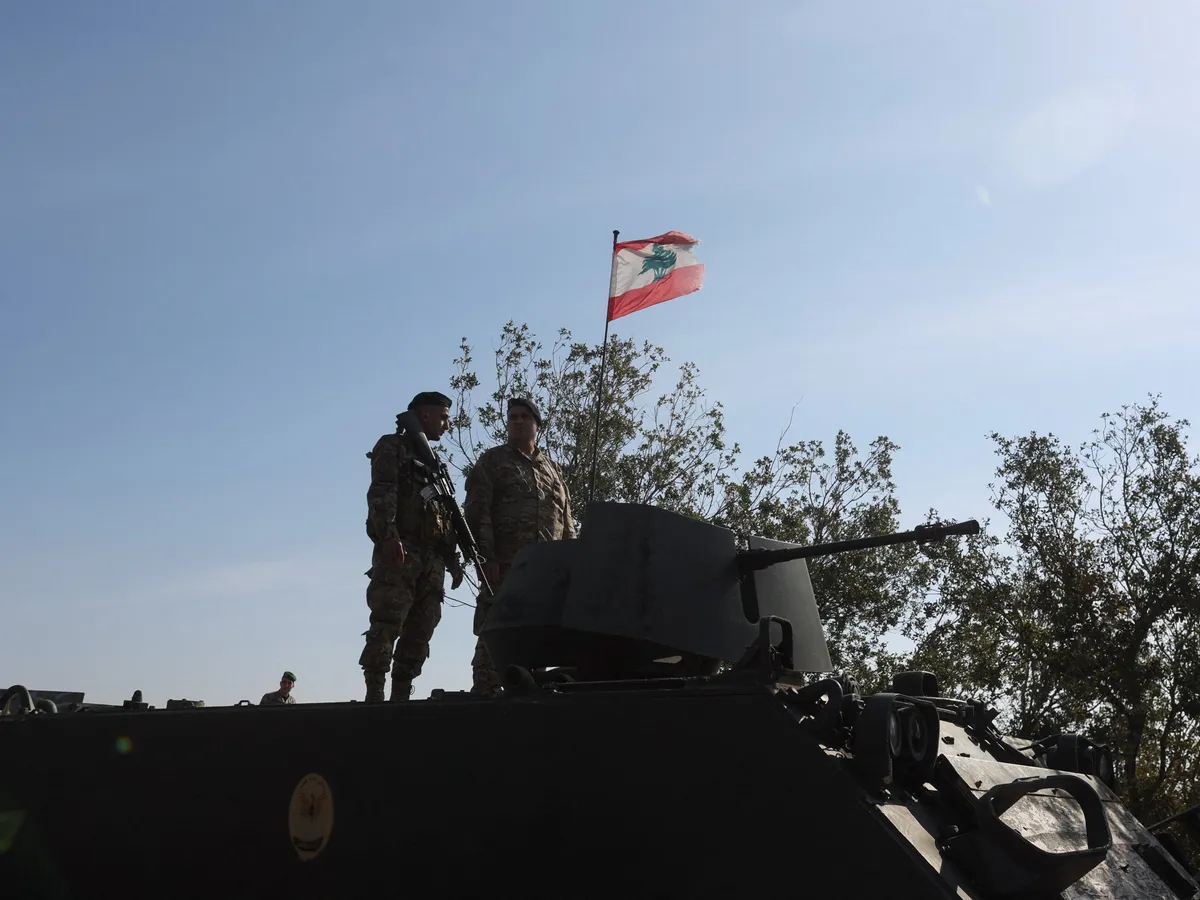
Ongoing fighting means issue of Hezbollah’s disarmament likely to remain on hold, military experts and analysts say.Lebanese army members stand on a military vehicle during a Lebanese army media tour, to review the army's operations in the southern Litani sector, in Alma ash-Shaab, near the border with Israel, southern Lebanon, November 28, 2025 [Aziz Taher/Reuters]Published On 10 Mar 2026Beirut, Lebanon – After more than a year of holding fire, Hezbollah last week launched a volley of missiles and drones towards an Israeli military site in the northern city of Haifa.The Lebanese group said the attack was in response to the killing of Iran’s Supreme Leader Ayatollah Ali Khamenei on the first day of the United States-Israeli war on Iran on February 28. Iran is Hezbollah’s main benefactor.Recommended Stories list of 3 itemslist 1 of 3Why Israel’s war on Hezbollah keeps returninglist 2 of 3Putin says Russia can supply oil, gas to Europe as energy prices soarlist 3 of 3Who is Iran’s new supreme leader?end of listSince then, Israel has carried out a fierce air campaign on Lebanon, killing nearly 500 people, including 83 children, and forcing half a million from their homes. It also launched a new ground incursion into the south of the country, ordering troops to “take control of additional strategic positions” as it opened a new front in the regional war prompted by the attacks on Iran.But as regional tensions rise, military experts and analysts say the Israeli escalation and Hezbollah’s resumption of fighting are complicating the Lebanese government’s efforts to disarm Hezbollah.Under the terms of a 2024 ceasefire deal between Hezbollah and Israel after more than a year of fighting, Israeli troops were to withdraw from southern Lebanon, and the group’s fighters were to go north of the Litani River that runs across the south of the country.Both sides would stop attacks, and the south would be handed over to the Lebanese Armed Forces (LAF) – even though Israel violated the ceasefire more than 10,000 times as it continued to target Hezbollah targets across the country, according to United Nations peacekeepers, and killed more than 100 civilians.Analysts say the increasingly contentious issue of Hezbollah’s role in Lebanon cannot come about before the end of the war in the country, due to the active fighting and its potential effect within LAF ranks. Such a solution is also seen as highly tied to the US and Israel’s war on Iran.“If there is an Israeli invasion, the Army cannot arrest someone opposing the Israelis on their own land,” Hassan Jouni, a retired brigadier general with the LAF, told Al Jazeera.Israeli soldiers on Lebanese landHezbollah’s decision to enter the fighting reportedly took much of the Lebanese political establishment by surprise.The government, which in August 2025 approved a plan to have the LAF disarm Hezbollah, immediately declared the group’s military activities “illegal”, while Prime Minister Nawaf Salam called Hezbollah’s move a “strategic mistake”, in an interview with Lebanese newspaper L’Orient-Le Jour.The Reuters news agency reported that Parliament Speaker Nabih Berri, a longtime steadfast ally of Hezbollah, was surprised by the move after he had received “assurances” from Hezbollah that it would not retaliate against Israel for its attacks on Iran.One week into the resumption of fighting, however, the conflict shows no signs of slowing down.A Lebanese military source told Al Jazeera that Israeli ground troops are present in numerous points, mostly in unpopulated land a few kilometres (miles) into Lebanese territory. Data collected by conflict monitor ACLED showed the Israeli forces had also engaged in clashes with Hezbollah fighters in villages in the central and eastern sectors of southern Lebanon.Multiple analysts told Al Jazeera the presence of the Israeli army in southern Lebanon would make the army’s job of disarming Hezbollah impossible, foremost in that any occupation would lead to a renewed form of resistance – be it from Hezbollah or another group.“No one can implement the government’s decision [to enforce the illegality of Hezbollah’s military actions],” Qassem Kassir, a Lebanese analyst close to Hezbollah. “And today there is an Israeli occupation. Everyone will become part of the resistance.”For years, Hezbollah was considered Lebanon’s most capable fighting force. Formed in the early 1980s with considerable support from Iran’s Islamic Revolutionary Guard Corps (IGRC), it grew to become a regional actor, with members deployed in countries such as Syria and Yemen.The LAF, meanwhile, has faced severe economic struggles that have led to defections and soldiers working second jobs to get by. Still, according to a 2024 Arab Barometer report, 85 percent of Lebanese citizens say they have a high level of trust in the army.The LAF has also proven it can be an effective fighting force when called upon. Joseph Aoun, now Lebanon’s president, led the LAF in operations against ISIL (ISIS) and other armed groups along the Lebanese-Syrian border in 2017.“It’s a solid institution, and it has considerable combat capabilities, especially regarding special forces,” Jouni said.Still, multiple sources told Al Jazeera the army could not confront Hezbollah directly because there was no political consensus in the country, and any such confrontation could lead to internal strife.During the Lebanese civil war from 1975 to 1990, the Lebanese army split along sectarian lines. Various sources told Al Jazeera that such a scenario could repeat should the LAF confront Hezbollah, with Shia members defecting rather than fighting relatives.“You can’t rely on them in a confrontation with Hezbollah,” Jouni said. “First, this confrontation will inevitably lead us to a very violent civil war.”The army source said the public demand on the LAF currently falls into two groups.“The first side wants the army to confront Hezbollah,” the source said. “And that could split the army, which has a sizable Shia contingent,” the source added.“The other side wants the army to fight Israel, and that would be suicide.”Much like the Israeli army, the LAF is funded and equipped predominantly by the US. But the US also provides Israel’s military with billions of dollars and far superior equipment to the LAF, creating a disparity between the two national armies.Raids and checkpoints over confrontationEven if the divisiveness over Hezbollah’s weapons was not present, there is still the question of the army’s capacity.Hezbollah is well-trained in street combat and rebel warfare tactics. It also has experience fighting in Syria on the side of former President Bashar al-Assad’s forces and against Israel in southern Lebanon.The LAF, on the other hand, is more suitable for special operations, Jouni said. “It’s not geared towards chasing Hezbollah members in the streets of Lebanon,” he said. “That would deplete the army.”Various sources told Al Jazeera that instead, the LAF has focused on stopping people carrying unsanctioned arms at checkpoints. That has included Hezbollah members.Seth Krummrich, a retired US Army colonel who worked with the LAF during his time as the former chief of staff for Special Operations Command Central, told Al Jazeera that it would be unlikely for the Lebanese army to directly confront Hezbollah battalions in combat.“At best, we can expect arrest warrants and raids,” Krummrich said. “But not head-to-head fighting with foot soldiers.”However, with the current security status quo, disarming Hezbollah would be impossible, experts said. First, Hezbollah fighters, particularly its elite Radwan Force, are engaging Israeli troops on Lebanese territory. And second, even if the LAf focused on areas where there are no clashes, it would be a logistical nightmare.The military source said much of Hezbollah’s weapons are in deep valleys north of the Litani River that are dangerous to access. This is where the LAF was supposed to disarm Hezbollah in phase two of the disarmament plan – between the Litani and Awali Rivers.
SRCAl Jazeera
LANGEN
LEANCenter
WORDS1 263
ENT10
TUE · 2026-03-10 · 08:09 GMTBRIEF NSR-2026-0310-23122
NSR-2026-0310-23122News Report·EN·Conflict
As Israel intensifies Lebanon attacks, Hezbollah disarmament takes backseat
Amidst escalating conflict between Israel and Hezbollah, the disarmament of Hezbollah has been sidelined. Fighting resumed after Hezbollah launched attacks on an Israeli military site in response to the death of Iran's Supreme Leader, prompting a fierce Israeli air campaign and ground incursion into Lebanon.
Justin SalhaniAl JazeeraFiled 2026-03-10 · 08:09 GMTLean · CenterRead · 6 min
Al JazeeraFIG 01
Reading time
6min
Word count
1 263words
Sources cited
1cited
Entities identified
10entities
Quality score
100%
§ 01
Briefing Summary
AI-generatedNEWSAR · AI
Amidst escalating conflict between Israel and Hezbollah, the disarmament of Hezbollah has been sidelined. Fighting resumed after Hezbollah launched attacks on an Israeli military site in response to the death of Iran's Supreme Leader, prompting a fierce Israeli air campaign and ground incursion into Lebanon. The renewed hostilities are complicating the Lebanese government's efforts to disarm Hezbollah, a key condition of a 2024 ceasefire agreement. Analysts suggest that resolving the issue of Hezbollah's role in Lebanon is unlikely before the end of the war, especially considering the potential impact on the Lebanese Armed Forces and the broader US and Israeli conflict with Iran. The ongoing fighting has resulted in significant casualties and displacement in Lebanon.
Confidence 0.90Sources 1Claims 5Entities 10
§ 02
Article analysis
Model · rule-basedFraming
Conflict
Political Strategy
Tone
Mixed Tone
AI-assessed
CalmNeutralAlarmist
Factuality
0.70 / 1.00
Factual
LowHigh
Sources cited
1
Limited
FewMany
§ 03
Key claims
5 extracted01
The Lebanese government approved a plan in August 2025 to have the LAF disarm Hezbollah.
factualAl Jazeera
Confidence
1.00
02
Hezbollah launched missiles and drones towards an Israeli military site in Haifa.
factualAl Jazeera
Confidence
1.00
03
Half a million people have been displaced from their homes in Lebanon due to Israeli attacks.
factualAl Jazeera
Confidence
0.90
04
Israel has carried out an air campaign on Lebanon, killing nearly 500 people, including 83 children.
factualAl Jazeera
Confidence
0.90
05
Ongoing fighting means issue of Hezbollah’s disarmament likely to remain on hold.
predictionmilitary experts and analysts
Confidence
0.80
§ 04
Full report
6 min read · 1 263 words§ 05
Entities
10 identifiedKey playerOppositionContextPositiveNeutralNegative
§ 06
Keywords & salience
10 termshezbollah disarmament
0.90
israel
0.80
lebanon
0.80
fighting
0.70
regional tensions
0.70
israeli attacks
0.70
ceasefire deal
0.60
iran
0.60
military escalation
0.60
regional war
0.50
§ 07
Topic connections
Interactive graph Network visualization showing 51 related topics
View Full Graph Person Organization Location Event|Click node to navigate|Edge numbers = shared articles