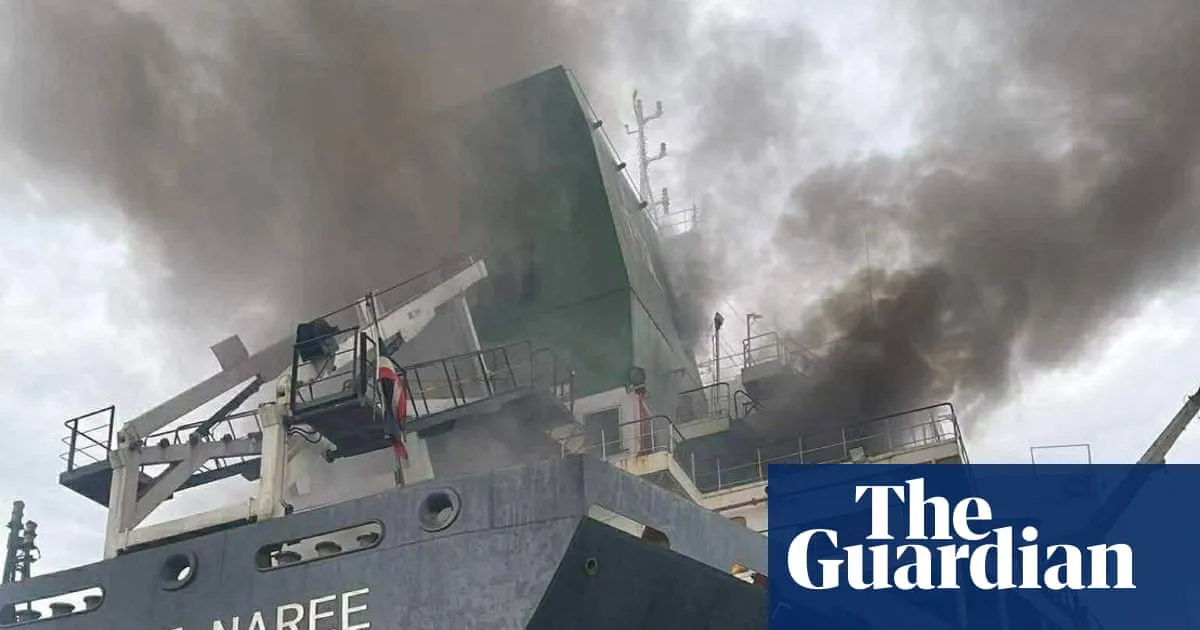
Iran dramatically escalated its strategy of striking civilian infrastructure and transport networks across the Gulf on Wednesday, attacking commercial ships travelling through the Gulf and targeting Dubai’s international airport, as US and Israeli warplanes launched new waves of strikes on the Islamic Republic.Senior Iranian officials struck a defiant tone, warning of a long “war of attrition” that will threaten global economic chaos as energy supplies from the oil and gas rich region are throttled.Amid what appears to be a growing stalemate in the 12-day-old conflict, violence continued across a swath of the Middle East, with Israeli strikes on what it says are Hezbollah targets in Lebanon and barrages of Iranian missiles and Hezbollah rockets targeting Israel.The UN refugee agency said at least 759,000 people have been internally displaced in Lebanon, while more than 92,000 others have crossed into neighbouring Syria.In the Gulf, Kuwait said its air defences downed eight Iranian drones and Saudi Arabia said it intercepted five heading toward the kingdom’s Shaybah oil field.In Tehran and other cities, huge crowds took to the streets for funerals for senior Iranian commanders killed by US and Israeli airstrikes since the beginning of the war 12 days ago. Mourners carried caskets and brandished flags and portraits of the late supreme leader, Ayatollah Ali Khamenei, who was killed in the first minute of the US-Israeli offensive, and his son and successor, Mojtaba.Iranian officials admitted for the first time on Wednesday that Iran’s new leader had been wounded in the airstrikes that killed his father, mother, wife and a son. The 56-year-old has not appeared in public or issued any direct message since the war began.“I have heard that he was injured in his legs and hand and arm … I think he is in the hospital because he is injured,” Alireza Salarian, Tehran’s ambassador to Cyprus, told the Guardian.Despite growing pressure for the US and Israel to consider reining back their joint offensive, decision-makers in both countries appeared to continuing the campaign for now.Israel Katz, Israel’s defence minister, said on Wednesday the joint offensive against Iran “will continue without any time limit, as long as required, until we achieve all objectives and win the campaign”.Donald Trump has sent more mixed messages in recent days, going from calling the war a “short-term excursion” that could end soon to proclaiming “we haven’t won enough” during a single speech in Washington on Monday.On Wednesday the US president told Axios the war would end “soon” because there is “practically nothing left to target … Any time I want it to end, it will end.”Governments across the world fear economic turmoil from surging oil prices which would anger many voters.On Wednesday, Trump appeared to praise the “tremendous impact” of decisions being by leaders of the Group of Seven nations as they met to discuss the war and its economic consequences, according to a short video clip shared by the French presidency.“I think we are having a tremendous impact, unbelievable actually, on the world,” Trump said, after being given the floor by Emmanuel Macron, the French president, who chaired the G7 meeting, though it was not entirely clear who or what Trump was referring to.The US president was speaking after a recommendation by the International Energy Agency (IEA) to release 400m barrels of oil, the largest such move in the IEA history, in a bid to restrain soaring oil prices.But so far there is no sign that ships can safely sail through the strait of Hormuz, which carries a fifth of the world’s oil.Three more merchant ships were struck in the Gulf by unknown projectiles on Wednesday, according to agencies that monitor maritime security, raising the number of ships reportedly hit since the war began to 14.Crew were evacuated from a Thai-flagged bulk freighter after an explosion caused a fire. A Japanese-flagged container ship and a Marshall Islands-flagged bulk carrier also sustained damage.Trump told reporters on Wednesday that oil tankers passing through the strait would “see great safety, and it’s going to be very, very quickly”, without giving further details.Hundreds of ships are now blockaded behind the narrow channel along the Iranian coast for fear of Iranian attack in the worst disruption to energy supplies since the oil shocks of the 1970s.The Revolutionary Guards said Iran would not allow “a single litre of oil” through the vital waterway until the US stopped its bombing campaign.Iran has also continued to target oilfields and refineries in Gulf Arab nations as it seeks to force the US and Israel to stop their offensive.“Get ready for oil to be $200 a barrel, because the oil price depends on regional security which you have destabilised,” Ebrahim Zolfaqari, spokesperson for Iran’s military command, said in comments addressed to the US.Iran’s army said it had attacked key targets in Israel, including the military intelligence headquarters, a naval base in Haifa and a radar system. It also said it targeted US bases in Kuwait and Bahrain.US and Israeli officials say their aim is to end Iran’s ability to project force beyond its borders and to destroy its nuclear programme, though they have also encouraged Iranians to overthrow the Islamist clerical regime, which took power after the 1979 revolution that ousted the Shah, a US ally. Benjamin Netanyahu, Israel’s prime minister, on Tuesday repeated a call for the Iranian people to rise up.Iran’s police chief, Ahmadreza Radan, said any protesters in Iran would be treated “as an enemy … All our security forces have their fingers on the trigger”.Residents of Tehran said they were getting used to nightly airstrikes that have sent hundreds of thousands of people fleeing to the countryside and contaminated the city with black rain from oil smoke.“There were bombings last night but I did not get scared like before. Life goes on,” Farshid, 52, said by phone.Iran accused the US and Israel of striking a maritime ambulance boat at an island in the strait of Hormuz, Mehr news agency reported.Adm Brad Cooper, commander of US Central Command, said that as a result of the US strikes, including one on a “large ballistic missile manufacturing facility”, Iran’s ballistic missile and drone attacks have “dropped drastically”. The targets have included more than 60 ships, he said in a video posted to social media Wednesday.Cooper also confirmed that the military was using “advanced AI tools” to “sift through vast amounts of data in seconds”. He said these tools are enabling leaders to make smarter decisions faster, but stressed that “humans will always make final decisions on what to shoot and what not to shoot and when to shoot”.In Israel, explosions rang out before dawn from air defences intercepting missiles. Sirens sent Israelis to shelters. Twelve people have been killed and hundreds injured by Iranian attacks and those by Hezbollah. Israeli officials have repeatedly accused Iran of using cluster munitions, which are illegal under international law, against population centres.Israel also launched a barrage on Beirut, targeting southern suburbs that are a stronghold of Hezbollah, which has fired into Israel from Lebanon in solidarity with Tehran.More than 1,300 Iranian civilians have been killed since the US and Israeli airstrikes began on 28 February, according to Iran’s UN ambassador, Amir Saeid Iravani.In Lebanon, Israel’s offensive against Hezbollah has killed 570 people, the country’s health ministry says, including 45 women and 86 children. It does not distinguish between combatants and civilians but the total includes 14 healthcare workers, the ministry says.Washington says seven US soldiers have been killed and approximately 140 have been wounded.
SRCThe Guardian - World News
LANGEN
LEANCenter-Left
WORDS1 243
ENT12
WED · 2026-03-11 · 18:27 GMTBRIEF NSR-2026-0311-23636
NSR-2026-0311-23636News Report·EN·Conflict
Iran escalates attacks on infrastructure and transport networks across the Gulf
Amidst a 12-day-old conflict, Iran has escalated attacks on infrastructure and transport networks across the Gulf, including commercial ships and Dubai's airport, while the US and Israel continue airstrikes within Iran. Iranian officials warn of a prolonged conflict threatening global energy supplies.
Jason Burke, JerusalemThe Guardian - World NewsFiled 2026-03-11 · 18:27 GMTLean · Center-LeftRead · 5 min
The Guardian - World NewsFIG 01
Reading time
5min
Word count
1 243words
Sources cited
5cited
Entities identified
12entities
Quality score
100%
§ 01
Briefing Summary
AI-generatedNEWSAR · AI
Amidst a 12-day-old conflict, Iran has escalated attacks on infrastructure and transport networks across the Gulf, including commercial ships and Dubai's airport, while the US and Israel continue airstrikes within Iran. Iranian officials warn of a prolonged conflict threatening global energy supplies. Violence has spread, with Israeli strikes in Lebanon and Iranian/Hezbollah attacks on Israel, causing mass displacement. Kuwait and Saudi Arabia report intercepting Iranian drones and missiles. Large public funerals are being held in Iran for commanders killed in US/Israeli strikes, and officials confirmed the new Iranian leader was wounded in the initial attacks. Despite international pressure, the US and Israel indicate their offensive will continue indefinitely until objectives are met.
Confidence 0.90Sources 5Claims 5Entities 12
§ 02
Article analysis
Model · rule-basedFraming
Conflict
Economic Impact
Tone
Mixed Tone
AI-assessed
CalmNeutralAlarmist
Factuality
0.70 / 1.00
Factual
LowHigh
Sources cited
5
Well sourced
FewMany
§ 03
Key claims
5 extracted01
The joint offensive against Iran “will continue without any time limit...until we achieve all objectives”.
quoteIsrael Katz, Israel’s defence minister
Confidence
1.00
02
At least 759,000 people have been internally displaced in Lebanon.
statisticUN refugee agency
Confidence
0.95
03
Kuwait said its air defences downed eight Iranian drones.
factualKuwait
Confidence
0.90
04
Iran attacked commercial ships and Dubai’s international airport.
factual
Confidence
0.90
05
Iranian officials admitted that Iran’s new leader had been wounded in the airstrikes.
factual
Confidence
0.80
§ 04
Full report
5 min read · 1 243 words§ 05
Entities
12 identifiedKey playerOppositionContextPositiveNeutralNegative
Organizations1
§ 06
Keywords & salience
10 termsiran
1.00
attacks on infrastructure
0.90
gulf
0.90
transport networks
0.80
us and israeli airstrikes
0.80
war of attrition
0.70
hezbollah
0.60
economic chaos
0.60
refugee crisis
0.50
shaybah oil field
0.40
§ 07
Topic connections
Interactive graph Network visualization showing 51 related topics
View Full Graph Person Organization Location Event|Click node to navigate|Edge numbers = shared articles