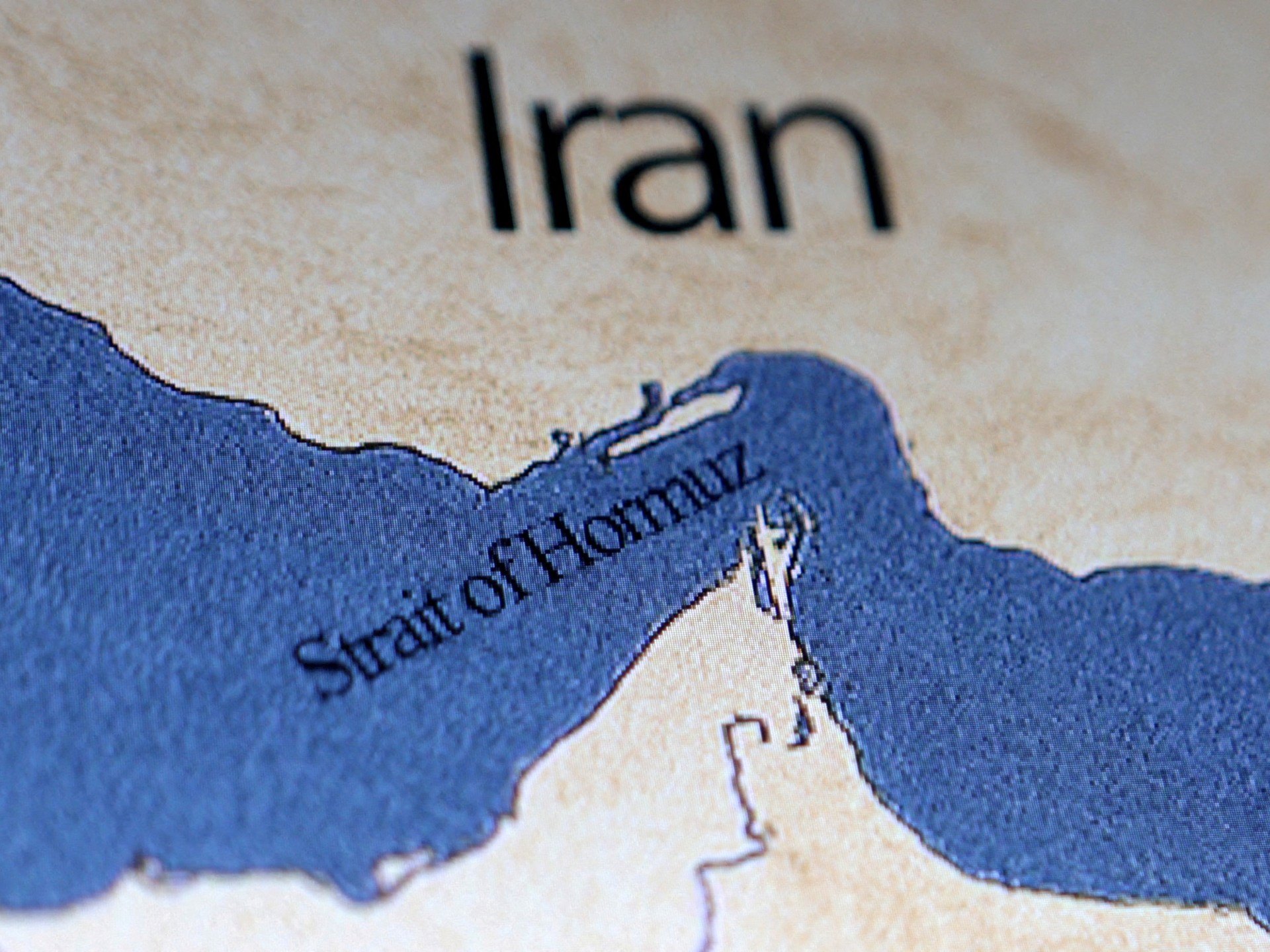
EXPLAINERAnalysts say US president’s solution to secure the strait is fraught with problems.Iranian attacks have essentially closed the Strait of Hormuz, which is 21 nautical miles (39km) wide at its narrowest point [Illustration/Dado Ruvic/Reuters]Published On 15 Mar 2026United States President Donald Trump has called for a naval coalition to deploy warships to secure the Strait of Hormuz, through which one-fifth of world oil shipments transit, as oil markets reel from supply disruptions caused by the US-Israeli war with Iran.What is essentially the closure of the Strait of Hormuz by Iran in response to the attacks by the US and Israel has sent oil prices soaring to more than $100 per barrel.Iran’s new supreme leader, Mojtaba Khamenei, has promised to keep the maritime artery closed while another top official in Tehran warned that oil prices could shoot up beyond $200 per barrel.Trump said he hoped a naval coalition could secure the vital waterway, which connects the Gulf to the Gulf of Oman and the Arabian Sea. Iran has struck more than a dozen ships trying to sail through the narrow waterway since the hostilities started two weeks ago.But will Trump’s solution work?A tanker sits at anchor in Port Sultan Qaboos in Muscat, Oman, as oil shipments through the Strait of Hormuz have plummeted [File: Benoit Tessier/Reuters]What has Trump said?The US president has been facing domestic pressure over starting the war alongside Israel with no endgame or off-ramps in sight.“On the Strait of Hormuz, they had NO PLAN,” US Democratic Senator Chris Murphy wrote in a post on X. “I can’t go into more detail about how Iran gums up the Strait, but suffice it [to] say, right now, they don’t know how to get it safely back open.”After threatening to bomb Iran more, Trump called on China, France, Japan, South Korea and the United Kingdom to send warships to secure the strait.Trump claimed “100% of Iran’s military capability” had already been destroyed but added that Tehran could still “send a drone or two, drop a mine, or deliver a close-range missile somewhere along, or in, this waterway”.“Hopefully China, France, Japan, South Korea, the UK, and others, that are affected by this artificial constraint will send ships to the area so that the Hormuz Strait will no longer be a threat by a nation that has been totally decapitated,” Trump wrote in a post on his Truth Social platform.“In the meantime, the United States will be bombing the hell out of the shoreline, and continually shooting Iranian Boats and Ships out of the water. One way or the other, we will soon get the Hormuz Strait OPEN, SAFE, and FREE!”Not long after, Trump returned to the keyboard, extending the invitation to all “the Countries of the World that receive Oil through the Hormuz Strait” to send warships, adding that the US would provide “a lot” of support to those who participated.Israeli soldiers walk by a billboard commissioned by the evangelical Christian group Friends of Zion during the US-Israel war on Iran in Tel Aviv, Israel [File: Nir Elias/Reuters]What has Iran said?Alireza Tangsiri, commander of the Islamic Revolutionary Guard Corps Navy, said in a statement that claims by the US about destroying Iran’s navy or providing safe escort for oil tankers were false.“The Strait of Hormuz has not been militarily blocked and is merely under control,” he said in a statement.Iranian Foreign Minister Abbas Araghchi later doubled down on this, saying the strait remained open to international shipping except for vessels belonging to the US and its allies.“The Strait of Hormuz is open. It is only closed to the tankers and ships belonging to our enemies, to those who are attacking us and their allies. Others are free to pass,” Araghchi said.Khamenei – son of the late Supreme Leader Ali Khamenei, who was killed on the first day of the US-Israeli strikes – suggested in his first statement since taking power that the Strait of Hormuz would remain closed to provide leverage for Iran during the conflict.F-18 combat aircraft are parked on the deck of the USS Abraham Lincoln aircraft carrier in the Gulf of Oman near the Strait of Hormuz during a 2019 deployment [File: Ahmed Jadallah/Reuters]What are the challenges in the Strait of Hormuz?The strait, which is just 21 nautical miles (39km) wide at its narrowest point, is the only maritime passage into the Arabian Gulf (known as the Persian Gulf in Iran). Shipping lanes in the waterway are even narrower and more vulnerable to attacks.It separates Iran on one side from Oman and the United Arab Emirates on the other.In brief, there is no way in or out by sea when the Strait of Hormuz is closed.Alexandru Hudisteanu, a maritime security expert who served 13 years in the Romanian navy, told Al Jazeera that in the type of coalition that Trump is hinting at, “interoperability is the biggest hurdle.”“That’s the ability of cruises to work together or with different units and different doctrine when basic communication would be an issue,” he said.Then, there is the geography of the Strait of Hormuz: “a very unforgiving environment to sail with this type of wartime threats”, Hudisteanu said. “Especially difficult under missile threats and these asymmetric potential mines or unmanned systems that could damage or destroy ships.”Providing escorts to ships would be a costly option, and it would pose risks to participating foreign warships from possible Iranian attacks, which would likely further drag more countries into the ongoing war.From Iran’s point of view, “the fact that the shoreline is so close and the actual maritime passage is highly congested and confined is an advantage by default,” Hudisteanu added. Geographically, Iran keeps it as a gauntlet, with no way out for the ships unless Tehran allows it.Another major challenge for any naval coalition trying to secure the passage would be the timeline of any operation. ”The security of the strait could be achieved. It’s just a matter of how much time you need and how many assets you need,” the analyst said. Rushing through it “could have negative implications for the security of the mission and the region”.Smoke rises from the Thai bulk carrier Mayuree Naree near the Strait of Hormuz after an attack on March 11, 2026 [Handout/Royal Thai Navy via AFP]How have countries responded?No country has so far publicly agreed to Trump’s call to send warships to secure the Strait of Hormuz.London said it is “intensively looking” at what it can do to help reopen the maritime passage. British Energy Secretary Ed Miliband said: “We are intensively looking with our allies at what can be done because it’s so important that we get the strait reopened.”Chinese Ministry of Foreign Affairs officials said Beijing is calling for hostilities to stop and “all parties have the responsibility to ensure stable and unimpeded energy supply.”Japan said the threshold is “extremely high” to send its warships on such a mission. “Legally speaking, we do not rule out the possibility, but given the current situation in which this conflict is ongoing, I believe this is something that must be considered with great caution,” said Takayuki Kobayashi, policy chief of Japan’s ruling Liberal Democratic Party.France also confirmed that it will not send ships. The Ministry for Europe and Foreign Affairs said in a statement on Saturday: “Posture has not changed: defensive it is,” in reference to President Emanuel Macron’s assertion that France will not join the war against Iran.South Korea, which imports 70 percent of its oil from the Gulf, said it was “closely monitoring” Trump’s statements and “comprehensively considering and exploring various measures … to ensure the safety of energy transport routes”.(Al Jazeera)Are countries negotiating with Iran?Some countries have been negotiating with Iran to secure passage for their petroleum shipments.
SRCAl Jazeera
LANGEN
LEANCenter
WORDS1 283
ENT12
SUN · 2026-03-15 · 14:56 GMTBRIEF NSR-2026-0315-24757
NSR-2026-0315-24757News Report·EN·Conflict
Trump calls for naval coalition to open Strait of Hormuz: Can it work?
In March 2026, amid a US-Israeli war with Iran, President Trump called for a naval coalition to secure the Strait of Hormuz, a vital waterway for global oil shipments. Iran's actions have essentially closed the Strait of Hormuz, causing oil prices to surge past $100 per barrel.
Yashraj SharmaAl JazeeraFiled 2026-03-15 · 14:56 GMTLean · CenterRead · 6 min
Al JazeeraFIG 01
Reading time
6min
Word count
1 283words
Sources cited
2cited
Entities identified
12entities
Quality score
100%
§ 01
Briefing Summary
AI-generatedNEWSAR · AI
In March 2026, amid a US-Israeli war with Iran, President Trump called for a naval coalition to secure the Strait of Hormuz, a vital waterway for global oil shipments. Iran's actions have essentially closed the Strait of Hormuz, causing oil prices to surge past $100 per barrel. Trump urged countries like China, France, Japan, South Korea, and the UK to deploy warships, claiming Iran's military capabilities were decimated but acknowledging the potential for continued attacks. The call for a coalition comes as Trump faces domestic pressure regarding the war and concerns over reopening the Strait safely. The Strait of Hormuz connects the Gulf to the Gulf of Oman and the Arabian Sea.
Confidence 0.90Sources 2Claims 5Entities 12
§ 02
Article analysis
Model · rule-basedFraming
Conflict
National Security
Tone
Mixed Tone
AI-assessed
CalmNeutralAlarmist
Factuality
0.70 / 1.00
Factual
LowHigh
Sources cited
2
Limited
FewMany
§ 03
Key claims
5 extracted01
Trump claimed “100% of Iran’s military capability” had already been destroyed.
quoteDonald Trump
Confidence
1.00
02
One-fifth of world oil shipments transit through the Strait of Hormuz.
statisticArticle's own claim
Confidence
1.00
03
Oil prices soaring to more than $100 per barrel.
factualArticle's own claim
Confidence
0.90
04
Iranian attacks have essentially closed the Strait of Hormuz.
factualArticle's own claim
Confidence
0.80
05
Iran has struck more than a dozen ships trying to sail through the narrow waterway since the hostilities started two weeks ago.
factualArticle's own claim
Confidence
0.70
§ 04
Full report
6 min read · 1 283 words§ 05
Entities
12 identifiedKey playerOppositionContext
SO
Strait of Hormuz location · Context
100
DT
Donald Trump person · Key Player
90
I
Iran location · Opposition
90
US
United States location · Key Player
80
I
Israel location · Key Player
70
MK
Mojtaba Khamenei person · Opposition
60
C
China location
50
J
Japan location
50
UK
United Kingdom location
50
F
France location
50
SK
South Korea location
50
CM
Chris Murphy person
40
§ 06
Keywords & salience
10 termsstrait of hormuz
1.00
iran
0.90
naval coalition
0.80
oil shipments
0.70
united states
0.70
supply disruptions
0.60
war
0.60
oil prices
0.60
maritime artery
0.50
warships
0.40
§ 07
Topic connections
Interactive graph Network visualization showing 51 related topics
View Full Graph Person Organization Location Event|Click node to navigate|Edge numbers = shared articles