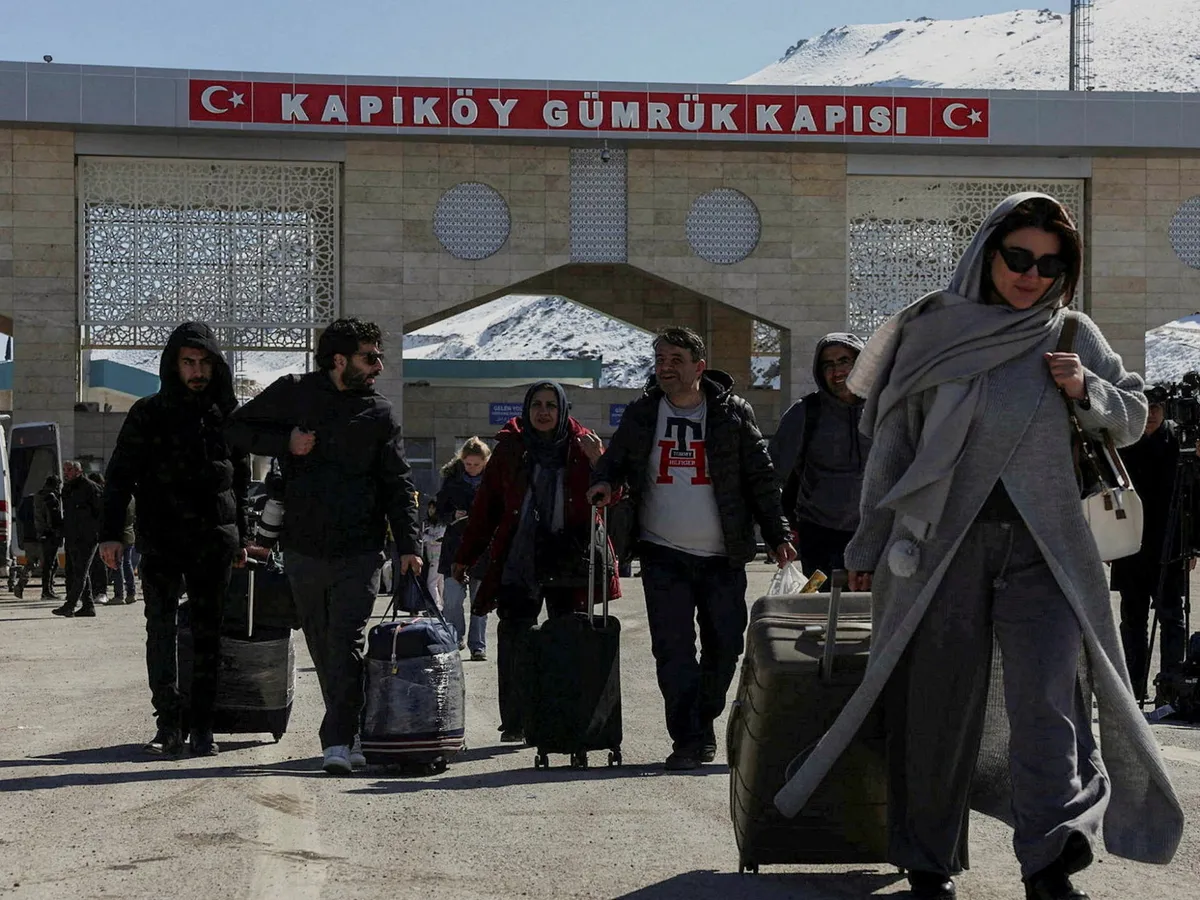
As war engulfs Iran, neighbouring states quietly prepare for a potential refugee exodus across already fragile borders.Iranians make their way after crossing into Turkiye at the Kapikoy border gate in the eastern Van province, Turkiye, March 3, 2026 [Dilara Senkaya/Reuters]Published On 17 Mar 2026Islamabad, Pakistan — The war launched by the United States and Israel on Iran has already killed more than 1,400 people, set off retaliatory attacks by Tehran targeting Gulf nations and Israel, and pushed global oil prices above $100 a barrel.Now, eighteen days into the conflict, aid agencies and countries neighbouring Iran are increasingly concerned about a potential refugee crisis.Recommended Stories list of 4 itemslist 1 of 4‘We were just praying’: Pakistani students recount escape from war-hit Iranlist 2 of 4How Iran’s women footballers took asylum in Australia and what happens nextlist 3 of 4Photos: People flee US-Israeli bombardment of Iranlist 4 of 4Up to 3.2 million people displaced across Iran amid US-Israeli attacks: UNend of listThe United Nations refugee agency, UNHCR, estimates that 3.2 million people have already been displaced in Iran since US-Israeli strikes began on February 28. For now, the number of people physically crossing Iran’s borders remains comparatively modest. But this is what could happen next, and has put Iran’s neighbours on high alert.Iran borders seven countries: Afghanistan, Armenia, Azerbaijan, Iraq, Pakistan, Turkiye and Turkmenistan. Iraq shares the longest frontier, stretching for almost 1,600km (994 miles).Each of these states faces its own political pressures, economic limitations and security concerns.But pressure on the ground in Iran is mounting. The country’s Red Crescent Society reports that more than 10,000 civilian sites have been damaged since the war began, including 65 schools and 32 medical facilities, while more than 1,400 people have been killed in the US-Israel attacks. Strikes have hit residential areas in Tehran, Shiraz and Isfahan.Meanwhile, commercial flights out of Iran have been suspended as airspace is closed.Eldaniz Gusseinov, head of research at the geopolitical advisory firm Nightingale International, noted that because strikes have so far been concentrated largely on Tehran and western and southwestern Iran, other parts of the country — especially provinces bordering Turkmenistan, Afghanistan and Pakistan are absorbing much of the internal displacement.“If the strike pattern remains the same, internally displaced people inside Iran will increasingly concentrate in provinces located near those states, creating the preconditions for cross-border movement,” the Almaty-based analyst told Al Jazeera.And things could get worse. If Tehran, a city of about 10 million people, were to lose its electricity grid or water supply in a US-Israel attack, for instance, residents could be forced to leave en masse.“Infrastructure destruction does not produce the gradual, manageable flows that the Syrian war initially generated. It produces sudden, massive displacement, driven by the collapse of basic urban services,” Gusseinov said.Turkiye fears repeat of Syrian migration crisisAmong Iran’s neighbours, only Turkiye, Iraq and Pakistan have extensive experience of hosting large refugee populations.Imtiaz Baloch, an independent researcher focusing on conflicts in Pakistan and Central Asia, said that if the crisis in Iran deepens, many Iranians could seek refuge in neighbouring states, particularly Iraq and Turkiye.Analysts say no country faces greater political exposure than Turkiye.“Turkiye is currently hosting many refugees from Syria and other countries. A new influx of Iranian migrants would likely intensify the humanitarian burden and create new challenges for both host countries and international relief agencies in the coming days,” Baloch said.Turkiye shares a 530km (329-mile) border with Iran and allows visa-free entry for Iranian citizens. It already hosts the world’s largest refugee population, including roughly 3.6 million Syrians, and anti-immigrant sentiment has hardened within domestic politics over the past decade.Turkiye’s interior minister, Mustafa Çiftçi, said earlier in March that the government had prepared three contingency plans for the war in Iran.The first involves intercepting migration flows within Iranian territory before they reach the border. The second proposes establishing buffer zones along the frontier. The third would allow refugees to enter Turkiye under controlled conditions as a last resort.Turkish authorities say they have already strengthened the border with Iran, adding 380km (236 miles) of concrete wall, 203 optical towers and 43 observation posts – undertaken, according to a Turkish Ministry of National Defence statement issued in January, as the US was building up its armada in the Gulf late last year.“Although there is currently no mass migration detection at our borders, additional measures have been taken on the border line, and these measures will be implemented if needed,” the Defence Ministry stated on January 15.So far, this has not been necessary. According to Turkish government data on the movement of people from Iran, 5,010 entered Turkiye from between March 1 and 3, while 5,495 exited.But Turkiye has felt the effects of the war’s spillover in other ways. On March 9, NATO confirmed it had intercepted an Iranian ballistic missile over Turkish airspace. The debris landed near Gaziantep, in the western-most part of the country, about 50km (31 miles) from the Syrian border. Iran denied that it was behind the attack on Turkiye.Crisis on an unprecedented scale?What makes the current situation in Iran particularly urgent is the scale of its population, say analysts.Syria had approximately 21 million people at the start of its civil war. Iran has roughly 90 million. The Syrian conflict caused more than 13 million people to be displaced, including more than 6 million who fled the country.A proportionate displacement from Iran would represent a humanitarian crisis with few modern parallels. To put it into perspective, if a country of 90 million experienced the exact same scale of crisis as Syria, nearly 56 million people would be forced to flee their homes, and nearly 26 million of them would become international refugees.Gusseinov said such a scale of displacement and the capacity of international aid agencies is “fundamentally mismatched”.Furthermore, Iran itself hosts one of the world’s largest refugee populations: about 3.7 million displaced people, most of them from Afghanistan.“Any mass displacement from Iran, therefore, creates a dual crisis: Iranian civilians fleeing outward, and Afghan and Iraqi refugees who were already in Iran being displaced a second time, or pushed back to countries that cannot absorb them,” he said.Hamid Shirmohammadzadeh, 35, who arrived in Turkiye from Iran, shows his passport while staying at a hotel in Van province, Turkiye, March 5, 2026 [Dilara Senkaya/Reuters]Iraq and the South Caucasus face difficult choicesAlthough most population movement is still taking place within Iran rather than across its borders, Iran’s neighbours do have cause for concern, analysts say.“Iran’s neighbouring countries are already dealing with their own crises, which limits their ability to absorb a potential refugee influx. Countries such as Syria, Iraq, Azerbaijan, Pakistan, and Afghanistan are facing varying degrees of economic, political, or security challenges. These internal pressures make it difficult for them to accommodate a large influx of refugees,” Gusseinov told Al Jazeera.Iraq, which shares Iran’s longest border, faces a particularly complex situation.The country is not only a potential destination for Iranian refugees, but has also been caught in military exchanges between Washington and Tehran. US forces have targeted armed groups operating from Iraqi territory, while Iran and pro-Iran armed groups have struck – or attempted to strike – US military and diplomatic positions inside the country.The UN’s International Organization for Migration says disruptions on the Iranian side of the border have led to the closure of several crossing points, although Iraqi crossings remain technically open. Meanwhile, the UNHCR says it is monitoring developments closely, and that the Iraqi government would lead any emergency refugee response.The semi-autonomous Kurdish region of northern Iraq, which, unlike the rest of the country, still allows visa-free entry for Iranian passport holders, adds another layer of complexity.The region hosts several Kurdish armed groups, some of which have reportedly been in discussions with Washington about receiving military support in return for joining the war against Iran. The development has prompted Iran’s Revolutionary Guard Corps (IRGC) to strike Kurdish positions inside Iraqi territory.Baghdad has publicly stated that it will not allow its territory to be used to infiltrate Iran, but experts on the region say its ability to enforce the position is limited.Further north, the South Caucasus states of Armenia, Azerbaijan and Georgia have each expressed concern while attempting to carefully balance relations with both Washington and Tehran.Azerbaijan has closed its land borders to routine traffic, requiring government approval for any crossing, while Armenia’s border with Iran, which is just 44km (27 miles) long, remains open.“Armenia is a small economy already absorbing Russian and Ukrainian migrants,” Gusseinov said.(Al Jazeera)Pakistan and Afghanistan confront overlapping crisesTo Iran’s east lie Pakistan and Afghanistan, each grappling with existing refugee pressures.According to the UNHCR, since October 2023, about 5.4 million Afghans have returned to Afghanistan from Iran and Pakistan, many not by choice.Following the withdrawal of US troops from Afghanistan and the Taliban’s return to power in August 2021, a huge wave of Afghans sought refuge across the country’s borders, fearful of economic collapse and security threats.The UN and international migration agencies estimate that between 1 and 1.5 million Afghans fled to Iran in the immediate aftermath of the US withdrawal, pushing the total Afghan population in Iran to upwards of 5 or 6 million.Concurrently, hundreds of thousands of newly displaced Afghans crossed into Pakistan, joining a long-established refugee community there and swelling the total number of Afghans in the country to more than 3 million.In response to this influx and citing domestic economic and security pressures, both Pakistan and Iran initiated aggressive mass deportation campaigns, forcing millions back into Afghanistan. Between late 2023 and the end of 2025, between 2.8 million and 3.5 million Afghans are thought to have been sent back.Pakistan’s stringent repatriation plans pushed out more than 1.3 million people, while Iran drastically accelerated its expulsions, deporting nearly 2 million individuals in 2025 alone.According to the UNHCR, in 2026 so far, more than 232,500 Afghans have returned to their country, including 146,206 from Pakistan and 86,253 from Iran.The primary concern now is that the war in Iran could accelerate these returns, pushing people into communities already struggling to cope and potentially triggering further onward migration. The UNHCR has also warned that largescale and hurried returns of refugees could trigger further instability in the region.Further complicating the situation, Pakistan and Afghanistan have been engaged in fighting, as Islamabad claims that Afghanistan is providing a safe haven to armed groups launching attacks at Pakistan. Kabul has consistently denied the presence of any such groups on its soil.Another bout of hostilities in October 2025 led Pakistan to close its borders with Afghanistan. Since then, Afghanistan’s trade and economic ties with Iran have deepened.“Destabilisation of the Iranian economy, therefore, hits Afghanistan through two channels simultaneously: reduced trade flows and refugee return surges,” Gusseinov said.Meanwhile, Pakistan faces its own geographical and security challenges.The country’s border with Iran runs through Balochistan, its largest but most volatile province, where separatist sentiment has simmered for decades. The province has seen an increasing number of attacks by armed groups seeking independence from Pakistan. In February this year, Pakistan’s military concluded a weeklong security operation in the province, and claimed it had killed 216 fighters in targeted offensives.While Balochistan’s provincial officials say they have sufficient resources to accommodate refugees if large numbers begin arriving across the southern border, researcher Baloch said the reality was more complicated. Any refugee crisis, he said, could make the situation in Balochistan difficult for Islamabad to manage.“Balochistan’s porous border is next to Iran’s Sistan and Baluchestan province, a region that has historically been home to various separatist groups. Any significant influx of refugees across this border could impose additional security and economic costs on Pakistan,” Baloch said.
SRCAl Jazeera
LANGEN
LEANCenter
WORDS1 930
ENT12
TUE · 2026-03-17 · 06:13 GMTBRIEF NSR-2026-0317-25204
NSR-2026-0317-25204News Report·EN·Conflict
Iran’s neighbours brace for fallout as war threatens new refugee crisis
Following the US-Israeli attacks on Iran that began on February 28, 2026, neighboring countries are bracing for a potential refugee crisis. The conflict has already displaced an estimated 3.2 million people within Iran, according to the UNHCR, and killed over 1,400.
Abid HussainAl JazeeraFiled 2026-03-17 · 06:13 GMTLean · CenterRead · 8 min
Al JazeeraFIG 01
Reading time
8min
Word count
1 930words
Sources cited
2cited
Entities identified
12entities
Quality score
100%
§ 01
Briefing Summary
AI-generatedNEWSAR · AI
Following the US-Israeli attacks on Iran that began on February 28, 2026, neighboring countries are bracing for a potential refugee crisis. The conflict has already displaced an estimated 3.2 million people within Iran, according to the UNHCR, and killed over 1,400. While border crossings remain relatively low, Iran's neighbors, including Iraq, Turkiye, Pakistan, and Afghanistan, are on high alert due to mounting pressure within Iran, including damaged civilian infrastructure and suspended commercial flights. These nations face their own political, economic, and security challenges as they prepare for a possible influx of refugees. The strikes have been concentrated in western and southwestern Iran, leading to internal displacement towards provinces bordering Turkmenistan, Afghanistan, and Pakistan.
Confidence 0.90Sources 2Claims 5Entities 12
§ 02
Article analysis
Model · rule-basedFraming
Conflict
Human Interest
Tone
Mixed Tone
AI-assessed
CalmNeutralAlarmist
Factuality
0.70 / 1.00
Factual
LowHigh
Sources cited
2
Limited
FewMany
§ 03
Key claims
5 extracted01
Commercial flights out of Iran have been suspended as airspace is closed.
factualAl Jazeera (article's claim)
Confidence
1.00
02
Up to 3.2 million people displaced across Iran amid US-Israeli attacks.
statisticUNHCR
Confidence
0.90
03
The war launched by the United States and Israel on Iran has already killed more than 1,400 people.
factualAl Jazeera (article's claim)
Confidence
0.90
04
More than 10,000 civilian sites have been damaged since the war began, including 65 schools and 32 medical facilities.
statisticIran’s Red Crescent Society
Confidence
0.80
05
If Tehran were to lose its electricity grid or water supply in a US-Israel attack, residents could be forced to leave en masse.
predictionAl Jazeera (article's claim)
Confidence
0.60
§ 04
Full report
8 min read · 1 930 words§ 05
Entities
12 identifiedKey playerOppositionContextPositiveNeutralNegative
People1
Organizations2
§ 06
Keywords & salience
9 termsiran
1.00
refugee crisis
0.90
war
0.80
displacement
0.70
us-israeli attacks
0.70
neighbouring states
0.60
aid agencies
0.50
borders
0.50
unhcr
0.40
§ 07
Topic connections
Interactive graph Network visualization showing 51 related topics
View Full Graph Person Organization Location Event|Click node to navigate|Edge numbers = shared articles