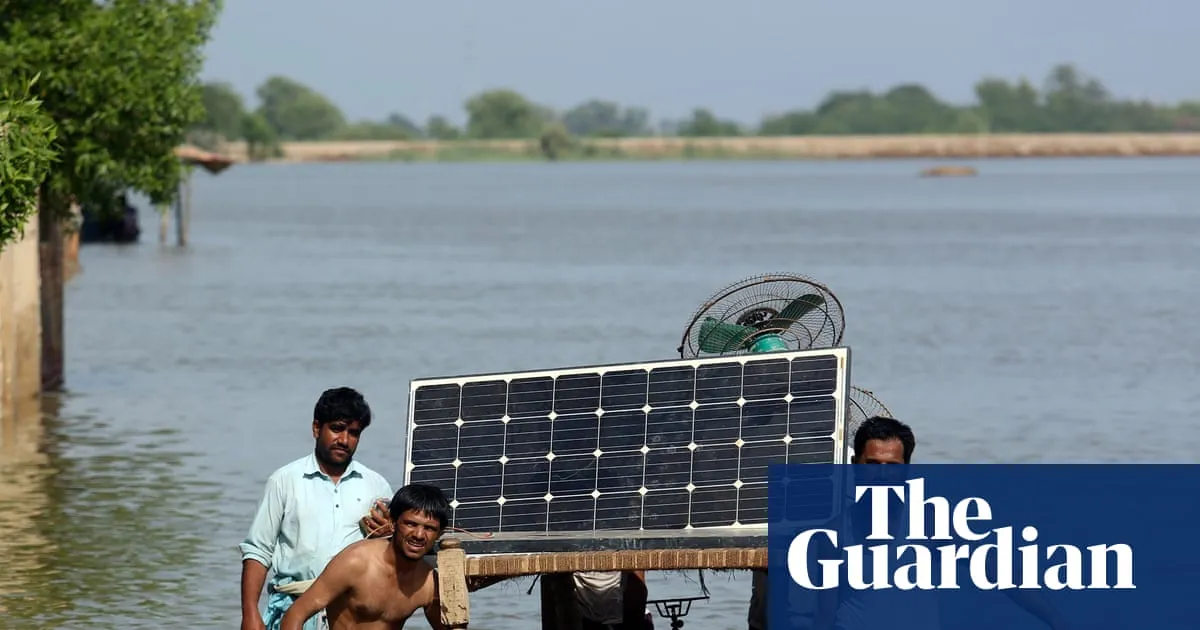
After prices of liquefied natural gas surged to record highs after Russia’s full-scale invasion of Ukraine in 2022, millions of people in Pakistan were repeatedly left without electricity. An intense heatwave and gas shortages amid record-breaking prices resulted in power cuts across the country.But people soon started to realise there was an alternative. The falling costs of solar panels and generous government incentives to feed excess power back to the grid made rooftop solar an attractive option.“People who could afford to do it at that time realised that it was much cheaper and cost-effective and better for them in the long run to do a one-time investment in rooftop solar as opposed to keep paying high electricity bills from a grid that is also unreliable,” said Nabiya Imran, an associate at Renewables First, a Pakistani thinktank.Since then, there has been a stunning surge in rooftop solar deployment in Pakistan. Aerial photos of the city of Lahore capture the scale of the bottom-up rollout. Nationwide, the share of electricity generated by solar jumped fivefold between December 2021 and December 2025, according to data from Ember, another thinktank. Renewables First estimates the figure reached about one-fifth of the country’s grid-supplied electricity in 2024.As the war in Iran chokes off a key global oil and gas trade route through the Strait of Hormuz, energy analysts say Pakistan’s solar expansion has so far insulated the power sector from the worst of the energy market disruptions.“While we’re certainly seeing some impacts, the expansion of distributed solar in the country has provided a cushioning effect against the impacts [of the energy crisis] which could have been much worse had solar not been present in the country,” Imran said.Booming solar generation has reduced the need for gas to generate electricity, especially during the day. Before the war in Iran broke out, Pakistan was diverting cargoes from a long-term supply agreement with Qatar because of falling gas demand. Liquefied natural gas (LNG) still contributes about a fifth of Pakistan’s power mix but it is mostly used to meet evening demand peaks.Analysis by Renewables First and the Centre for Research on Energy and Clean Air shows that as of February 2026, Pakistan’s solar surge had helped to avoid about $12bn in oil and gas imports.Haneea Isaad, an energy finance specialist at the Institute for Energy Economics and Financial Analysis (IEEFA), said: “Distributed solar has been a blessing for Pakistan, preventing at least any immediate supply crunches in the gas sector. Pakistan serves as a great case study as to how renewables can provide a hedge against dependence on fossil fuels.”Nonetheless, the country is still bracing for disruptions to its economy as the war in Iran continues to block tankers from shipping millions of barrels of crude oil each day, which the International Energy Agency has described as the largest supply disruption in history.Isaad said: “Pakistan is highly dependent on the Middle East for its oil and gas imports, with over 90% of its LNG and oil resources passing through the Strait of Hormuz.”In 2024 alone, Pakistan spent more than 10% of its GDP on fossil fuel imports. Soaring oil prices have pushed up prices at the pump by about 20%, which is hitting the transport sector hard and driving inflation. And disruptions to the LNG market have had an impact on the fertiliser sector.Workers unload solar panels from a lorry at a market in Rawalpindi in April 2024. Photograph: Farooq Naeem/AFP/Getty ImagesLast week the government said schools would close for two weeks and half of public sector employees would work from home, as part of a range of measures to curb fuel use.Pakistan’s power minister, Awais Leghari, told Reuters that “the people-led solar revolution” as well as government decisions to invest in nuclear, hydropower and domestic coal power had reduced the country’s vulnerability to global LNG supply disruptions. But a prolonged crisis could lead to additional shortages in the summer, when demand for air conditioning soars, he said.Imran said doubling down on investments to roll out electric vehicles, updating the grid and supporting the deployment of batteries that can store excess solar power and discharge it in the evenings would help the country reduce its dependence on fossil fuels.“If anything, the crisis will probably motivate more people to adopt rooftop solar as well as battery storage in the future. For Pakistan, and I think for a lot of other countries, the energy transition towards renewables is no longer just about climate but it’s a matter of energy security,” she added.The conflict in the Middle East has left the region particularly exposed to higher prices and fuel shortages as 80% of the oil that transits through the Strait of Hormuz is destined for Asia. Bangladesh, Myanmar and the Philippines have introduced fuel rationing measures, and in India hot food and drinks are disappearing from menus amid fears of a shortage of cooking gas.Ramnath Iyer, the Asia sustainable finance lead at IEEFA, said: “A lot of these problems could have been avoided if Asian countries had switched faster to renewables.”But the region bet on a massive build out of LNG infrastructure. India, Bangladesh, and Pakistan alone have $107bn in LNG terminals and gas pipelines that have been announced or are under construction, according to data from Global Energy Monitor.In most Asian countries, the cost of solar energy and storage is already economically competitive with the price of gas, Iyer said. “Asian economies really have every incentive to accelerate the move towards renewables. It is actually a win-win both in terms of availability as well as in terms of cost, including storage,” he said.Like Pakistan, Vietnam’s rapid expansion of its solar capacity could help the government reduce the costs of fossil fuel imports. Meanwhile in Thailand, expanding solar and battery capacity targets could save $1.8bn in power generation costs by 2037, according to Ember.In the Philippines, where prices at the pump have increased by 40%, rooftop solar combined with battery storage could help mitigate rising costs in areas that are underserved or not connected to the grid and rely on diesel power plants, said Gaspar Escobar Jr, of the Institute for Climate and Sustainable Cities, which is installing solar panels on the roofs of government buildings, hospitals and other infrastructure.Dinita Setyawati, a senior energy analyst at Ember, said Asian countries were at “a really important juncture”. “We’ve had several shocks to oil and gas in the past … but it seems that the lessons learned have not been applied seriously. Renewables, grids, but also storage, could be the holy trinity solutions for the energy dilemma for the whole of the Asia region,” she said.
SRCThe Guardian - World News
LANGEN
LEANCenter-Left
WORDS1 102
ENT12
TUE · 2026-03-17 · 13:00 GMTBRIEF NSR-2026-0317-25326
NSR-2026-0317-25326News Report·EN·Economic Impact
How Pakistan’s people-led solar boom is easing impact of Middle East energy crisis
Pakistan has experienced a significant surge in rooftop solar installations since 2022, driven by rising LNG prices following the war in Ukraine and government incentives. This shift towards solar energy has been led by individuals seeking a cheaper and more reliable alternative to the national grid, which was plagued by power cuts.
Chloé FarandThe Guardian - World NewsFiled 2026-03-17 · 13:00 GMTLean · Center-LeftRead · 5 min
The Guardian - World NewsFIG 01
Reading time
5min
Word count
1 102words
Sources cited
4cited
Entities identified
12entities
Quality score
100%
§ 01
Briefing Summary
AI-generatedNEWSAR · AI
Pakistan has experienced a significant surge in rooftop solar installations since 2022, driven by rising LNG prices following the war in Ukraine and government incentives. This shift towards solar energy has been led by individuals seeking a cheaper and more reliable alternative to the national grid, which was plagued by power cuts. The share of electricity generated by solar increased fivefold between December 2021 and December 2025, reaching approximately one-fifth of the country's grid-supplied electricity in 2024. As of February 2026, this solar expansion has helped Pakistan avoid approximately $12 billion in oil and gas imports, providing a buffer against the impacts of the Middle East energy crisis and reducing reliance on LNG for power generation, especially during daylight hours.
Confidence 0.90Sources 4Claims 4Entities 12
§ 02
Article analysis
Model · rule-basedFraming
Economic Impact
Environmental
Tone
Measured
AI-assessed
CalmNeutralAlarmist
Factuality
0.80 / 1.00
Factual
LowHigh
Sources cited
4
Well sourced
FewMany
§ 03
Key claims
4 extracted01
Renewables First estimates solar reached about one-fifth of Pakistan’s grid-supplied electricity in 2024.
statisticRenewables First
Confidence
1.00
02
Pakistan's solar surge had helped to avoid about $12bn in oil and gas imports as of February 2026.
statisticRenewables First and the Centre for Research on Energy and Clean Air
Confidence
1.00
03
Share of electricity generated by solar jumped fivefold between December 2021 and December 2025 in Pakistan.
statisticEmber
Confidence
1.00
04
Distributed solar has been a blessing for Pakistan, preventing at least any immediate supply crunches in the gas sector.
quoteHaneea Isaad, IEEFA
Confidence
0.90
§ 04
Full report
5 min read · 1 102 words§ 05
Entities
12 identifiedKey playerOppositionContextPositiveNeutralNegative
Organizations3
§ 06
Keywords & salience
9 termssolar energy
1.00
energy crisis
0.90
rooftop solar
0.80
pakistan
0.70
electricity generation
0.60
energy market
0.50
liquefied natural gas
0.50
government incentives
0.40
oil and gas imports
0.40
§ 07
Topic connections
Interactive graph Network visualization showing 51 related topics
View Full Graph Person Organization Location Event|Click node to navigate|Edge numbers = shared articles