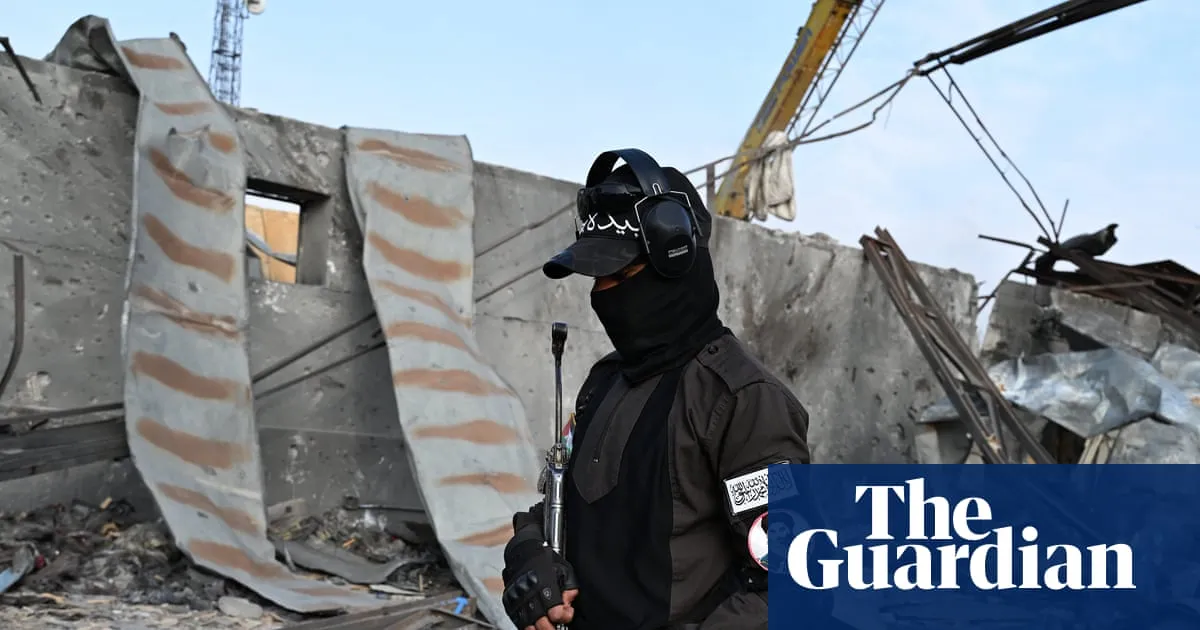
An escalating Pakistani campaign of airstrikes against targets in Afghanistan is aimed at forcing the Taliban authorities to abandon their support for Pakistani militants, according to officials and experts.The strategy is to impose such a steep cost on the Taliban administration that they act to prevent attacks emanating from Afghanistan. Yet it carries the risk of spiralling violence.Afghan authorities said on Tuesday that an overnight airstrike in Kabul had hit a drug rehabilitation centre, killing 400 people. Islamabad described that claim as propaganda, saying that the targets were “military and terrorist infrastructure”.Since the 2021 Taliban takeover, waves of terrorist attacks have pummelled Pakistan, launched from what Islamabad considers to be sanctuaries in Afghanistan. Pakistan says that its patience has snapped, naming an operation launched at the end of last month Ghazab lil-Haq or “Righteous Fury”.A senior Pakistani security official said that, as Pakistan was facing a rise in bloodshed, Afghanistan should also suffer, asking: “Why should they live in peace?”At least 400 were killed after the Pakistani missile fell on a site in Kabul. Photograph: Anadolu/Getty ImagesThe Taliban has denounced the airstrikes as a violation of sovereignty and vowed to retaliate. It has hinted at unleashing suicide bombers. “They should not think that they can martyr people in Kabul, destroy the city and disturb its security, while remaining safe in Islamabad,” the Taliban’s defence minister, Mohammad Yaqoob – son of the movement’s founder, Mullah Omar – said earlier this month.On Tuesday, Amir Khan Muttaqi, the Taliban’s foreign minister, compared the airstrike to Israel’s actions in Gaza, “repeated with full cruelty by a Muslim neighbour”.Some of the airstrikes are rumoured to have targeted Taliban leaders. Pakistan may eventually look for even more radical options.In past decades, Islamabad backed armed opposition in Afghanistan, including the Taliban. But no obvious group now exists to stage an uprising, while experts in Pakistan have said that this strategy backfired repeatedly. Islamabad has called for a more “inclusive” government in Kabul.In recent months, Pakistan also imposed other measures, such as closing the border for trade to landlocked Afghanistan and expelling hundreds of thousands of Afghan refugees.Mosharraf Zaidi, a spokesperson for Pakistan’s prime minister, Shehbaz Sharif, said that Pakistan had no quarrel with the Afghan people. He said the airstrikes were based on intelligence and as accurate as counter-terrorism operations anywhere.Mosharraf Zaidi, a spokesperson for Pakistan’s PM, gives an interview on Tuesday. Photograph: Salahuddin/Reuters“There’s one objective: protect the people of Pakistan from further terrorist attacks,” said Zaidi. “Under this[Taliban] regime, there is a clear and sustained protection, nurturing and support for terrorist groups that has to end.”Aizaz Ahmad Chaudhry, formerly Pakistan’s most senior career diplomat, said that Islamabad had tried to negotiate with the Taliban, bilaterally and with the involvement of other countries as mediators, including China and Middle Eastern nations, without results.“The Taliban are running the state as a militia, rather than a government that cares for its people,” said Chaudhry. “Pakistan’s actions are defensive, not offensive.”Asif Durrani, Pakistan’s former special envoy for Afghanistan, said that the west had washed its hands of Afghanistan with the 2021 withdrawal of foreign forces, leaving Pakistan to deal with the fallout.“Pakistan has borne the pain,” said Durrani. “This is payback time.” Durrani predicted that the Taliban government would not last, with tribal factions or other opponents emerging at some point in the future.US-led international forces, present in Afghanistan for 20 years after the 9/11 terror attacks, had accused Pakistan of harbouring the Taliban. Islamabad says that Pakistani militants are now based in Afghanistan and that Afghans have also joined them.Some analysts warned that just as those international and Afghan soldiers had failed to defeat the Taliban, a military onslaught from Pakistan would not work and had no clear off-ramp. Pakistan has always tried to avoid being sandwiched between a hostile Afghanistan to the west and the threat from its foe India to the east, a scenario it now confronts. The current US-Israeli war on Iran adds further instability along another of Pakistan’s borders.Qamar Cheema, the executive director of Sanober Institute, a thinktank in Islamabad, said that Pakistan’s current military leadership – led by Field Marshal Asim Munir – was different. Munir has been described by the US president, Donald Trump, as his “favourite field marshal”.“The military leadership at the moment has a view that we need to act hard, we need to act strong, we need to be bold and we need to deal with the threat wherever it is,” said Cheema. “Nothing is off the table.”
SRCThe Guardian - World News
LANGEN
LEANCenter-Left
WORDS748
ENT10
WED · 2026-03-18 · 00:30 GMTBRIEF NSR-2026-0318-25508
NSR-2026-0318-25508News Report·EN·National Security
Pakistan hopes steep cost of airstrikes on Taliban targets will protect against terror attacks
Pakistan has escalated airstrikes against targets in Afghanistan, aiming to pressure the Taliban to stop supporting Pakistani militants operating from Afghan territory. These strikes, which began last month under the operation "Righteous Fury," are intended to impose a high cost on the Taliban administration to deter cross-border attacks.
Saeed Shah in IslamabadThe Guardian - World NewsFiled 2026-03-18 · 00:30 GMTLean · Center-LeftRead · 3 min
The Guardian - World NewsFIG 01
Reading time
3min
Word count
748words
Sources cited
5cited
Entities identified
10entities
Quality score
100%
§ 01
Briefing Summary
AI-generatedNEWSAR · AI
Pakistan has escalated airstrikes against targets in Afghanistan, aiming to pressure the Taliban to stop supporting Pakistani militants operating from Afghan territory. These strikes, which began last month under the operation "Righteous Fury," are intended to impose a high cost on the Taliban administration to deter cross-border attacks. However, the actions risk escalating violence, with the Taliban denouncing the strikes as a violation of sovereignty and threatening retaliation. Afghanistan claims a recent strike hit a drug rehabilitation center in Kabul, killing 400, while Pakistan insists the targets were military and terrorist infrastructure. Pakistan has also closed borders and expelled Afghan refugees in recent months.
Confidence 0.90Sources 5Claims 5Entities 10
§ 02
Article analysis
Model · rule-basedFraming
National Security
Conflict
Tone
Mixed Tone
AI-assessed
CalmNeutralAlarmist
Factuality
0.70 / 1.00
Factual
LowHigh
Sources cited
5
Well sourced
FewMany
§ 03
Key claims
5 extracted01
Pakistan says that its patience has snapped, naming an operation launched at the end of last month Ghazab lil-Haq or “Righteous Fury”.
factualPakistan
Confidence
1.00
02
Since the 2021 Taliban takeover, Pakistan has experienced waves of terrorist attacks launched from Afghanistan.
factualPakistan
Confidence
0.90
03
Islamabad denies the claim that an airstrike hit a drug rehabilitation center, stating the targets were military and terrorist infrastructure.
factualIslamabad
Confidence
0.90
04
Afghan authorities claim an airstrike in Kabul hit a drug rehabilitation center, killing 400 people.
factualAfghan authorities
Confidence
0.90
05
Pakistan is conducting airstrikes against targets in Afghanistan to force the Taliban to stop supporting Pakistani militants.
factualofficials and experts
Confidence
0.90
§ 04
Full report
3 min read · 748 words§ 05
Entities
10 identifiedKey playerOppositionContextPositiveNeutralNegative
People4
Organizations1
Locations4
§ 06
Keywords & salience
10 termstaliban
1.00
pakistan
1.00
afghanistan
0.90
airstrikes
0.90
terror attacks
0.80
militants
0.70
violence
0.50
security
0.50
sovereignty
0.40
retaliation
0.40
§ 07
Topic connections
Interactive graph Network visualization showing 51 related topics
View Full Graph Person Organization Location Event|Click node to navigate|Edge numbers = shared articles