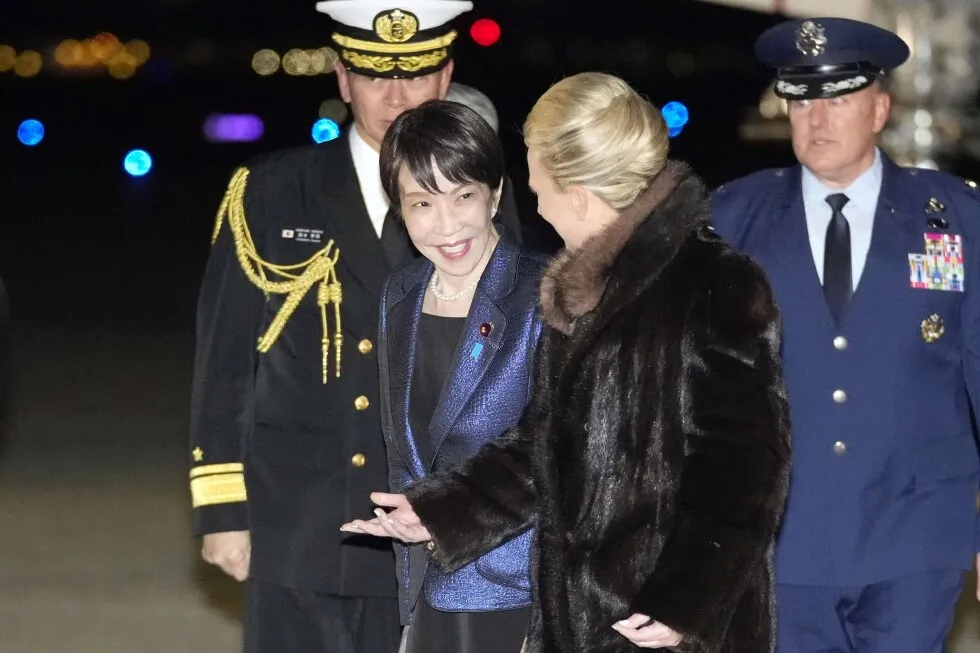
Japan’s Prime Minister Takaichi meets with Trump as he seeks help securing the Strait of Hormuz 1 of 3 | Japanese Prime Minister Sanae Takaichi, center, arrives at Joint Base Andrews, Md. Wednesday, March 18, 2026. (Yuki Sato/Kyodo News via AP) 2 of 3 | Japanese Prime Minister Sanae Takaichi, left, arrives at Joint Base Andrews, Md. Wednesday, March 18, 2026. (Yuki Sato/Kyodo News via AP) 3 of 3 | Japanese Prime Minister Sanae Takaichi gestures as U.S. President Donald Trump delivers his speech during their visit to the aircraft carrier USS George Washington at the U.S. Navy’s Yokosuka base in Yokosuka, south of Tokyo, on Oct. 28, 2025. (AP Photo/Eugene Hoshiko, File) 1 of 3 Japanese Prime Minister Sanae Takaichi, center, arrives at Joint Base Andrews, Md. Wednesday, March 18, 2026. (Yuki Sato/Kyodo News via AP) Add AP News on Google Add AP News as your preferred source to see more of our stories on Google. 2 of 3 Japanese Prime Minister Sanae Takaichi, left, arrives at Joint Base Andrews, Md. Wednesday, March 18, 2026. (Yuki Sato/Kyodo News via AP) Add AP News on Google Add AP News as your preferred source to see more of our stories on Google. 3 of 3 Japanese Prime Minister Sanae Takaichi gestures as U.S. President Donald Trump delivers his speech during their visit to the aircraft carrier USS George Washington at the U.S. Navy’s Yokosuka base in Yokosuka, south of Tokyo, on Oct. 28, 2025. (AP Photo/Eugene Hoshiko, File) Add AP News on Google Add AP News as your preferred source to see more of our stories on Google. Updated [hour]:[minute] [AMPM] [timezone], [monthFull] [day], [year] WASHINGTON (AP) — The meeting that Japanese Prime Minister Sanae Takaichi will have at the White House on Thursday originally seemed like a prime opportunity to have President Donald Trump’s ear before he embarked on a trip to China.But now, the war in Iran and Trump’s unsuccessful call for Japan and other nations to help protect the Strait of Hormuz means the China trip has been delayed and Takaichi may be likely to get an earful.Trump has repeatedly complained on camera and online that U.S. allies, including Japan, have rejected his request to help safeguard the critical waterway for oil and gas transport.“In fact, speaking as President of the United States of America, by far the Most Powerful Country Anywhere in the World, WE DO NOT NEED THE HELP OF ANYONE!” Trump exclaimed on Truth Social after his initial call for help was rebuffed. The prime minister acknowledged before she left Japan that she expects her meeting with Trump will be “very difficult.” She and her ministers have denied that Washington officially requested Japanese warships for the U.S.-Israeli operation.Japan, a key U.S. ally in Asia, is one of the countries that Trump namechecked on Tuesday as he railed against the lack of help with the Strait of Hormuz before declaring the help wasn’t needed. Trump is expected to put “enormous pressure” on Takaichi, said Kurt Campbell, the former U.S. deputy secretary of state in the Biden administration who is now chair of The Asia Group. Campbell said he’s never seen a meeting between U.S. and Japanese leaders carrying such high stakes. In order to press for Japan’s interests, he said, Takaichi will want to find a way to suggest that Japan is a part of the U.S. plan in the Middle East.“She’s going to want to come out of that as a partner in this case and realize that if she can do that, that she can translate that potentially into the president listening more to Japanese concerns about Taiwan or other issues,” Campbell said. The constraints on Japan’s involvement in Iran include a provision in its post-World War II constitution that bans the use of force except to defend its territory. The country’s military is called the Self-Defense Force.Christopher Johnstone, a partner and chair of the defense and national security practice at The Asia Group, said Japan could help with mine-sweeping, and has had “a small naval presence” in the region as part of an anti-piracy mission for at least a decade. But to join the U.S. mission would require Takaichi to clear “an exceptionally high bar politically to invoke collective self-defense” that has never been done before.Takaichi wanted to focus on trade and security in the Indo-Pacific regionTakaichi, who had her first meeting with Trump in October in Tokyo, is Japan’s first female prime minister and a protégé of former leader Shinzo Abe, who developed a close relationship with Trump.She is also a hardline conservative and longtime supporter of Taiwan whose comments about Japan’s willingness to provide military support to the island have heightened tensions with China.Ahead of her meeting with Trump, Takaichi had sought to focus on trade, strengthening the U.S.-Japan relationship and security concerns. Japanese officials said the two sides would work to deepen cooperation in regional security, critical minerals, energy and dealing with China. China views self-governed Taiwan, which the U.S. relies on for its production of computer chips, as its sovereign territory and has said it would take it by force if needed.But beyond questions about helping with the Strait of Hormuz, the global implications of the Iran war have also put the Japanese leader in a tougher spot with Trump as she seeks to ensure U.S. commitment to the Indo-Pacific region.Japan considers China a growing security threat and has pushed a military buildup on southwestern islands near the East China Sea. But the U.S. has shifted some troops stationed in Japan to the Middle East, removing a check against China’s power.Takaichi is expected to raise concerns about troop shifts with Trump because they are coming at the same time China is launching a large number of exercises around Taiwan.“This raises the prospect that — once again — the United States will be distracted and bogged down in the Middle East at a time when the deterrence problem in East Asia has never been greater,” Johnstone said.Associated Press writer Mari Yamaguchi in Tokyo contributed to this report. Price covers the White House. She previously covered the 2024 presidential campaign and politics, government and other news in New York, Nevada, Utah and Arizona. She is based in Washington. Tang joined the AP Washington bureau in 2023 after spending 11 years in Beijing as a China correspondent. She covers anything related to the Indo-Pacific region with a focus on U.S.-China competitions
SRCAssociated Press (AP)
LANGEN
LEANCenter
WORDS1 069
ENT10
THU · 2026-03-19 · 08:53 GMTBRIEF NSR-2026-0319-25967
NSR-2026-0319-25967News Report·EN·Diplomatic
Japan’s Prime Minister Takaichi meets with Trump as he seeks help securing the Strait of Hormuz
Japanese Prime Minister Sanae Takaichi met with former U.S. President Donald Trump on Thursday, March 18, 2026, in Washington D.C.
By
MICHELLE L. PRICE and DIDI TANGAssociated Press (AP)Filed 2026-03-19 · 08:53 GMTLean · CenterRead · 5 min
Associated Press (AP)FIG 01
Reading time
5min
Word count
1 069words
Sources cited
2cited
Entities identified
10entities
Quality score
100%
§ 01
Briefing Summary
AI-generatedNEWSAR · AI
Japanese Prime Minister Sanae Takaichi met with former U.S. President Donald Trump on Thursday, March 18, 2026, in Washington D.C. The meeting's original purpose was to allow Takaichi to speak with Trump before his planned trip to China. However, the meeting's focus shifted due to the war in Iran and Trump's unsuccessful call for international assistance, including from Japan, to secure the Strait of Hormuz. Trump has publicly expressed his displeasure with allies, including Japan, for declining his request to help safeguard the waterway critical for oil and gas transport. The meeting may now involve Trump voicing his concerns directly to Takaichi.
Confidence 0.90Sources 2Claims 5Entities 10
§ 02
Article analysis
Model · rule-basedFraming
Diplomatic
National Security
Tone
Measured
AI-assessed
CalmNeutralAlarmist
Factuality
0.70 / 1.00
Factual
LowHigh
Sources cited
2
Limited
FewMany
§ 03
Key claims
5 extracted01
Takaichi expects her meeting with Trump will be “very difficult.”
quoteSanae Takaichi
Confidence
1.00
02
Trump complained that U.S. allies, including Japan, rejected his request.
factualArticle
Confidence
1.00
03
Trump requested Japan and other nations to help protect the Strait of Hormuz.
factualArticle
Confidence
1.00
04
Japanese Prime Minister Sanae Takaichi met with Donald Trump to discuss the Strait of Hormuz.
factualArticle
Confidence
1.00
05
Trump is expected to put “enormous pressure” on Takaichi.
predictionKurt Campbell
Confidence
0.80
§ 04
Full report
5 min read · 1 069 words§ 05
Entities
10 identifiedKey playerOppositionContextPositiveNeutralNegative
§ 06
Keywords & salience
8 termsstrait of hormuz
1.00
japan
0.90
donald trump
0.80
sanae takaichi
0.70
u.s. allies
0.60
oil and gas transport
0.50
china trip
0.40
war in iran
0.40
§ 07
Topic connections
Interactive graph Network visualization showing 51 related topics
View Full Graph Person Organization Location Event|Click node to navigate|Edge numbers = shared articles