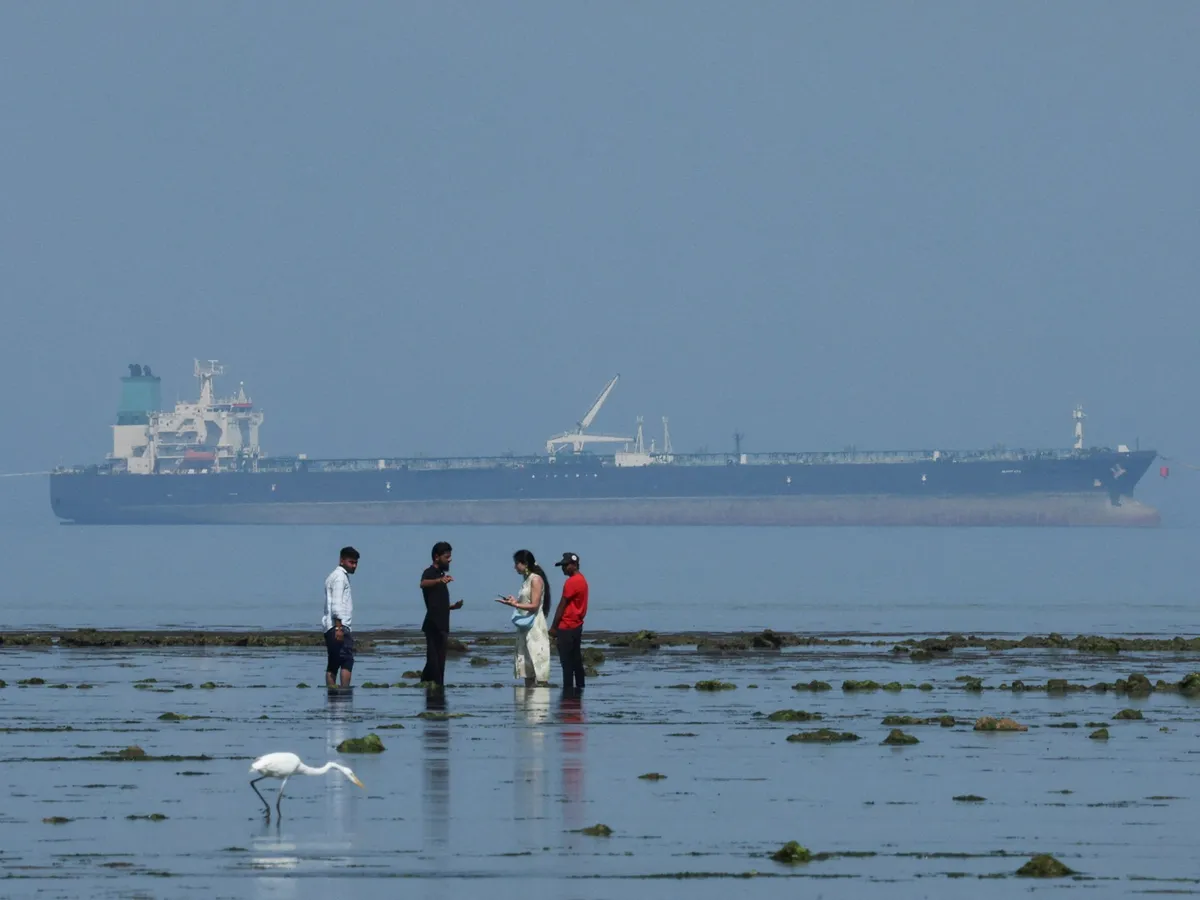
EXPLAINERThe price of Russian Urals has soared in recent weeks. How Russia – and other energy producing nations – could profit.Tourists watch marine life, with the MT Desert Kite oil tanker carrying Russian oil in the background, at Narara Marine National Park in the Arabian Sea, Gujarat, India on March 11, 2026 [File: Amit Dave/Reuters]Published On 20 Mar 2026Russian oil is emerging as a key beneficiary of the US-Israeli war on Iran, as countries scramble to charter tankers following United States President Donald Trump’s decision to temporarily ease sanctions, analysts say.Following a phone call with Russian President Vladimir Putin on March 10, Trump said the US would waive Russian oil-related sanctions on “some countries” to ease the shortage caused by Iran’s closure of the Strait of Hormuz, which in peacetime carries 20 percent of the world’s oil and gas from producers in the Gulf.This week, it was reported that a number of tankers carrying Russian oil bound for China had changed course and were heading for India instead.According to figures from the Centre for Research on Energy and Clean Air (CREA), Russia earned an additional 672 million euros ($777m) in oil sales in the first two weeks of the war on Iran, which began on February 28 when Israel and the US launched strikes on Tehran, killing Ayatollah Ali Khamenei and other senior Iranian officials.Iran has since struck back, launching thousands of missiles and drones towards Israel as well as US military assets and infrastructure in neighbouring Gulf countries. The war stepped up a level this week, when Israel bombed Iran’s critical South Pars gasfield, and Iran hit back with strikes on Gulf energy assets, including Qatar’s Ras Laffan Liquefied Natural Gas (LNG) facility – the world’s largest.(Al Jazeera)This week, the average price of Urals oil – the Russian benchmark – was significantly higher than the pre-war price of less than $60, at around $90 per barrel.Here’s more about who is buying Russian oil and which other nations might benefit from the oil crisis.Why is Russian oil benefitting from the Iran war?Iran’s effective closure of the Hormuz Strait, which is the only sea route from the Gulf to the open ocean, has “walled in” 20 million barrels of Gulf oil per day, George Voloshin, an independent energy analyst based in Paris, told Al Jazeera.This has prompted the US to, at least temporarily, ease sanctions on shipped Russian oil to slow the ensuing energy crisis and potential global price collapse. The price of Brent crude, the international benchmark, has risen to above $100 a barrel since the closure of the strait, compared with about $65 before the war began.Many analysts say a price of $200 is no longer “far-fetched”.“Russia has emerged as a primary beneficiary of the Middle East conflict due to the massive supply vacuum created by the closure of the Strait of Hormuz,” Voloshin said. “Global refiners are desperate for alternative medium-sour crudes, a need that Russia’s Urals grade specifically meets.”He added that the US decision to grant a temporary reprieve for shipped Russian oil “has provided Moscow with a critical window to maximise export volumes and oil revenues, essentially allowing Russian crude to act as the world’s primary swing supply during the Iranian blockade”.(Al Jazeera)How has the price of Russian oil been affected so far?The price of Russian Urals has surged significantly, experts say. As a result of US sanctions, the oil had been trading at below $60 a barrel for some time. However, while “Urals historically traded at a significant discount to Brent due to Western sanctions”, Voloshin said, “that gap has narrowed as demand outstrips supply”.“Since the beginning of the year, the price of Russian oil is estimated to have risen by nearly 80 percent – most recently close to $90 per barrel – and consistently trading well above the G7 price cap of $60 as buyers prioritise energy security over regulatory compliance in a high-volatility environment,” he added.Are ships changing course to deliver Russian oil to new buyers?Earlier this week, Bloomberg reported that at least seven tankers carrying Russian oil had changed course mid-voyage from China to India, citing data from Vortexa, the data analytics group.Then, Indian media quoted Rakesh Kumar Sinha, special secretary in the Ministry of Ports, Shipping and Waterways, confirming that the Aqua Titan, a Russian oil-laden tanker originally destined for China, is now expected to arrive at New Mangalore port on March 21 having been chartered by Mangalore Refinery and Petrochemicals Limited (MPCL).India was the first country to receive a time-limited exemption from the US Treasury to import Russian oil that is already at sea, Voloshin said.“There is clear evidence of a massive logistical redirection of Russian oil cargoes mid-voyage. Several tankers originally bound for Chinese ports have, indeed, switched trajectory to India. This shift is driven by India’s aggressive pursuit of discounted distressed cargoes to fill its strategic reserves and meet domestic demand, as well as the increased risk and insurance costs associated with long-haul shipments to East Asia via contested waters.”Until recently, Trump had been strongly pressuring India to stop buying Russian oil, even slapping additional 25 percent trade tariffs on India last year in punishment for doing so. This was lifted earlier this year when Trump claimed he had received assurances from India’s Prime Minister Narendra Modi that India would start buying US oil, or even Venezuelan oil seized by the US, instead.Which countries are buying Russian oil now?Indian media has reported that India’s purchases of Russian crude have surged in the past three weeks, since the war on Iran began and the Strait of Hormuz was closed.“The primary buyers of Russian oil continue to be India and China, who together now account for the vast majority of Russia’s seaborne exports,” Voloshin said.Turkiye is also a significant buyer, he added, now using Russian crude to stabilise its domestic market amid the gas shortages caused by the Israeli strikes on Iran’s South Pars field.“Additionally, a shadow fleet of ageing tankers continues to move Russian oil to smaller, less-regulated refineries across Southeast Asia and the Middle East, often through complex ship-to-ship transfers designed to obscure the origin of the crude,” he added.He said this shadow fleet is becoming the primary delivery mechanism for oil in several contested regions, meaning more buyers could appear. “Additionally, the degree of cooperation between the US and its European allies remains a wild card. If the EU continues to refuse participation in military operations near Iran, the diplomatic and economic pressure on the US to maintain the Russian oil reprieve will likely increase.”A French Navy helicopter hovers over the Deyna vessel, which is believed to be a member of the Russian shadow fleet, during an operation in the Western Mediterranean Sea, in this handout image obtained by Reuters on March 20, 2026 [Prefecture maritime de la Mediterranee/Etat Major des Armees/Handout via Reuters]Will Russian oil remain in demand if the US re-imposes sanctions?If there is nowhere else to readily source oil, countries may continue to seek Russian crude even if the US reimposes sanctions, Voloshin said. The International Energy Agency (IEA) says the closure of the Hormuz Strait has caused a shortage of 8 million barrels of oil per day.If that persists, “major importers like India may feel they have no choice but to continue buying Russian oil to prevent domestic economic collapse”, Voloshin said.If secondary sanctions on Russian oil are reintroduced, he added, buyers may demand much lower prices to compensate for the increased legal and financial risks of dealing with Moscow. “At the same time, in the presence of a continued severe market disruption, the US is very likely to roll over [extend] current exemptions,” Voloshin said.Which other energy-producing nations could benefit?Two other major non-OPEC energy producers that could benefit are Norway and Canada, experts say. However, this will largely depend on their capacity to increase production.“Norway has already signalled its intent to maintain maximum gas and oil production to support European energy security, primarily selling to EU nations seeking to replace lost Iranian and Russian volumes,” Voloshin said. “Canada is exploring ways to increase its export capacity to the US Gulf Coast. However, like Russia, its ability to significantly ramp up production in the short term is constrained by pipeline throughput and infrastructure bottlenecks.”
SRCAl Jazeera
LANGEN
LEANCenter
WORDS1 371
ENT12
FRI · 2026-03-20 · 14:48 GMTBRIEF NSR-2026-0320-26415
NSR-2026-0320-26415News Report·EN·Economic Impact
Will Russian oil be the biggest winner in the US-Israel war on Iran?
Amidst the US-Israeli war on Iran that began in late February 2026, Russian oil has become a major beneficiary. With Iran's closure of the Strait of Hormuz disrupting global oil supplies, the US has temporarily eased sanctions on Russian oil, leading to increased sales and profits for Russia.
Nina Montagu-SmithAl JazeeraFiled 2026-03-20 · 14:48 GMTLean · CenterRead · 6 min
Al JazeeraFIG 01
Reading time
6min
Word count
1 371words
Sources cited
1cited
Entities identified
12entities
Quality score
100%
§ 01
Briefing Summary
AI-generatedNEWSAR · AI
Amidst the US-Israeli war on Iran that began in late February 2026, Russian oil has become a major beneficiary. With Iran's closure of the Strait of Hormuz disrupting global oil supplies, the US has temporarily eased sanctions on Russian oil, leading to increased sales and profits for Russia. Specifically, Russia earned an additional 672 million euros in the first two weeks of the war. The price of Russian Urals oil has also risen significantly, reaching around $90 per barrel. Some tankers carrying Russian oil initially bound for China have been rerouted to India. The disruption caused by the war has created a global energy crisis, prompting the US to allow increased Russian oil exports to mitigate potential price increases.
Confidence 0.90Sources 1Claims 5Entities 12
§ 02
Article analysis
Model · rule-basedFraming
Economic Impact
Political Strategy
Tone
Mixed Tone
AI-assessed
CalmNeutralAlarmist
Factuality
0.70 / 1.00
Factual
LowHigh
Sources cited
1
Limited
FewMany
§ 03
Key claims
5 extracted01
The price of Brent crude has risen to above $100 a barrel since the closure of the strait, compared with about $65 before the war began.
factual
Confidence
1.00
02
The US would waive Russian oil-related sanctions on “some countries” to ease the shortage caused by Iran’s closure of the Strait of Hormuz.
quoteDonald Trump
Confidence
1.00
03
Iran’s effective closure of the Hormuz Strait has “walled in” 20 million barrels of Gulf oil per day.
quoteGeorge Voloshin, independent energy analyst
Confidence
0.90
04
Russia earned an additional 672 million euros ($777m) in oil sales in the first two weeks of the war on Iran.
statisticCentre for Research on Energy and Clean Air (CREA)
Confidence
0.90
05
Russian oil is emerging as a key beneficiary of the US-Israeli war on Iran.
factualanalysts
Confidence
0.80
§ 04
Full report
6 min read · 1 371 words§ 05
Entities
12 identifiedKey playerOppositionContextPositiveNeutralNegative
§ 06
Keywords & salience
8 termsrussian oil
1.00
iran war
0.90
oil price
0.80
energy crisis
0.70
strait of hormuz
0.60
sanctions
0.60
urals oil
0.50
energy assets
0.40
§ 07
Topic connections
Interactive graph Network visualization showing 51 related topics
View Full Graph Person Organization Location Event|Click node to navigate|Edge numbers = shared articles