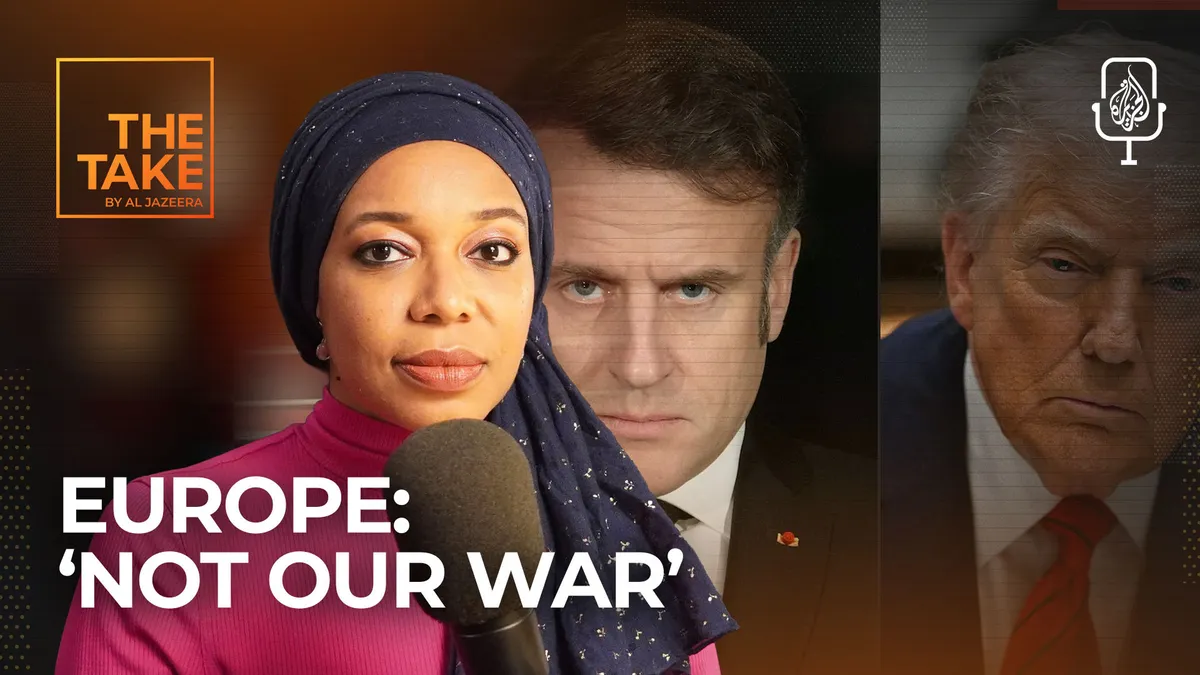
The TakeEurope is under pressure as Trump pushes allies to support the Iran war. How are they responding?As US President Donald Trump pushes deeper into war with Iran, Europe is keeping its distance, calling it “not our war”. But as strikes on Gulf energy facilities send oil and gas prices soaring, that distance is being tested. In a rare joint move, leaders from across Europe and Japan have pledged to help stabilize energy markets and ensure safe passage through the Strait of Hormuz. Can Europe stay out of the fighting while being pulled in by its economic consequences?In this episode: Sven Kühn von Burgsdorff, Former EU Diplomat Episode credits:This episode was produced by David Enders and Chloe K. Li, with Spencer Cline, Sonia Baghat, Tuleen Barakat, Catherine Nouhan and our host, Malika Bilal. It was edited by Sarí el-Khalili. Our sound designer is Alex Roldan. Our video editors are Hisham Abu Salah and Mohannad al-Melhem. Alexandra Locke is The Take’s executive producer. Connect with us:@AJEPodcasts on X, Instagram, Facebook, and YouTubePublished On 20 Mar 2026
SRCAl Jazeera
LANGEN
LEANCenter
WORDS175
ENT8
FRI · 2026-03-20 · 20:09 GMTBRIEF NSR-2026-0320-26496
NSR-2026-0320-26496News Report·EN·Conflict
Will Europe be pulled into the Iran war?
As the U.S. under President Trump escalates tensions with Iran in March 2026, Europe is attempting to maintain its distance, viewing the conflict as "not our war." However, strikes on Gulf energy facilities are causing rising oil and gas prices, impacting European economies.
Al JazeeraFiled 2026-03-20 · 20:09 GMTLean · CenterRead · 1 min
Al JazeeraFIG 01
Reading time
1min
Word count
175words
Sources cited
1cited
Entities identified
8entities
Quality score
100%
§ 01
Briefing Summary
AI-generatedNEWSAR · AI
As the U.S. under President Trump escalates tensions with Iran in March 2026, Europe is attempting to maintain its distance, viewing the conflict as "not our war." However, strikes on Gulf energy facilities are causing rising oil and gas prices, impacting European economies. Leaders from Europe and Japan have jointly pledged to stabilize energy markets and ensure safe passage through the Strait of Hormuz. The central question is whether Europe can avoid direct military involvement while grappling with the economic repercussions of the conflict. The situation presents a challenge to Europe's neutrality as it navigates the economic fallout of the U.S.-Iran conflict.
Confidence 0.90Sources 1Claims 5Entities 8
§ 02
Article analysis
Model · rule-basedFraming
Conflict
Economic Impact
Tone
Mixed Tone
AI-assessed
CalmNeutralAlarmist
Factuality
0.60 / 1.00
Mixed
LowHigh
Sources cited
1
Limited
FewMany
§ 03
Key claims
5 extracted01
Leaders from across Europe and Japan have pledged to ensure safe passage through the Strait of Hormuz.
factualArticle
Confidence
0.90
02
Leaders from across Europe and Japan have pledged to help stabilize energy markets.
factualArticle
Confidence
0.90
03
Strikes on Gulf energy facilities are sending oil and gas prices soaring.
factualArticle
Confidence
0.90
04
Europe is keeping its distance from the conflict, calling it “not our war”.
factualArticle
Confidence
0.90
05
US President Donald Trump is pushing deeper into war with Iran.
factualArticle
Confidence
0.80
§ 04
Full report
1 min read · 175 words§ 05
Entities
8 identifiedKey playerOppositionContextPositiveNeutralNegative
Organizations1
§ 06
Keywords & salience
8 termsiran war
1.00
europe
0.90
energy markets
0.70
strait of hormuz
0.60
economic consequences
0.60
us president donald trump
0.50
oil and gas prices
0.50
geopolitics
0.40
§ 07
Topic connections
Interactive graph Network visualization showing 51 related topics
View Full Graph Person Organization Location Event|Click node to navigate|Edge numbers = shared articles