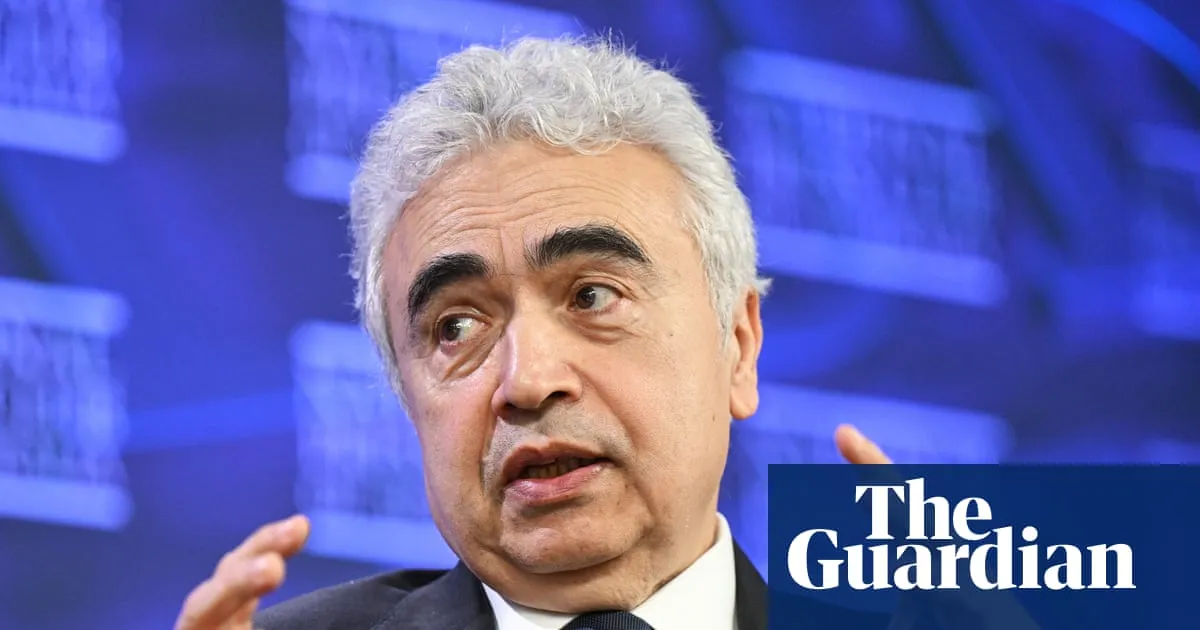
The global energy crisis caused by the war in Iran is equivalent to the combined force of the twin oil shocks of the 1970s and the fallout of Russia’s invasion of Ukraine, the head of the International Energy Agency has warned.Fatih Birol, the IEA’s executive director, said the growing fallout could be seriously compounded through interuptions to the “vital arteries of the global economy”, including petrochemicals, fertilisers, sulphur and helium.Speaking at the National Press Club of Australia in Canberra on Monday, Birol said the depth of the problems in energy markets caused by American and Israeli bombings in Iran, and the closure of the stragetic Strait of Hormuz, had not initally been properly understood by world leaders.That situation prompted his intervention last week, when the IEA pushed for demand-side measures such as increases in the number of employees working from home, a temporary lowering of speed limits on highways and reduced air travel.He warned that at least 40 energy assets in the Gulf region had been severely or very severely damaged, so even an end to the conflict would not immediately restore energy supply.Birol said that about 5m barrels of oil had been lost each day in the two crises in 1973 and 1979. Russia’s 2022 invasion of Ukraine had removed about 75bn cubic metres (bcm) of natural gas from international markets.But the current crisis, which started with bombings against the regime in Tehran on 28 February, already represented the loss of 11m barrels of oil per day and about 140 bcm of gas.Before meetings with the Australian prime minister, Anthony Albanese, Birol told journalists: “This crisis, as things stand now, is two oil crises and one gas crisis put all together.”On 11 March, Birol oversaw the release of 400m barrels of oil from strategic reserves, the largest emergency measure in its history.There was a surplus in global oil markets at the start of 2026, but strikes on ships in the Strait of Hormuz, through which about 20% of the world’s oil supply is transported, have sparked shortages and growing anxieties around the world.The US president, Donald Trump, gave Iran 48 hours to reopen the strait to shipping at the weekend, warning Tehran would face the destruction of its energy infrastructure if it failed to act. That deadline is due to expire late Monday night.Birol said the Asia Pacfic region had been badly affected by the closure. “The single most important solution to this problem is opening up the Hormuz strait,” Birol said.In response to Trump’s threat, Iran’s army said it would target energy and desalination infrastructure “belonging to the US and the regime in the region”.Map of Strait of HormuzTrump has criticised Nato members, as well as Australia, Japan and South Korea for not assisting in the strait. On Sunday, Japan said it could consider deploying its military for minesweeping efforts if a ceasefire was reached.Birol said he was consulting world leaders in Asia, Europe and North America about another possible release of emergency oil supply, noting the initial move was only 20% of overall stocks.“If needed, we can put more oil in the markets, both crude oil and products, if it is needed,” he said. “Our stock release will help to comfort the markets, but this is not the solution. It will only have to reduce the pain on the economy.”He declined to say what might trigger a further release. “We will look at the conditions. We will analyse the assessed markets and discuss with our member countries.”Asked if countries adopting defensive positions on their own fuel holdings was a concern for the world economy, Birol said such moves were a problem in Asian countries. Changes to diesel and jet fuel supply was being felt in Europe, but increased oil production in Canada and Mexico would help.He said: “I think no country will be immune to the effects of this crisis if it continues to go in this direction, so there is a need for global efforts.”
SRCThe Guardian - World News
LANGEN
LEANCenter-Left
WORDS659
ENT12
MON · 2026-03-23 · 05:04 GMTBRIEF NSR-2026-0323-29961
NSR-2026-0323-29961News Report·EN·Economic Impact
Iran war energy crisis equal to 70s twin oil shocks and fallout from Ukraine war, says IEA chief
The head of the International Energy Agency (IEA) warned that the current global energy crisis, triggered by bombings in Iran and the closure of the Strait of Hormuz on February 28th, is equivalent to the combined impact of the 1970s oil shocks and the fallout from the Ukraine war. IEA Executive Director Fatih Birol stated the crisis has resulted in the loss of 11 million barrels of oil per day and 140 billion cubic meters of gas, exceeding previous crises.
Tom McIlroy Political editorThe Guardian - World NewsFiled 2026-03-23 · 05:04 GMTLean · Center-LeftRead · 3 min
The Guardian - World NewsFIG 01
Reading time
3min
Word count
659words
Sources cited
2cited
Entities identified
12entities
Quality score
100%
§ 01
Briefing Summary
AI-generatedNEWSAR · AI
The head of the International Energy Agency (IEA) warned that the current global energy crisis, triggered by bombings in Iran and the closure of the Strait of Hormuz on February 28th, is equivalent to the combined impact of the 1970s oil shocks and the fallout from the Ukraine war. IEA Executive Director Fatih Birol stated the crisis has resulted in the loss of 11 million barrels of oil per day and 140 billion cubic meters of gas, exceeding previous crises. The IEA has urged demand-side measures and released 400 million barrels of oil from strategic reserves. The closure of the Strait of Hormuz, a vital route for 20% of global oil supply, has caused shortages and anxiety, particularly in the Asia Pacific region. The US president has given Iran a deadline to reopen the strait or face destruction of its energy infrastructure.
Confidence 0.90Sources 2Claims 5Entities 12
§ 02
Article analysis
Model · rule-basedFraming
Economic Impact
Conflict
Tone
Mixed Tone
AI-assessed
CalmNeutralAlarmist
Factuality
0.70 / 1.00
Factual
LowHigh
Sources cited
2
Limited
FewMany
§ 03
Key claims
5 extracted01
Donald Trump gave Iran 48 hours to reopen the strait to shipping.
factual
Confidence
1.00
02
About 20% of the world’s oil supply is transported through the strait of Hormuz.
statistic
Confidence
1.00
03
The IEA pushed for demand-side measures such as increases in the number of employees working from home.
factual
Confidence
1.00
04
The current crisis represents the loss of 11m barrels of oil per day and about 140 bcm of gas.
statisticFatih Birol
Confidence
0.90
05
Global energy crisis caused by war in Iran is equivalent to the combined force of the twin oil shocks of the 1970s and the fallout of Russia’s invasion of Ukraine.
quoteFatih Birol, IEA executive director
Confidence
0.90
§ 04
Full report
3 min read · 659 words§ 05
Entities
12 identifiedKey playerOppositionContextPositiveNeutralNegative
People3
Organizations2
§ 06
Keywords & salience
9 termsenergy crisis
1.00
oil shocks
0.80
iran war
0.80
ukraine war
0.70
strait of hormuz
0.70
oil supply
0.60
iea
0.50
natural gas
0.50
energy markets
0.40
§ 07
Topic connections
Interactive graph Network visualization showing 51 related topics
View Full Graph Person Organization Location Event|Click node to navigate|Edge numbers = shared articles