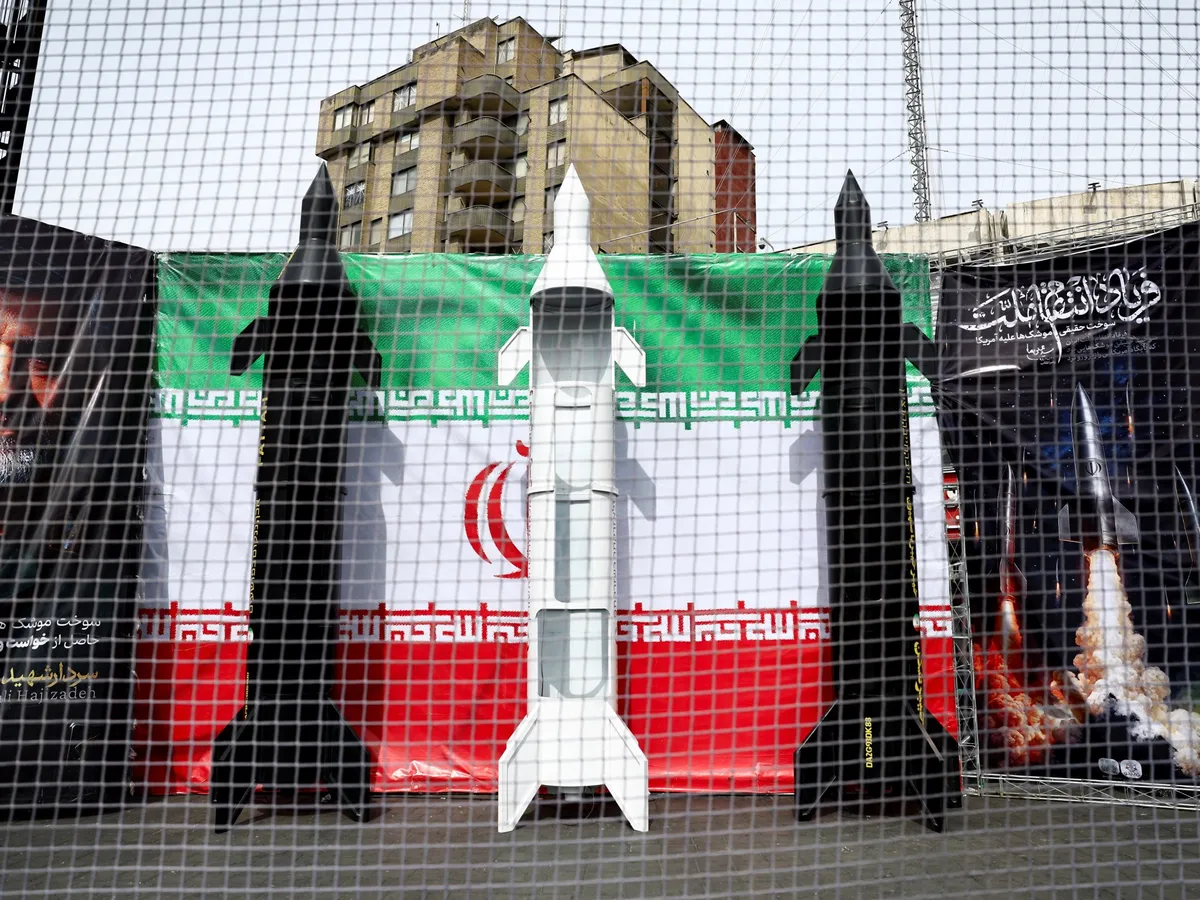
Iranian officials continue to deny any peace talks, amid reports the US sent the country a ceasefire proposal via Pakistan.Symbolic mock-ups of Iranian missiles are displayed on a street in Tehran, Iran, March 22, 2026 [Majid Asgaripour/WANA (West Asia News Agency) via Reuters]Published On 25 Mar 2026Iran’s military has said the United States is failing in its war and negotiating with itself to save face, dismissing claims by US President Donald Trump that talks are under way to end the conflict.“Has the level of your inner struggle reached the stage of you negotiating with yourself?” Ebrahim Zolfaqari, spokesperson for the unified command of Iran’s armed forces, Khatam al-Anbiya Central Headquarters, said on Wednesday in comments carried by Iran’s semiofficial Fars News Agency.Recommended Stories list of 3 itemslist 1 of 3Trump claims US has achieved ‘regime change’, ‘received present’ from Iranlist 2 of 3Trump keeps up claims of talks with ‘the right people’ in Iranlist 3 of 3Iraq to summon US, Iran envoys over deadly attacks: PM’s officeend of list“Don’t call your failure an agreement,” he added, mocking US leadership.The statement is the latest official Iranian denial that Tehran is engaged in diplomacy with Washington, even as Trump insists talks are ongoing and reports circulate of the US sending a peace proposal.Speaking to reporters at the White House yesterday, the US president said Washington is speaking to the “right people” in Iran, which he claimed wants to make a deal “so badly”.“They are talking to us, and they’re making sense,” said Trump.Trump’s position marks a stark shift from days earlier, when he threatened to strike Iran’s power plants if Tehran did not fully reopen the Strait of Hormuz, where it has threatened vessels from “enemy” nations. Hours before the ultimatum expired on Monday – and US markets reopened for the trading week – Trump said he would delay any planned attack by five days, citing diplomatic progress. Iranian officials denied this.Zolfaqari said there would be no return to previous oil prices or the prior regional order “until our will is done”.‘Obscurity in Iran’Questions over possible diplomacy were amplified by US media reports that Washington had sent Tehran a 15-point plan to end the war.The Wall Street Journal, quoting unnamed officials, reported that the plan calls on Iran to dismantle its three main nuclear sites, end any enrichment on its soil, suspend its ballistic missile programme, curb support for its regional allies and fully reopen the Strait of Hormuz. In return, Iran would have nuclear-related sanctions lifted and the US would assist the country’s civilian nuclear programme, according to the Journal.Al Jazeera’s Mohamed Vall, reporting from Tehran, said there is “total confusion” in Iran over the status of potential negotiations.“Contrary to the clarity with which Donald Trump seems to speak, there is obscurity in Iran,” said Vall. “What we hear instead are the officials and politicians here saying the complete opposite. They say there is no negotiation.“There is total confusion, total obscurity, and it’s really making this situation very interesting and very strange,” he added.While there is a “cloud of mistrust” between the US and Iran, Tehran is engaged diplomatically with several regional countries, including Pakistan, said Al Jazeera’s Tohid Asadi, also reporting from Tehran. Islamabad, which appears to have emerged as a possible mediator in the conflict, delivered the US’s plan to Tehran, according to The New York Times.“Based on my information, contrary to Trump’s claim, no direct or indirect negotiations have taken place between the two countries so far,” Reza Amiri Moghadam, Iran’s ambassador to Pakistan, said, adding that “friendly countries seek to lay the ground for dialogue between Tehran and Washington, which we hope will be fruitful in ending this imposed war”.Meanwhile, sources from Pakistan on Wednesday confirmed to Al Jazeera that Islamabad has shared the US’s ceasefire demands with Iran. “We now can confirm that senior Pakistani sources told Al Jazeera that a document given to Pakistan by the Trump administration has been presented to the Iranians by Pakistan. A response is now awaited,” Al Jazeera’s Osama Bin Javaid reported.“There have also been reports that officials from the US and Iran could meet in Islamabad in the coming days,” Javaid said.On Wednesday, a senior leader from Turkiye’s ruling AK Party told Reuters that Ankara has been “playing a role passing messages” between Tehran and Washington.Harun Armagan, a vice chairman for foreign affairs of the AK party, said the aim is to de-escalate tensions and pave the way for direct negotiations.Turkiye has strong ties with officials in the US and Iran and has been trying to position itself, along with a group of other countries, as a possible mediator. Ankara received praise from Iran’s President Masoud Pezeshkian. Turkiye plays an “important role” in solidarity with the Islamic world, Pezeshkian said on Wednesday.Amid the competing claims about negotiations, Israel continued to strike Iran, and the US reportedly prepared to send more troops to the Middle East.Israel’s military said it carried out a series of late-night strikes on infrastructure in Tehran. Iran’s Fars News Agency reported at least 12 people killed and 28 wounded in an “enemy attack” on the residential area of Varamin in southern Tehran.Iran, for its part, claimed to fire more missiles at Israel, including targeting a military base in the northern Israeli city of Safad, as well as sites in the cities of Tel Aviv, Kiryat Shmona and Bnei Brak. There were no immediate reports of casualties from that missile salvo, though an earlier rocket attack by Hezbollah killed one woman in northern Israel.Meanwhile, the US was expected to send at least 1,000 soldiers from the Army’s elite 82nd Airborne Division to the Middle East, adding to some 50,000 US soldiers already in the region, the Reuters and AP news agencies reported.“As the US is preparing for peace talks, it’s also preparing for war,” said Al Jazeera’s John Hendren from Washington, DC. “Diplomacy and military moves are going on at the same time.”
SRCAl Jazeera
LANGEN
LEANCenter
WORDS986
ENT12
WED · 2026-03-25 · 08:09 GMTBRIEF NSR-2026-0325-34581
NSR-2026-0325-34581News Report·EN·Diplomatic
US talking to itself, says Iran as Trump claims wheels of diplomacy turning
Amid ongoing conflict in March 2026, the US and Iran are publicly contradicting each other regarding diplomatic efforts. US President Trump claims that talks are underway with Iran and that a deal is desired by Tehran.
Al Jazeera StaffAl JazeeraFiled 2026-03-25 · 08:09 GMTLean · CenterRead · 4 min
Al JazeeraFIG 01
Reading time
4min
Word count
986words
Sources cited
6cited
Entities identified
12entities
Quality score
100%
§ 01
Briefing Summary
AI-generatedNEWSAR · AI
Amid ongoing conflict in March 2026, the US and Iran are publicly contradicting each other regarding diplomatic efforts. US President Trump claims that talks are underway with Iran and that a deal is desired by Tehran. However, Iranian officials, including a military spokesperson, deny any negotiations and mock the US, stating that Washington is negotiating with itself to save face from a failing war. Reports have surfaced that the US sent Iran a ceasefire proposal via Pakistan, but Iran continues to deny any peace talks. The conflicting statements highlight the ongoing tensions and lack of clear communication between the two nations.
Confidence 0.90Sources 6Claims 5Entities 12
§ 02
Article analysis
Model · rule-basedFraming
Diplomatic
Conflict
Tone
Measured
AI-assessed
CalmNeutralAlarmist
Factuality
0.70 / 1.00
Factual
LowHigh
Sources cited
6
Well sourced
FewMany
§ 03
Key claims
5 extracted01
Ebrahim Zolfaqari mocked US leadership.
factualEbrahim Zolfaqari
Confidence
1.00
02
Trump claims Washington is speaking to the “right people” in Iran.
quoteDonald Trump
Confidence
1.00
03
Iranian officials continue to deny any peace talks with the US.
factualIranian officials
Confidence
1.00
04
The Wall Street Journal reported the US plan calls on Iran to dismantle its three main nuclear sites.
factualThe Wall Street Journal
Confidence
0.90
05
The US sent Iran a ceasefire proposal via Pakistan.
factualreports
Confidence
0.70
§ 04
Full report
4 min read · 986 words§ 05
Entities
12 identifiedKey playerOppositionContextPositiveNeutralNegative
Organizations3
§ 06
Keywords & salience
9 termsus-iran relations
0.90
diplomacy
0.80
peace talks
0.70
iranian denial
0.60
ceasefire proposal
0.60
donald trump
0.60
military conflict
0.50
nuclear sites
0.40
ballistic missile programme
0.40
§ 07
Topic connections
Interactive graph No topic relationship data available yet. This graph will appear once topic relationships have been computed.