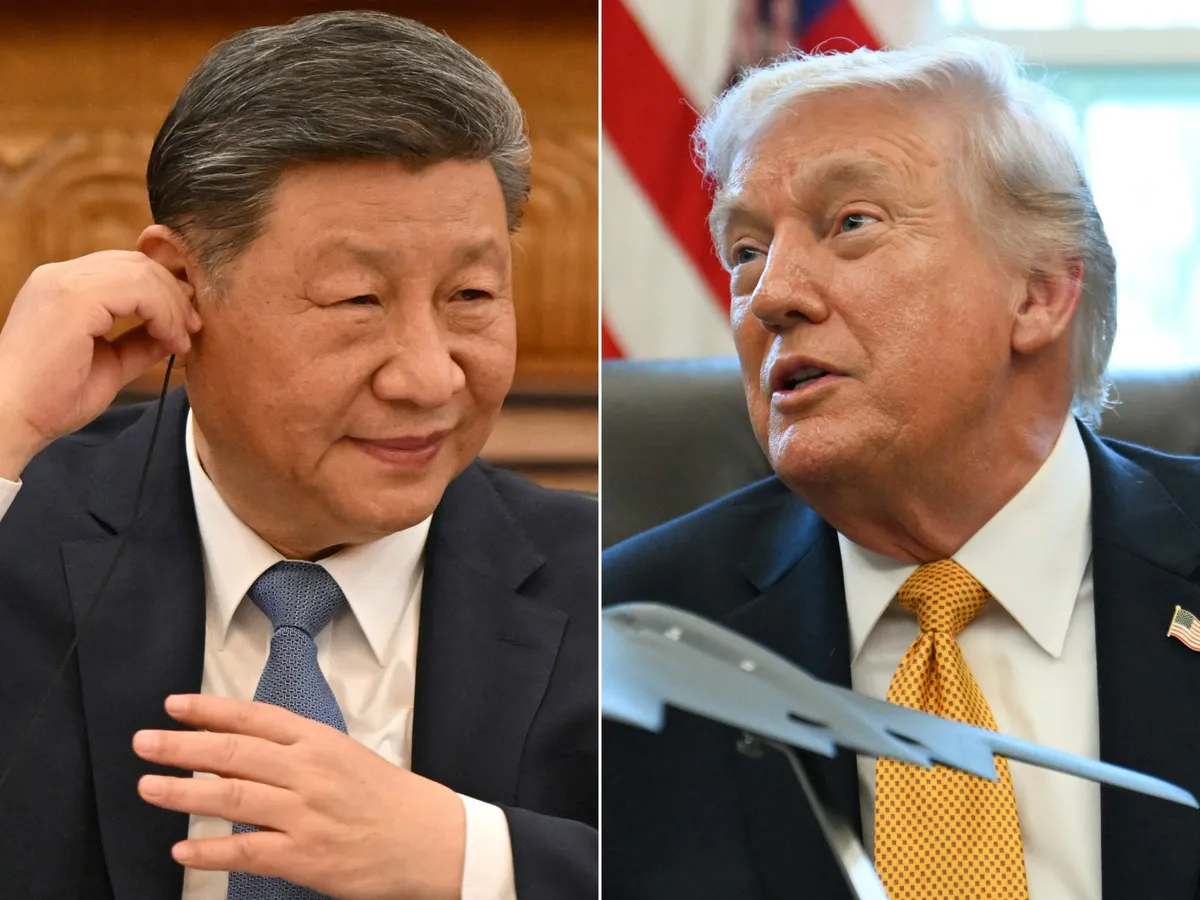
Press secretary Karoline Leavitt says Chinese President Xi Jinping will also visit US at a later date.US President Donald Trump is likely to discuss trade and international conflict with his Chinese counterpart Xi Jinping [AFP]Published On 25 Mar 2026United States President Donald Trump will travel to Beijing for a meeting with Chinese President Xi Jinping in mid-May, delaying a planned trip by several weeks as the war against Iran drags on.White House press secretary Karoline Leavitt confirmed on Wednesday that Trump’s trip will now take place on May 14 and 15, instead of its originally planned dates, from March 31 to April 2.Recommended Stories list of 3 itemslist 1 of 3US intelligence agencies not expecting China to invade Taiwan in 2027list 2 of 3Iran developing a ‘vetting system’ for Strait of Hormuz transit: Reportlist 3 of 3QatarEnergy declares force majeure on some LNG contracts due to Iran warend of listShe added that Trump and First Lady Melania Trump expect to host Xi during a visit to Washington, DC, later in the year.During Wednesday’s news briefing, Leavitt faced questions about whether the new dates for the trip symbolised that the war in Iran might be coming to a close.One reporter asked, “Did the two leaders speak about the conclusion of the war? Was that a precondition for them to have this rescheduled meeting?”Leavitt denied any such preconditions.“President Xi understood that it’s very important for the president to be here throughout these combat operations right now,” she said. “He understood, obviously, the request to postpone and accepted it, which is why we have new dates on the books.”Fighting in Iran has continued as the war approaches the one-month mark, despite repeated assurances by the White House that victory is close at hand.Iran’s continued closure of the Strait of Hormuz, a vital artery for petrol shipping, has sent shocks through the global economy, including in China. The analytics firm Kpler found that, in 2025, more than 80 percent of Iranian oil shipments were bought by Beijing, amounting to about 1.38 million barrels per day.China has called for an end to the war. Trump, meanwhile, has requested that China help reopen the Strait of Hormuz, but Beijing has so far declined to participate.“The recent tense situation in the Strait of Hormuz and waters nearby has impacted the route for international goods and energy trade, disrupting peace and stability in the region and beyond,” a Chinese Foreign Ministry spokesperson, Lin Jian, said last week.“China once again calls on parties to immediately stop military operations.”In Wednesday’s briefing, the Trump administration once again signalled that its joint operations with Israel against Iran were progressing according to plan.The US, Leavitt added, was “meeting our goals of Operation Epic Fury expeditiously”.Reporters, however, pressed Leavitt about nailing down a timeline to end combat operations. “Should we infer that the war will be wound down and concluded by the time of that May 15th, 14th visit?”“We’ve always estimated approximately four to six weeks, so you can do the math on that,” Leavitt responded.Trump and his allies have often given conflicting statements about the timeline and purpose of the war, which began when the US and Israel attacked Iran on February 28.The war is largely unpopular in the United States. In a recent Pew Research Center poll, 59 percent of respondents believe Trump’s decision to use military force against Iran was the wrong choice, while 38 percent said it was the right choice.The poll also found that respondents believed the war is not going well by a nearly two-to-one margin, and that 54 percent believe the war will continue for at least six more months despite claims of rapid progress by the White House.Leavitt did not offer further details about the upcoming talks between Trump and Xi. But continued tension over trade between the two superpowers is likely to be a prominent topic.Since his first term as president, Trump has levied steep tariffs against China in an attempt to bolster US industry and rectify what he has described as a trade imbalance.But Trump’s ability to implement sweeping tariffs has been thrown into question after a February Supreme Court ruling in the US.All the tariffs Trump had invoked under the International Emergency Economic Powers Act were deemed invalid, and the Trump administration has since resorted to a flat 10 percent tariff, based on a different authority, starting on March 1.The war in Iran is also expected to be discussed during Trump’s visit to Beijing. China has offered limited criticisms of the US war on Iran, which analysts have said could benefit the country by straining US military resources and decreasing its capacity in Asia.Trump visited China in 2017 during his first term in office, the most recent trip to the country by a US president. Trump and Xi also briefly met on the sidelines of an ASEAN summit in South Korea in October.
SRCAl Jazeera
LANGEN
OutletState media · Qatar
WORDS810
ENT11
WED · 2026-03-25 · 20:20 GMTBRIEF NSR-2026-0325-35803
NSR-2026-0325-35803News Report·EN·Diplomatic
Trump to visit Xi Jinping in China on May 14 and 15 after Iran war delay
In May 2026, US President Donald Trump will meet with Chinese President Xi Jinping in Beijing on May 14 and 15. The meeting was rescheduled from its original late March/early April dates due to the ongoing war in Iran.
Al Jazeera StaffAl JazeeraFiled 2026-03-25 · 20:20 GMTOutlet · State media · QatarRead · 4 min
Al JazeeraFIG 01
Reading time
4min
Word count
810words
Sources cited
4cited
Entities identified
11entities
NEWSAR · AI
In May 2026, US President Donald Trump will meet with Chinese President Xi Jinping in Beijing on May 14 and 15. The meeting was rescheduled from its original late March/early April dates due to the ongoing war in Iran. Press Secretary Karoline Leavitt stated that Xi Jinping will visit Washington, DC, later in the year. Discussions between the two leaders are expected to cover trade and international conflicts. China has called for an end to the war in Iran, which has disrupted global oil shipments through the Strait of Hormuz, a vital route for international goods and energy trade. Trump has requested China's assistance in reopening the Strait, but Beijing has so far declined.
Confidence 0.90Sources 4Claims 5Entities 11
Framing
Diplomatic
National Security
Tone
Measured
AI-assessed
CalmNeutralAlarmist
Factuality
0.70 / 1.00
Factual
LowHigh
Sources cited
4
Well sourced
FewMany
01
The recent tense situation in the Strait of Hormuz has impacted the route for international goods and energy trade.
quoteLin Jian
Confidence
1.00
02
China has called for an end to the war.
factualArticle
Confidence
1.00
03
Trump and First Lady Melania Trump expect to host Xi during a visit to Washington, DC, later in the year.
factualKaroline Leavitt
Confidence
1.00
04
Trump's trip will now take place on May 14 and 15.
factualKaroline Leavitt
Confidence
1.00
05
Donald Trump will travel to Beijing for a meeting with Xi Jinping in mid-May.
factualArticle
Confidence
1.00
§ 04
Full report
4 min read · 810 wordsKey playerOppositionContextPositiveNeutralNegative
People3
Organizations1
us-china relations
0.90
iran war
0.80
xi jinping
0.70
donald trump
0.70
strait of hormuz
0.60
trade
0.60
international conflict
0.60
global economy
0.50
oil shipments
0.50
beijing
0.40
§ 07
Connections
Who appears together in the newsIn this articleWider coverageLine weight = articles in common
Laying out network…
Strongest ties articles in common
- 15,001
- 12,267
- 7,768
- 4,854
- 3,992
- 3,563
Recurring context not named in this article
- LIsraellinks 11
- LMiddle Eastlinks 11
- LRussialinks 11
- LUnited Kingdomlinks 11
- LLebanonlinks 11
- OEuropean Unionlinks 11
- LPakistanlinks 11
- LUkrainelinks 11