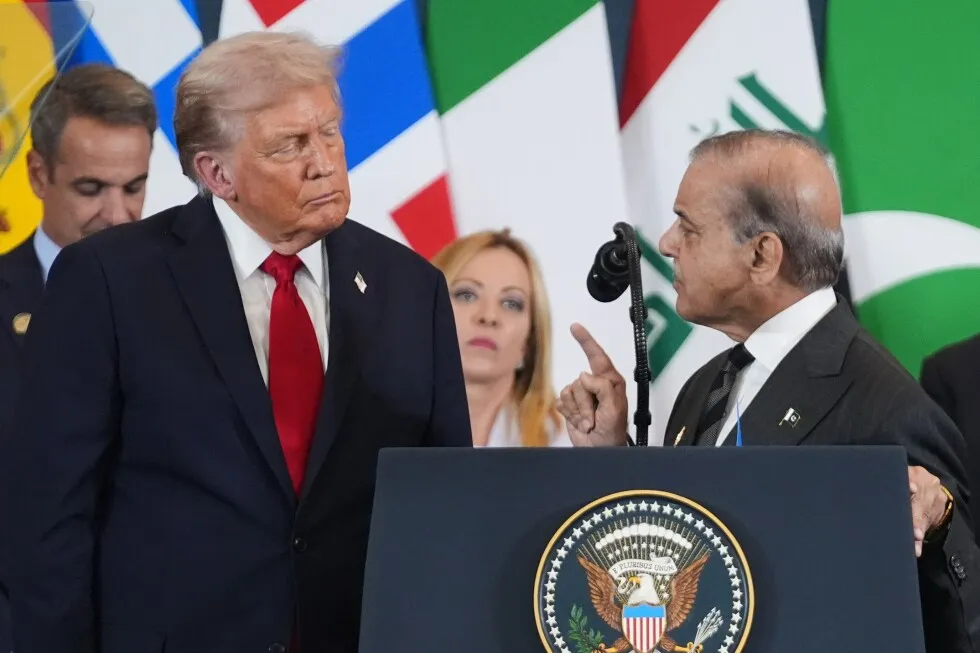
Why Pakistan has emerged as a mediator between US and Iran 1 of 5 | Pakistan has emerged as an unexpected mediator in the Iran war, offering to help bring Washington and Tehran to the negotiating table. (Produced by Elaine Carroll) 2 of 5 | President Donald Trump, left, listens as Pakistan’s Prime Minister Shehbaz Sharif speaks during a summit to support ending the more than two-year Israel-Hamas war in Gaza after a breakthrough ceasefire deal, on Oct. 13, 2025, in Sharm El Sheikh, Egypt. (AP Photo/Evan Vucci, File) 3 of 5 | In this photo released by Pakistan Prime Minister Office, Pakistan’s Prime Minister Shahbaz Sharif, left, and Iran’s President Ebrahim Raisi meet during an inauguration of the Mand-Pishin border in Pishin, border of Pakistan-Iran, on May 18, 2023. (Pakistan Prime Minister Office via AP, File) 4 of 5 | Paramilitary soldiers take positions at the U.S. Consulate after protesters stormed the building in Karachi, Pakistan, on March 1, 2026. (AP Photo/Ali Raza, File) 5 of 5 | In this photo released by the Inter Services Public Relations, newly elevated Field Marshal General Asim Munir prays after laying wreath on the Martyrs monument during a special guard of honor ceremony at General Headquarters, in Rawalpindi, Pakistan, May 21, 2025. (Inter Services Public Relations via AP, File) 1 of 5 Pakistan has emerged as an unexpected mediator in the Iran war, offering to help bring Washington and Tehran to the negotiating table. (Produced by Elaine Carroll) Add AP News on Google Add AP News as your preferred source to see more of our stories on Google. 2 of 5 President Donald Trump, left, listens as Pakistan’s Prime Minister Shehbaz Sharif speaks during a summit to support ending the more than two-year Israel-Hamas war in Gaza after a breakthrough ceasefire deal, on Oct. 13, 2025, in Sharm El Sheikh, Egypt. (AP Photo/Evan Vucci, File) Add AP News on Google Add AP News as your preferred source to see more of our stories on Google. 3 of 5 In this photo released by Pakistan Prime Minister Office, Pakistan’s Prime Minister Shahbaz Sharif, left, and Iran’s President Ebrahim Raisi meet during an inauguration of the Mand-Pishin border in Pishin, border of Pakistan-Iran, on May 18, 2023. (Pakistan Prime Minister Office via AP, File) Add AP News on Google Add AP News as your preferred source to see more of our stories on Google. 4 of 5 Paramilitary soldiers take positions at the U.S. Consulate after protesters stormed the building in Karachi, Pakistan, on March 1, 2026. (AP Photo/Ali Raza, File) Add AP News on Google Add AP News as your preferred source to see more of our stories on Google. 5 of 5 In this photo released by the Inter Services Public Relations, newly elevated Field Marshal General Asim Munir prays after laying wreath on the Martyrs monument during a special guard of honor ceremony at General Headquarters, in Rawalpindi, Pakistan, May 21, 2025. (Inter Services Public Relations via AP, File) Add AP News on Google Add AP News as your preferred source to see more of our stories on Google. Updated [hour]:[minute] [AMPM] [timezone], [monthFull] [day], [year] ISLAMABAD (AP) — As fears of a wider regional conflict escalate following U.S. and Israeli strikes on Iran that began in late February, Pakistan has emerged as an unexpected mediator, offering to help bring Washington and Tehran to the negotiating table.Islamabad isn’t often called on to act as an intermediary in high-stakes diplomacy, but it’s stepped into the role this time for a number of reasons, both because it has relatively good ties with both Washington and Tehran and because it has a lot at stake in seeing the war resolved.Pakistani government officials have said that their public peace effort follows weeks of quiet diplomacy, though they have provided few details. They have also said that Islamabad stands ready to host talks between representatives from the U.S. and Iran.Here’s what to know about Pakistan’s mediation effort: Pakistan helped US deliver 15-point plan to IranPakistan’s role in Iran-U.S. negotiations surfaced only days ago following media reports. Officials in Islamabad later acknowledged that a U.S. proposal had been conveyed to Iran.It remains unclear who has served as Iran’s point of contact in the indirect talks. Iran has maintained it has not held such talks and dismissed the U.S. proposal, but Tehran has acknowledged responding with its own proposals.According to Pakistani officials, U.S. messages are being passed to Iran and Iranian responses relayed to Washington, though they did not specify how the process is being handled or who is directly communicating with whom. Pakistan’s Foreign Minister Ishaq Dar said this week that Turkey and Egypt are also working behind the scenes to bring the sides to the negotiating table. Abdullah Khan, managing director of the Pakistan Institute for Conflict and Security Studies, said that Pakistani’s mediation efforts may be contributing to relative restraint in the conflict. He noted that U.S. President Donald Trump has delayed his threats of large-scale attacks on Iran’s energy infrastructure citing diplomatic progress, and Iranian responses toward U.S. interests in the Gulf have been measured in what may be an effort to preserve space for diplomacy. Ties with both US and Iran set Pakistan up for new rolePrevious US-Iran negotiations have been facilitated mainly by countries in the Middle East, including Oman and Qatar, but as they come under Iranian fire during the war Pakistan has stepped into the role. Analysts say Pakistan’s geographic proximity to Iran — it’s one of its neighbors — coupled with its longstanding ties with the U.S., gives it a unique position at a time when direct communication between the two sides remains constrained. Islamabad has good working relations with most of the key parties in the war, including both the U.S. and Iran. It has close strategic ties with Gulf states including Saudi Arabia, with which it signed a defense cooperation agreement last year. However, Pakistan has no diplomatic relations with Israel because of the lingering issue of Palestinian statehood. Relations between the United States and Pakistan have improved since last year, with increased diplomatic engagement and expanding economic ties. Pakistan also joined Trump’s Board of Peace, which aims to ensure peace in Gaza, despite opposition from Islamists at home. Over the weekend, Trump spoke to the Pakistani army chief Field Marshal Asim Munir, whom the U.S. president has publicly described as his “favorite Field Marshal.” Analysts say he’s a player who enjoys good ties with both the Iranian and U.S. militaries. Pakistan has a lot at stake in ceasefire talksThe conflict poses some of “the biggest economic and energy security challenges” in Pakistan’s history, said Islamabad-based security analyst Syed Mohammad Ali.The country gets most of its oil and gas from the Middle East — and, he said, the five million Pakistanis working in the Arab world send home remittances each year roughly equal to the country’s total export earnings.Rising tensions have already contributed to higher global oil prices, forcing Pakistan to increase fuel prices by about 20% and putting pressure on the government of Prime Minister Shehbaz Sharif. The war is also adding to domestic turmoil, even as Pakistan has been grappling for months with its own conflict with neighboring Afghanistan. Islamabad has accused the country’s Taliban government of tolerating militant groups that are behind attacks in Pakistan. Earlier this month, protests erupted across the country following U.S. strikes on Iran, with demonstrators clashing with security forces in several cities.A day after the United States and Israel attacked Iran, killing Supreme Leader Ayatollah Ali Khamenei, clashes erupted in Pakistan’s southern port city of Karachi and in parts of the north, leaving at least 22 people dead and more than 120 injured nationwide. At least 12 people were killed in and around the U.S. Consulate in Karachi after a mob breached the compound and attempted to set it on fire.Khamenei was a central religious and political figure for Shiites worldwide, including in Pakistan. Pakistan has a record as a mediatorWhile Pakistan rarely serves as a mediator, its record does include playing a role in some very high-profile talks.Pakistan’s then-President Gen. Yahya Khan facilitated backchannel contacts that led to U.S. President Richard Nixon’s historic 1972 visit to China. That paved the way for the establishment of diplomatic ties between Washington and Beijing in 1979. Since then, Pakistan has played a role in several other complex regional conflicts, most notably during the 1988 Geneva Accords that paved the way for the Soviet withdrawal from Afghanistan. Acting as a frontline state and key interlocutor, Islamabad participated in U.N.-brokered negotiations while working closely with the United States and other stakeholders and helped increase pressure on Moscow to pull out its forces. More recently, Pakistan facilitated contacts between the Afghan Taliban and Washington that led to talks in Doha that culminated in a 2020 agreement and set the stage for the withdrawal of U.S.-led NATO troops and the Taliban’s return to power in 2021.___Castillo reported from Beijing.
SRCAssociated Press (AP)
LANGEN
LEANCenter
WORDS1 494
ENT12
FRI · 2026-03-27 · 08:23 GMTBRIEF NSR-2026-0327-38657
NSR-2026-0327-38657News Report·EN·Diplomatic
Why Pakistan has emerged as a mediator between US and Iran
Pakistan has positioned itself as a potential mediator between the United States and Iran, offering to facilitate negotiations. The article references past meetings between Pakistani and Iranian leaders, including Prime Minister Shahbaz Sharif and President Ebrahim Raisi in May 2023.
By
MUNIR AHMED and E. EDUARDO CASTILLOAssociated Press (AP)Filed 2026-03-27 · 08:23 GMTLean · CenterRead · 6 min
Associated Press (AP)FIG 01
Reading time
6min
Word count
1 494words
Sources cited
0cited
Entities identified
12entities
Quality score
100%
§ 01
Briefing Summary
AI-generatedNEWSAR · AI
Pakistan has positioned itself as a potential mediator between the United States and Iran, offering to facilitate negotiations. The article references past meetings between Pakistani and Iranian leaders, including Prime Minister Shahbaz Sharif and President Ebrahim Raisi in May 2023. A photo also shows President Donald Trump listening to Prime Minister Sharif at a summit in Egypt in October 2025, focused on the Israel-Hamas war. The article also includes a photo of paramilitary soldiers at the U.S. Consulate in Karachi after a protest in March 2026. The reasons behind Pakistan's emergence as a mediator are not explicitly stated in the provided text.
Confidence 0.90Claims 4Entities 12
§ 02
Article analysis
Model · rule-basedFraming
Diplomatic
National Security
Tone
Measured
AI-assessed
CalmNeutralAlarmist
Factuality
0.80 / 1.00
Factual
LowHigh
Sources cited
0
No named sources
FewMany
§ 03
Key claims
4 extracted01
Pakistan’s PM Shahbaz Sharif and Iran’s President Ebrahim Raisi met in May 2023.
factualPakistan Prime Minister Office
Confidence
1.00
02
President Donald Trump listens as Pakistan’s PM Shehbaz Sharif speaks at a summit in Egypt.
factualAP Photo/Evan Vucci
Confidence
1.00
03
Pakistan is offering to help bring Washington and Tehran to the negotiating table.
factualArticle
Confidence
0.90
04
Pakistan has emerged as an unexpected mediator in the Iran war.
factualArticle
Confidence
0.90
§ 04
Full report
6 min read · 1 494 words§ 05
Entities
12 identifiedKey playerOppositionContextPositiveNeutralNegative
People4
Organizations1
§ 06
Keywords & salience
8 termspakistan
0.90
mediation
0.90
iran
0.80
united states
0.80
negotiating table
0.70
ceasefire deal
0.50
israel-hamas war
0.50
sharm el sheikh
0.40
§ 07
Topic connections
Interactive graph Network visualization showing 51 related topics
View Full Graph Person Organization Location Event|Click node to navigate|Edge numbers = shared articles