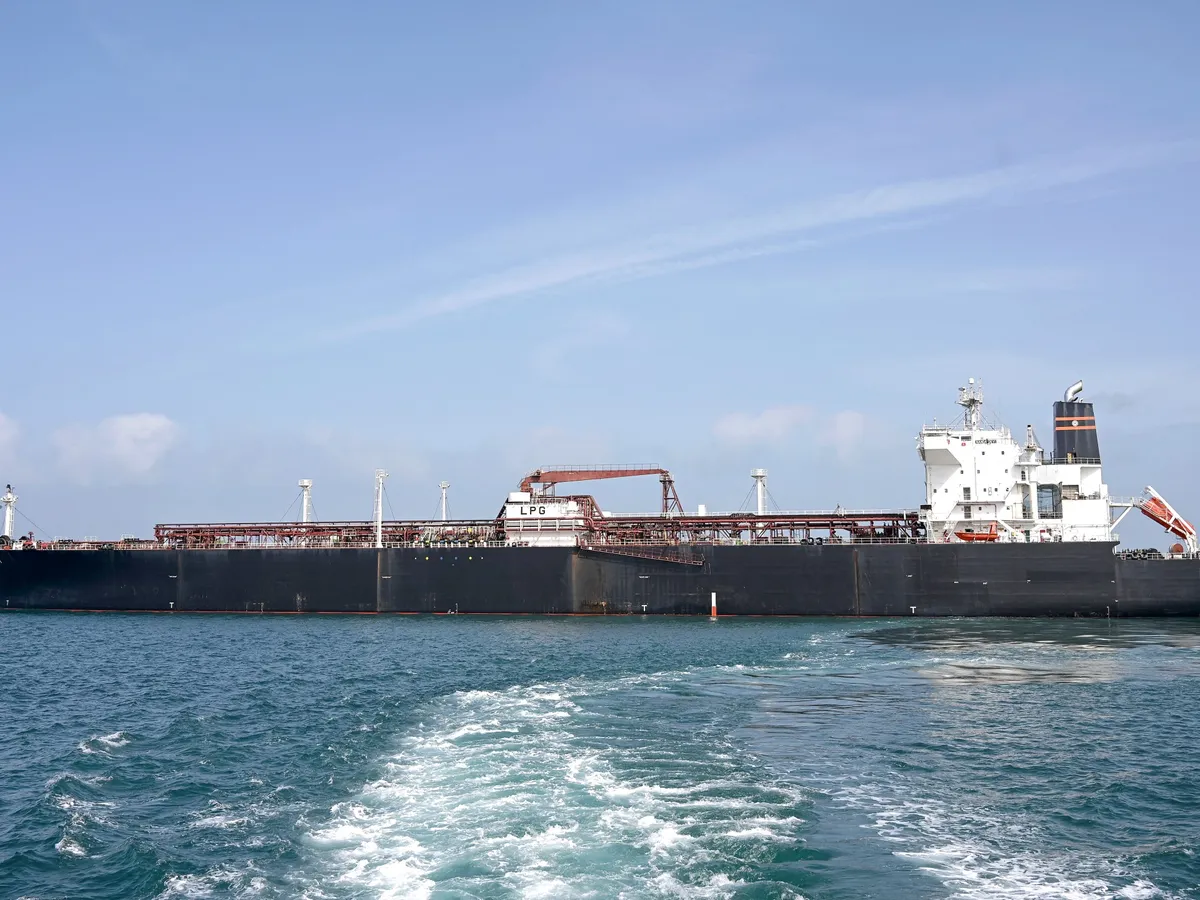
EXPLAINERCountries in the Middle East have ramped up oil exports via pipeline to bridge the Strait of Hormuz gap.Indian vessel the Nanda Devi, carrying liquefied petroleum gas (LPG) arrives at Vadinar Port in the Jamnagar district of Gujarat state on March 17, 2026 after Iran allowed it to pass through the Strait of Hormuz [AFP]Published On 27 Mar 2026As the United States-Israeli war on Iran enters its fourth week this weekend, pressure on oil and gas markets continues to mount due to severe disruption to shipping traffic through the Strait of Hormuz as well as attacks on and around key energy facilities in the Gulf.In peacetime, 20 percent of the world’s oil and gas is shipped from producers in the Gulf through the Strait of Hormuz – the only route to the open ocean – including 20 million barrels of oil per day.To bridge the shortage its closure has caused, countries in the Middle East are exploring alternative routes to get energy exports out.In this explainer, we look at three major pipelines in the Middle East that producers may be pinning their hopes on, and whether they can fill the gap.What has happened in the Strait of Hormuz?On March 2 – two days after the US and Israel began strikes on Iran – Ebrahim Jabari, a senior adviser to the commander-in-chief of Iran’s Islamic Revolutionary Guard Corps (IRGC), announced that the strait was “closed”. If any vessels tried to pass through, he said, the IRGC and the navy would “set those ships ablaze”. Since then, traffic through the strait has plunged by more than 95 percent.Iranian officials have most recently stated that the strait is not completely closed – except to ships belonging to the US, Israel and those who collaborate with them – but have also laid down new ground rules. Any vessel must secure Tehran’s approval to transit through the narrow waterway.As a result, over the past fortnight, countries have been scrambling to do deals with Iran to secure safe passage and a few, mostly Indian, Pakistani and Chinese-flagged tankers have been allowed to pass.On Thursday, Malaysian Prime Minister Anwar Ibrahim thanked Tehran for granting Malaysian vessels “early clearance” through the strait.Meanwhile, about 2,000 ships flying the flags of other nations are stuck on either side of the strait.(Al Jazeera)Which oil pipelines could serve as alternate routes?The only alternative to shipping oil is piping it across land or under the sea. Three oil pipelines could work as ways around the Strait of Hormuz, including:Saudi Arabia’s East-West PipelineThe East-West pipeline is also known as the Petroline and is operated by Saudi oil giant Aramco. Aramco is one of the world’s largest companies, with a market capitalisation exceeding $1.7 trillion and annual revenues of $480bn. The oil giant controls 12 percent of global oil production, with a capacity of more than 12 million bpd.It is a 1,200km (745-mile) pipeline which runs from the Abqaiq oil processing centre close to the Gulf in Saudi Arabia to the Yanbu port on the Red Sea, on the other side of the country.However, the pipeline does not have the capacity to fully make up for the Hormuz closure.In 2024, about 20 million barrels per day (bpd) passed through the Strait of Hormuz, according to data from the United Nations. Crude oil and condensate made up 14 million bpd of this, while petroleum was the remaining 6 million bpd.The East-West pipeline has the capacity of transporting up to 7 million bpd. On March 10, Aramco said about 5 million bpd could be made available for exports, while the rest could supply local refineries.Since the US-Israeli war on Iran began at the end of February, Saudi Arabia has ramped up its oil flow through this pipeline. In January and February, an average of 770,000 bpd flowed through the pipeline, according to data from Kpler, a data and analytics company. By Tuesday this week, this had increased to an average of 2.9 million bpd.However, using the Saudi pipeline still carries a risk.The Houthis, an Iran-backed Yemeni armed group whose attacks on ships in the Red Sea caused global shipping chaos during Israel’s genocidal war in Gaza from 2023 to 2025, could target the Bab al-Mandeb Strait, which connects the Red Sea to the Gulf of Aden, and the Indian Ocean beyond.An unnamed Houthi leader told the Reuters news agency that the Houthis remain ready to attack the Red Sea again in solidarity with Tehran, the agency reported on Thursday.“We stand fully militarily ready with all options. As for other details having to do with determining zero hour they are left to leadership and we are monitoring and following up with the developments and will know when is the suitable time to move,” the Houthi leader said.The Bab al-Mandeb is the southern outlet of the Red Sea, situated between Yemen on the Arabian Peninsula and Djibouti and Eritrea on the African coast.It is one of the world’s most important routes for global seaborne commodity shipments, particularly crude oil and fuel from the Gulf bound for the Mediterranean via the Suez Canal or the SUMED pipeline on Egypt’s Red Sea coast, as well as commodities bound for Asia, including Russian oil.The Bab al-Mandeb is 29km (18 miles) wide at its narrowest point, limiting traffic to two channels for inbound and outbound shipments.Iran could open a new front in the Bab al-Mandeb Strait if attacks are carried out on Iranian territory or its islands, Iran’s semiofficial Tasnim cited an unnamed Iranian military source as saying on Wednesday.(Al Jazeera)UAE’s Abu Dhabi Crude Oil PipelineThe Abu Dhabi Crude Oil Pipeline is also called the ADCOP or the Habshan-Fujairah pipeline.The 380km pipeline runs from Habshan, an oil and gasfield in the southwestern area of Abu Dhabi, United Arab Emirates, to the port of Fujairah on the Gulf of Oman.The pipeline, which became operational in 2012, has a capacity of about 1.5 million barrels per day (bpd). It is unclear how much is now being transported through the pipeline.However, oil exports from Fujairah do appear to have risen in the past month despite the closure of the strait, averaging 1.62 million bpd in March compared with 1.17 million bpd in February, according to Kpler analyst Johannes Rauball, who spoke to Reuters.Iraq-Turkiye Crude Oil PipelineThe Iraq-Turkiye Crude Oil Pipeline, also called the Kirkuk-Ceyhan Pipeline, links Iraq to the Mediterranean coast of Turkiye.The pipeline, which has the capacity of 1.6 million bpd, currently carries about 200,000bpd.Iraq is among the top five global producers of oil and is the second largest within the Organization of the Petroleum Exporting Countries (OPEC), exceeding 4 million bpd.Can these pipelines replace the Strait of Hormuz?No. While these pipelines can take on some of the capacity of Hormuz, their combined capacity is only about 9 million bpd, compared with about 20 million bpd for the strait.Additionally, these pipelines are land-based and within the range of Iranian missiles and drones, which makes them just as vulnerable to attacks and damage in the ongoing conflict as ships travelling through the strait. Throughout the war, energy infrastructure all over the Gulf has suffered strikes.Are there other options?Theoretically, oil can be transported on trucks, but this is costly, slow and inefficient.A standard truck can carry anywhere between 100 to 700 barrels per day, depending on the number of trips. Hundreds of thousands of barrels would be needed to meet needs, requiring thousands of trucks, which could also be targeted in strikes.
SRCAl Jazeera
LANGEN
LEANCenter
WORDS1 235
ENT12
FRI · 2026-03-27 · 13:27 GMTBRIEF NSR-2026-0327-39336
NSR-2026-0327-39336Analysis·EN·Economic Impact
Saudi, UAE, Iraq: Can three pipelines help oil escape Strait of Hormuz?
Due to the ongoing US-Israeli war on Iran in March 2026, traffic through the Strait of Hormuz has drastically decreased, disrupting global oil and gas shipments. The Strait, which normally sees 20% of the world's oil and gas pass through, is now heavily restricted by Iran.
Sarah ShamimAl JazeeraFiled 2026-03-27 · 13:27 GMTLean · CenterRead · 5 min
Al JazeeraFIG 01
Reading time
5min
Word count
1 235words
Sources cited
4cited
Entities identified
12entities
Quality score
100%
§ 01
Briefing Summary
AI-generatedNEWSAR · AI
Due to the ongoing US-Israeli war on Iran in March 2026, traffic through the Strait of Hormuz has drastically decreased, disrupting global oil and gas shipments. The Strait, which normally sees 20% of the world's oil and gas pass through, is now heavily restricted by Iran. To mitigate the resulting energy shortage, Middle Eastern countries are exploring alternative export routes, specifically oil pipelines. Three major pipelines are being considered as potential solutions to bypass the Strait of Hormuz and maintain oil exports. While some countries have negotiated limited passage through the Strait with Iran, thousands of ships remain stranded, highlighting the urgency of alternative routes.
Confidence 0.90Sources 4Claims 5Entities 12
§ 02
Article analysis
Model · rule-basedFraming
Economic Impact
Political Strategy
Tone
Mixed Tone
AI-assessed
CalmNeutralAlarmist
Factuality
0.70 / 1.00
Factual
LowHigh
Sources cited
4
Well sourced
FewMany
§ 03
Key claims
5 extracted01
Aramco controls 12 percent of global oil production, with a capacity of more than 12 million bpd.
statisticAl Jazeera
Confidence
1.00
02
The East-West pipeline is a 1,200km (745-mile) pipeline which runs from the Abqaiq oil processing centre to Yanbu.
factualAl Jazeera
Confidence
1.00
03
Ebrahim Jabari announced that the Strait of Hormuz was “closed”.
quoteEbrahim Jabari, senior adviser to the commander-in-chief of Iran’s Islamic Revolutionary Guard Corps (IRGC)
Confidence
1.00
04
20 percent of the world’s oil and gas is shipped from producers in the Gulf through the Strait of Hormuz in peacetime.
statisticAl Jazeera
Confidence
1.00
05
Traffic through the Strait of Hormuz has plunged by more than 95 percent.
statisticAl Jazeera
Confidence
0.90
§ 04
Full report
5 min read · 1 235 words§ 05
Entities
12 identifiedKey playerOppositionContextPositiveNeutralNegative
§ 06
Keywords & salience
10 termsstrait of hormuz
1.00
oil exports
0.80
pipelines
0.80
middle east
0.70
energy facilities
0.60
shipping traffic
0.60
iran
0.50
alternative routes
0.50
oil and gas markets
0.50
energy exports
0.40
§ 07
Topic connections
Interactive graph Network visualization showing 51 related topics
View Full Graph Person Organization Location Event|Click node to navigate|Edge numbers = shared articles