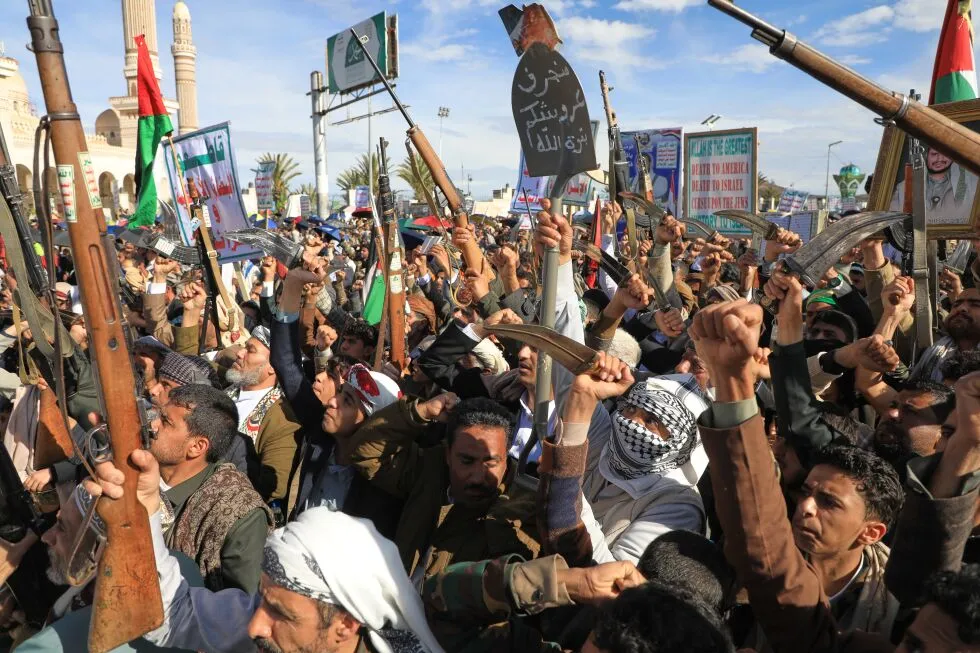
A Houthi missile attack on Israel stokes fears of renewed Red Sea shipping strikes 1 of 2 | Iranian-backed Houthi rebels entered the month-long war in the Middle East on Saturday, claiming two missile launches at Israel. The Houthis’ entry could further hurt global shipping if they again target vessels in the Bab el-Mandeb Strait off the Red Sea, through which about 12% of the world’s trade typically passes. 2 of 2 | Houthi supporters shout slogans during a rally against Israel and the United States’ war in Iran, in Sanaa, Yemen, Friday, March 27, 2026. (AP Photo/Osamah Abdulrahman) 1 of 2 Iranian-backed Houthi rebels entered the month-long war in the Middle East on Saturday, claiming two missile launches at Israel. The Houthis’ entry could further hurt global shipping if they again target vessels in the Bab el-Mandeb Strait off the Red Sea, through which about 12% of the world’s trade typically passes. Add AP News on Google Add AP News as your preferred source to see more of our stories on Google. 2 of 2 Houthi supporters shout slogans during a rally against Israel and the United States’ war in Iran, in Sanaa, Yemen, Friday, March 27, 2026. (AP Photo/Osamah Abdulrahman) Add AP News on Google Add AP News as your preferred source to see more of our stories on Google. Updated [hour]:[minute] [AMPM] [timezone], [monthFull] [day], [year] CAIRO (AP) — A missile attack on Israel by Iranian-backed Houthi rebels in Yemen on Saturday raises concern that Tehran’s proxies may again try to block Red Sea shipping routes, as Iran’s chokehold on the Strait of Hormuz keeps another key global trade passage virtually closed. The Houthis said they fired a barrage of missiles at “sensitive Israeli military sites” in southern Israel, their first since the start of the war in the Middle East a month ago. The Israeli military said it intercepted a missile fired from Yemen.When asked about the Houthis, Israeli military spokesperson Brig. Gen. Effie Defrin replied: “We are preparing for a multifront war.”The Houthis are a key Iranian allyThe Houthis are a crucial part of Iran’s so-called “Axis of Resistance,” which includes militant groups in Lebanon, Iraq and the Palestinian territories. They control the Yemeni capital of Sanaa and much of the country’s north, and since 2014 have fought a civil war against the internationally recognized government that is backed by a Saudi-led coalition. Unlike Lebanon’s Hezbollah and militant groups in Iraq, the Houthis in Yemen had held back for a month since the U.S. and Israel launched attacks on Iran on Feb. 28. Red Sea shipping attacks would further disrupt the global economyNow that they have entered the war with a missile attack on Israel, there are growing concerns that they could start attacking shipping in the Red Sea. Such a move would further disrupt the maritime industry and the global economy since the closure of the Strait of Hormuz has shaken markets and energy prices. The rebels also have the capability of striking oil facilities in the Persian Gulf as they did previously during the Yemen civil war.The Houthis said they won’t allow the U.S. and Israel to use the Red Sea for attacks on Iran. “Our fingers are on the trigger,” Brig. Gen. Yahya Saree, a military spokesman for the Houthis, said in a statement Friday. The Houthi attacks on vessels would not only further push up oil prices but destabilize “all of maritime security,” said Ahmed Nagi, a senior Yemen analyst at the International Crisis Group. “The impact would not be limited to the energy market.” Since the closure of the Strait of Hormuz, Saudi Arabia has been sending millions of barrels of crude oil a day through Bab el-Mandeb, at the southern tip of the Arabian Peninsula. The 32-kilometer (20-mile)-wide strait is one of the busiest for global oil trade. A fourth of global container trade also transits through the strait on its way to and from the Suez Canal. Disrupting transit through Bab al-Madab forces shipping firms to route their vessels around the Cape of Good Hope, as they did in 2024 and 2025, significantly increasing costs. About 12% of the world’s trade typically passes through Suez, including oil, natural gas, grain and everything from toys to electronics.“It would be devastating for so many countries,” Nagi said. “If we see more pressure on the Iranians, or there’s any escalation, the Houthis will jump in harshly.”
SRCAssociated Press (AP)
LANGEN
LEANCenter
WORDS735
ENT12
SUN · 2026-03-29 · 13:53 GMTBRIEF NSR-2026-0329-42089
NSR-2026-0329-42089News Report·EN·Conflict
A Houthi missile attack on Israel stokes fears of renewed Red Sea shipping strikes
Houthi rebels in Yemen, backed by Iran, launched missile attacks on Israel on Saturday, marking their entry into the ongoing Middle East conflict. The Houthis claimed to target sensitive Israeli military sites, while Israel reported intercepting a missile.
By
SAMY MAGDYAssociated Press (AP)Filed 2026-03-29 · 13:53 GMTLean · CenterRead · 3 min
Associated Press (AP)FIG 01
Reading time
3min
Word count
735words
Sources cited
2cited
Entities identified
12entities
Quality score
100%
§ 01
Briefing Summary
AI-generatedNEWSAR · AI
Houthi rebels in Yemen, backed by Iran, launched missile attacks on Israel on Saturday, marking their entry into the ongoing Middle East conflict. The Houthis claimed to target sensitive Israeli military sites, while Israel reported intercepting a missile. This action raises concerns about potential disruptions to global shipping through the Bab el-Mandeb Strait off the Red Sea, a crucial passage for approximately 12% of global trade. The Houthis, controlling much of northern Yemen, are a key part of Iran's "Axis of Resistance," and their involvement could exacerbate the existing tensions and further impact international trade routes. The Israeli military stated they are preparing for a multifront war.
Confidence 0.90Sources 2Claims 5Entities 12
§ 02
Article analysis
Model · rule-basedFraming
Conflict
Economic Impact
Tone
Measured
AI-assessed
CalmNeutralAlarmist
Factuality
0.80 / 1.00
Factual
LowHigh
Sources cited
2
Limited
FewMany
§ 03
Key claims
5 extracted01
The Houthis control the Yemeni capital of Sanaa and much of the country’s north.
factual
Confidence
1.00
02
We are preparing for a multifront war.
quoteBrig. Gen. Effie Defrin
Confidence
1.00
03
The Israeli military said it intercepted a missile fired from Yemen.
factualIsraeli military
Confidence
1.00
04
About 12% of the world’s trade typically passes through the Bab el-Mandeb Strait.
statistic
Confidence
1.00
05
Houthi rebels claimed two missile launches at Israel.
factualHouthis
Confidence
1.00
§ 04
Full report
3 min read · 735 words§ 05
Entities
12 identifiedKey playerOppositionContextPositiveNeutralNegative
§ 06
Keywords & salience
9 termshouthi missile attack
1.00
red sea shipping
0.90
middle east war
0.80
global shipping
0.70
bab el-mandeb strait
0.70
iranian-backed houthis
0.60
strait of hormuz
0.50
trade passage
0.50
axis of resistance
0.40
§ 07
Topic connections
Interactive graph Network visualization showing 51 related topics
View Full Graph Person Organization Location Event|Click node to navigate|Edge numbers = shared articles