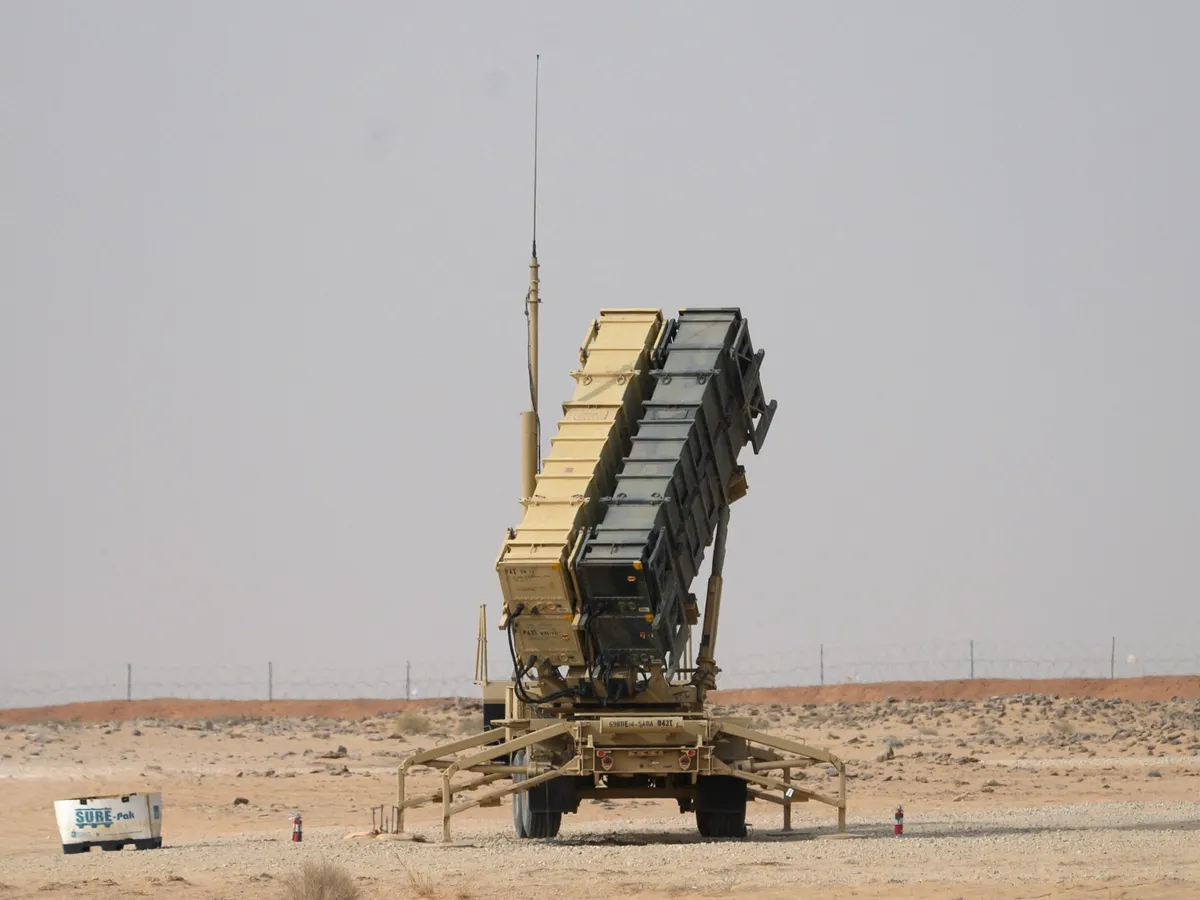
Iran reportedly hits E-3 Sentry flying radars, which track drones, missiles and aircraft from hundreds of kilometres away.A Patriot air defence system is seen near Prince Sultan Air Base in Saudi Arabia, where US forces are deployed [File: Andrew Caballero-Reynolds/AFP]Published On 29 Mar 2026As the United States and Israel launched the war on Iran on February 28, Tehran’s response was swift. Not only did Iran fire missiles and drones towards Israel, but it also targeted US assets in Gulf countries, expanding the conflict in one of the most important energy-producing regions in the world.In the past month, Iranian attacks have damaged or destroyed radar systems, a Terminal High Altitude Area Defense (THAAD) missile defence system and Reaper drones in attacks on US bases in Saudi Arabia, the United Arab Emirates, Bahrain, Jordan and Kuwait as it sought to counter the US air campaign, according to media reports. The Al Udeid base in Qatar, where US forces are stationed, also came under attack.Recommended Stories list of 3 itemslist 1 of 3Toddler rescued after US-Israeli strike on Iranlist 2 of 3Thick plumes of smoke rise over Iraq’s Mosul after strikeslist 3 of 3‘Trump has to open the Strait of Hormuz’ with ground forcesend of listOn Friday, an Iranian missile and drones reportedly hit the Prince Sultan Air Base in Saudi Arabia, according to a report by The Wall Street Journal (WSJ). The airbase, about 96km (60 miles) southeast of the Saudi capital, Riyadh, is run by the Saudi air force but is also used by US forces.The attack damaged multiple KC-135 tankers, which refuel US aircraft in flight, and an E-3 Sentry airborne warning and control system (AWACS) aircraft, Air & Space Forces Magazine, a publication that covers US air defence and national security issues, reported on Saturday.At least 15 American soldiers were wounded and five were in serious condition, The Associated Press news agency reported, quoting unnamed sources briefed on the strikes.Neither the US military nor Saudi Arabia has commented on the incident. Al Jazeera could not independently verify the reports.Here’s what we know about the incident and why it is significant as the US-Israel war on Iran enters its second month:What do we know about the incident?In a video statement on Saturday, Ebrahim Zolfaghari, spokesperson for Iran’s central military headquarters, said an attack on Friday on the airbase had destroyed one of the refuelling aircraft while three others were damaged and put out of service.Satellite images published by Iran’s English-language news channel Press TV showed the destruction of several aircraft at the airbase after the Iranian strikes.If what Iran said proves to be true, the airbase came under attack for the second time in a week. An attack on March 13 damaged five KC-135 refuelling aircraft, a US official was quoted as saying by the WSJ, although the report has not been independently verified.Saudi Arabia had previously intercepted several missiles fired near the base. It has been intercepting Iranian missiles and drones targeting the country’s oil-rich eastern region.On Friday, the Saudi Ministry of Defence said it intercepted several drones and missiles launched from Iran towards Riyadh but has not yet commented on the attack on the airbase.Meanwhile, former US military officials have told the WSJ that targeting the E-3G AWACS in particular “is a big deal”.Retired US Air Force Colonel John Venable told the WSJ on Saturday that the attack “hurts the US ability to see what’s happening in the Gulf and maintain situational awareness”.Heather Penney, a former F-16 pilot and director of studies and research at the Mitchell Institute for Aerospace Studies think tank, told Air & Space Forces Magazine that “the loss of this E-3 is incredibly problematic, given how crucial these battle managers are to everything from airspace deconfliction, aircraft deconfliction, targeting and providing other lethal effects that the entire force needs for the battle space”.What is AWACS?The E-3 Sentry, or AWACS, is critical in managing a battle space and tracking drones, missiles and aircraft from hundreds of kilometres away.According to the US Air Force, it is basically “a modified Boeing 707/320 commercial airframe and has a rotating radar dome”. This radar has a range of more than 375km (250 miles), which enables it to provide “situational awareness of friendly, neutral and hostile activity, command and control of an area of responsibility”, the US Air Force said.Introduced in the US military in 1977, it also provides “all-altitude and all-weather surveillance of the battle space, and early warning of enemy actions during joint, allied, and coalition operations”, it said.Data on the aircraft published on the official website of the US Air Force also indicate that it has the ability to carry out missions lasting eight continuous hours without the need for refuelling. There is also a possibility of extending its range and time in the air by refuelling while flying.The US has a fleet of 16 E-3 Sentry aircraft in service, and according to recent flight tracking data, the US Air Force has sent six of them to bases in Europe and the Middle East during Washington’s war on Iran.(Al Jazeera)What is so special about the E-3?Losing E-3s in the war could create significant gaps in the US air campaign on Iran, according to military experts.“It’s a significant loss for the war in the short term,” Kelly Grieco, a defence policy expert and senior fellow at the Stimson Center think tank, told Air & Space Forces Magazine on Saturday.“That has a consequence. There are going to be coverage gaps.”The attack also represents Iran’s tactics in asymmetric warfare, in which Tehran has focused on weakening Washington’s airpower using proxy networks, drone swarms, missile saturation and cyberoperations. It has also essentially blocked the Strait of Hormuz, through which 20 percent of global oil and gas passes, sending oil prices above $100 per barrel, a jump of roughly 40 percent from before the war.John Phillips, a British safety, security and risk adviser and a former military chief instructor, told Al Jazeera that the reported attack has disrupted the US air campaign’s command and control by creating temporary battle space awareness gaps.AWACS planes “typically provide critical airborne early warning, fighter direction and real-time data-linking for strikes, and its loss forces reliance on ground radars”, he said.[BELOW: What does “US force enablers” mean?]However, he noted that the overall impact is moderate and recoverable within weeks through deployments of the E-7 Wedgetail, a Boeing plane that provides immediate intelligence and surveillance information. But he warned that this exposes US force enablers to further attrition.“I would be curious as this evolves to see if the US moves to more ship-based systems that are better defended or harder to locate or if they shift to airfields farther away to give greater warning and more standoff should Iran launch more attacks,” he said.“I don’t know how much this degradation will impact the overall aims of the USA and if it will see them negotiate a ceasefire any sooner,” he added.What else has Iran targeted in the past 30 days?Since the war began, the US has reportedly lost 12 MQ-9 Reaper drones. These drones are remotely piloted and are primarily used to collect intelligence on an area as well as “perform strike, coordination and reconnaissance against high-value, fleeting and time-sensitive targets”, according to information from the US Air Force.On March 19, Iran’s Islamic Revolutionary Guard Corps issued a statement saying it had targeted a US aircraft, and the semiofficial Tasnim news agency released military footage that it said showed Tehran’s air defence systems hitting a US F-35 stealth fighter. But US officials have not yet confirmed that an F-35 fighter jet was indeed hit by Iranian fire.
SRCAl Jazeera
LANGEN
LEANCenter
WORDS1 269
ENT10
SUN · 2026-03-29 · 13:33 GMTBRIEF NSR-2026-0329-42248
NSR-2026-0329-42248News Report·EN·Conflict
Iran ‘hits’ US AWACS, air tankers: What else has it targeted in past month?
Following the start of the US-Israel war on Iran on February 28, 2026, Iran has reportedly targeted US assets in Gulf countries. Over the past month, attacks have damaged or destroyed radar systems, a THAAD missile defense system, and Reaper drones at US bases in Saudi Arabia, the UAE, Bahrain, Jordan, and Kuwait.
Priyanka ShankarAl JazeeraFiled 2026-03-29 · 13:33 GMTLean · CenterRead · 6 min
Al JazeeraFIG 01
Reading time
6min
Word count
1 269words
Sources cited
6cited
Entities identified
10entities
Quality score
100%
§ 01
Briefing Summary
AI-generatedNEWSAR · AI
Following the start of the US-Israel war on Iran on February 28, 2026, Iran has reportedly targeted US assets in Gulf countries. Over the past month, attacks have damaged or destroyed radar systems, a THAAD missile defense system, and Reaper drones at US bases in Saudi Arabia, the UAE, Bahrain, Jordan, and Kuwait. On Friday, Iranian missiles and drones reportedly hit Prince Sultan Air Base in Saudi Arabia, damaging KC-135 tankers and an E-3 Sentry AWACS aircraft. According to reports, at least 15 American soldiers were wounded in the attack. Neither the US military nor Saudi Arabia has officially commented on the incident.
Confidence 0.90Sources 6Claims 5Entities 10
§ 02
Article analysis
Model · rule-basedFraming
Conflict
National Security
Tone
Mixed Tone
AI-assessed
CalmNeutralAlarmist
Factuality
0.70 / 1.00
Factual
LowHigh
Sources cited
6
Well sourced
FewMany
§ 03
Key claims
5 extracted01
The attack damaged multiple KC-135 tankers and an E-3 Sentry airborne warning and control system (AWACS) aircraft.
factualAir & Space Forces Magazine
Confidence
0.90
02
An Iranian missile and drones reportedly hit the Prince Sultan Air Base in Saudi Arabia on Friday.
factualThe Wall Street Journal
Confidence
0.90
03
Iran fired missiles and drones towards Israel and targeted US assets in Gulf countries after the US and Israel launched war on Iran.
factualAl Jazeera (reportedly)
Confidence
0.80
04
Iranian attacks have damaged or destroyed radar systems, a THAAD missile defence system and Reaper drones in attacks on US bases.
factualMedia reports
Confidence
0.70
05
At least 15 American soldiers were wounded and five were in serious condition.
factualThe Associated Press, quoting unnamed sources
Confidence
0.60
§ 04
Full report
6 min read · 1 269 words§ 05
Entities
10 identifiedKey playerOppositionContextPositiveNeutralNegative
§ 06
Keywords & salience
10 termsus
1.00
iran
1.00
attacks
0.90
airbase
0.80
missiles
0.70
drones
0.70
air defence
0.60
e-3 sentry
0.60
saudi arabia
0.50
war
0.40
§ 07
Topic connections
Interactive graph Network visualization showing 51 related topics
View Full Graph Person Organization Location Event|Click node to navigate|Edge numbers = shared articles