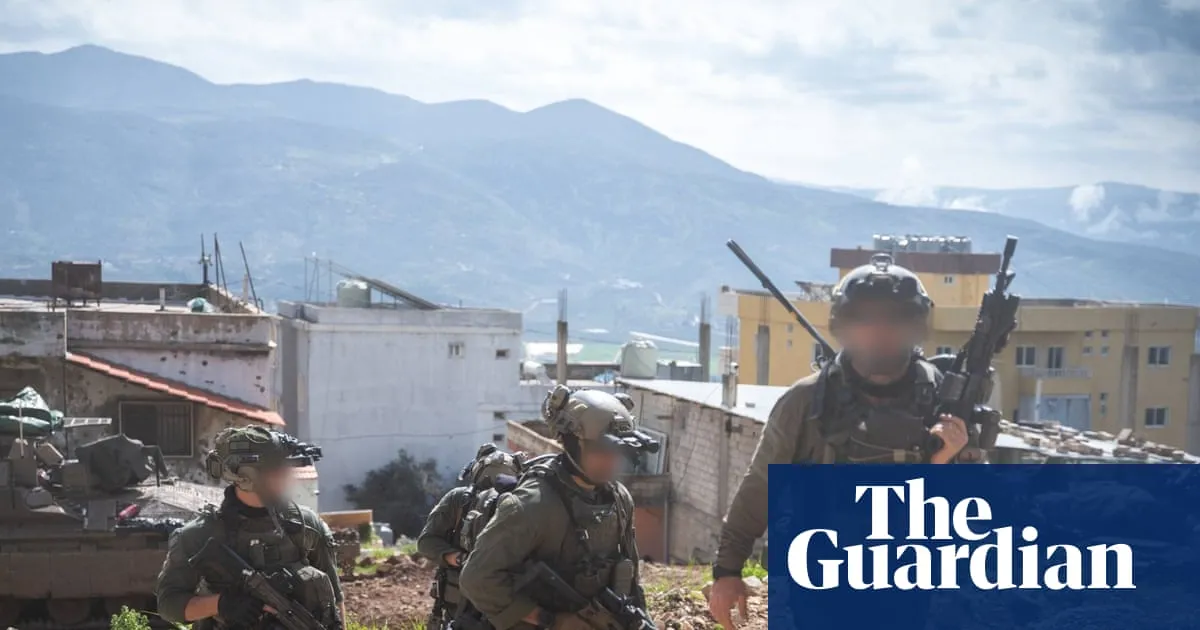
Israel says it will occupy swathes of south Lebanon and destroy the homes along the border to prevent the return of about 600,000 residents, prompting concerns of long-term forced displacement.The defence minister, Israel-katz" class="entity-link entity-person" data-entity-id="4249" data-entity-type="person">Israel Katz, said that when fighting with Hezbollah ended, Israel would occupy the area under the Litani River, about 19 miles from the Israel-Lebanon border, as part of its so-called buffer zone inside southern Lebanon.“At the end of the operation, the IDF would control the area up to the Litani River, including the remaining Litani bridges, while eliminating Radwan forces that infiltrated the area and destroying all weapons there,” Katz said, referring to the elite unit of the pro-Iran Hezbollah group.He added that all homes near the villages would be destroyed “in accordance with the Rafah and Beit Hanoun model in Gaza”. The Israeli military razed most homes and public infrastructure in both neighbourhoods of Gaza.Human Rights Watch has said that similar statements by Katz in the past week could amount to forced displacement and wanton destruction, which are war crimes.In an interview on Sunday with LBCI, an Israeli military spokesperson, Maj Doron Spielman, said that “every home in southern Lebanon, the Shiite homes, are command centres”.Israel launched a military campaign in Lebanon shortly after Hezbollah launched rockets at Israel on 2 March to avenge the killing of the Iranian supreme leader, Ayatollah Ali Khamenei. Israeli jets have bombed what Israel says are Hezbollah targets across the country, while its troops are conducting a ground invasion about 18 miles south of the Litani River.The immediate goal of Israel’s invasion is to push Hezbollah back from the border in order to stop the ability of the group to fire rockets into communities in northern Israel.On Sunday, Israel’s prime minister, Benjamin Netanyahu, said that he has instructed the military to expand the so-called buffer zone within Lebanon, though he did not specify how far. Most of Hezbollah’s rocket fire into Israel has originated from north of the Litani River and it has large weapons caches in the vast Bekaa valley.Israeli troops have advanced quickly through southern Lebanon, reaching the town of Bayada on Sunday, just 8km from the city of Tyre. During the previous war, in 2024, Israeli troops did not reach Bayada until two days before the end of fighting. Israeli troops are also advancing closer to towns in the Nabatieh district, which if captured would give the Israeli military a high ground to control the Litani area.Israel also carried out a wave of airstrikes on the southern suburbs of Beirut on Tuesday.The Lebanese army withdrew from its positions in the Christian-majority towns of Rmeish and Ain Ebl on Tuesday as Israeli troops advanced, over the protests of residents.Despite being close to the Lebanese-Israeli border, the towns had previously been mostly spared from Israeli strikes. The Lebanese army had until now remained in those villages, organising convoys of food and other supplies and facilitating the evacuation of residents who wanted to leave.Ten Israeli soldiers have been killed by Hezbollah in southern Lebanon, while two civilians in northern Israel were killed by Hezbollah rocket fire.At least 1,268 people have been killed in Lebanon by Israel, according to Lebanon’s ministry of health.Three peacekeepers in the Lebanese UN mission were killed on Sunday and Monday in separate incidents as fighting intensified. On Sunday, two Indonesian peacekeepers near Aadshit al-Qusayr, in south Lebanon, were severely injured in an explosion near their base, with one later dying of his injuries. On Monday, an explosion near a vehicle in Bani Hayyan killed two more Indonesian peacekeepers.The UN Interim Force in Lebanon (Unifil) said it was investigating the attacks, but did not say whether Israel or Hezbollah was responsible. The Israeli military also said it was investigating.The UN undersecretary-general for peace operations, Jean-Pierre Lacroix, condemned what he called “unacceptable incidents”, and said that “all acts that endanger the peacekeepers must stop”. The EU also condemned the attacks, and the UN security council was set to hold an emergency session on Tuesday at the request of France.In the 13-month-war, which ended in 2024, Unifil peacekeepers were targeted several times by the Israeli military and its bases were also struck by Hezbollah rocket fire.More than 1 million people have been displaced by Israel’s invasion of Lebanon, over 80% of whom do not have any official state shelters. Medical facilities and public infrastructure such as bridges, water treatment stations and power stations have been damaged and destroyed by Israeli attacks in south Lebanon.If the south is permanently occupied and residents prevented from returning, analysts have predicted social and political disaster in Lebanon, where most of the population lived in poverty even before the beginning of the current war.
SRCThe Guardian - World News
LANGEN
LEANCenter-Left
WORDS779
ENT12
TUE · 2026-03-31 · 16:10 GMTBRIEF NSR-2026-0331-45808
NSR-2026-0331-45808News Report·EN·Conflict
Israel vows to occupy large parts of southern Lebanon to expand buffer zone
Israel has vowed to occupy a large portion of southern Lebanon up to the Litani River, approximately 19 miles from the border, to create a buffer zone after fighting with Hezbollah ends. Defence Minister Israel Katz stated that the military would control the area, eliminate Hezbollah forces, and destroy homes near villages, mirroring actions taken in Gaza.
William Christou in BeirutThe Guardian - World NewsFiled 2026-03-31 · 16:10 GMTLean · Center-LeftRead · 4 min
The Guardian - World NewsFIG 01
Reading time
4min
Word count
779words
Sources cited
4cited
Entities identified
12entities
Quality score
100%
§ 01
Briefing Summary
AI-generatedNEWSAR · AI
Israel has vowed to occupy a large portion of southern Lebanon up to the Litani River, approximately 19 miles from the border, to create a buffer zone after fighting with Hezbollah ends. Defence Minister Israel Katz stated that the military would control the area, eliminate Hezbollah forces, and destroy homes near villages, mirroring actions taken in Gaza. This plan has raised concerns about forced displacement, with Human Rights Watch suggesting it could constitute war crimes. The Israeli military launched its campaign in Lebanon after Hezbollah fired rockets into Israel on March 2, citing retaliation for the killing of the Iranian supreme leader. The stated goal is to push Hezbollah back from the border to prevent rocket fire into northern Israel, with troops advancing rapidly and Prime Minister Netanyahu instructing the military to expand the buffer zone.
Confidence 0.90Sources 4Claims 5Entities 12
§ 02
Article analysis
Model · rule-basedFraming
Conflict
Human Rights
Tone
Mixed Tone
AI-assessed
CalmNeutralAlarmist
Factuality
0.80 / 1.00
Factual
LowHigh
Sources cited
4
Well sourced
FewMany
§ 03
Key claims
5 extracted01
Human Rights Watch has said that similar statements by Katz in the past week could amount to forced displacement and wanton destruction, which are war crimes.
factualHuman Rights Watch
Confidence
1.00
02
All homes near the villages would be destroyed “in accordance with the Rafah and Beit Hanoun model in Gaza”.
quoteIsrael Katz
Confidence
1.00
03
Israel plans to occupy the area under the Litani River, about 19 miles from the Israel-Lebanon border.
factualIsrael Katz
Confidence
1.00
04
Israel says it will occupy swathes of south Lebanon and destroy homes along the border.
factualIsrael
Confidence
1.00
05
Israeli jets have bombed what Israel says are Hezbollah targets across the country.
factualArticle (attributing to Israel)
Confidence
0.90
§ 04
Full report
4 min read · 779 words§ 05
Entities
12 identifiedKey playerOppositionContextPositiveNeutralNegative
People4
§ 06
Keywords & salience
10 termsisrael-lebanon conflict
1.00
buffer zone
0.90
southern lebanon
0.80
hezbollah
0.80
forced displacement
0.70
military occupation
0.70
home destruction
0.60
litani river
0.60
war crimes
0.50
military campaign
0.50
§ 07
Topic connections
Interactive graph Network visualization showing 51 related topics
View Full Graph Person Organization Location Event|Click node to navigate|Edge numbers = shared articles