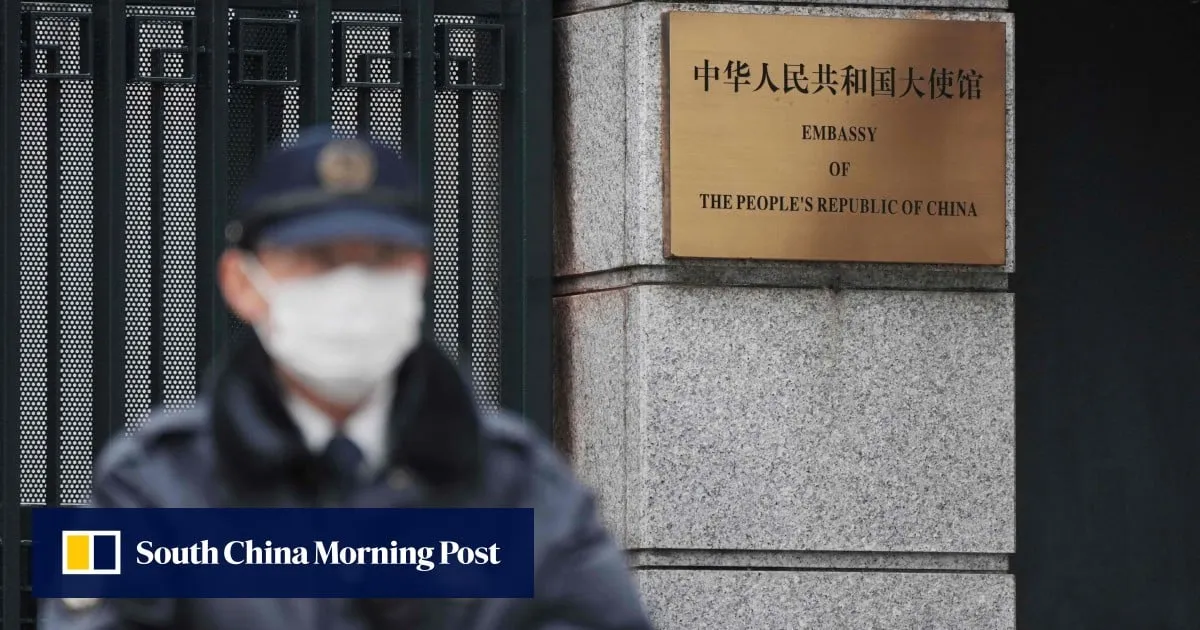
Japan has moved swiftly to contain the diplomatic fallout after a member of its Self-Defence Forces broke into the Chinese embassy in Tokyo last week.But observers and local media say the incident has given Beijing an opening to reinforce claims of rising militarism and anti-China sentiment in Japan.Yoshinobu Kusunoki, commissioner general of the National Police Agency, on Monday called the break-in on March 24 “extremely unusual and serious”, adding that it “should not have happened”.His remarks echoed those of Defence Minister Shinjiro Koizumi, who earlier said it was “deeply regrettable that a member of the Self-Defence Force, who is expected to abide by the law, has been arrested on suspicion of trespassing”.A car driven by investigators enters a Ground Self-Defence Force base in Ebino, Miyazaki prefecture, on Sunday in connection with the break-in at the Chinese embassy in Tokyo. Photo: KyodoThe suspect, Kodai Murata, 23, a second lieutenant based at Camp Ebino in Miyazaki prefecture, was detained inside the embassy compound. He told police he wanted to “convey my opinions to the ambassador” – specifically, to urge China to abandon what he regarded as its hardline stance towards Japan.
SRCSouth China Morning Post
LANGEN
LEANCenter-Right
WORDS189
ENT11
WED · 2026-04-01 · 02:00 GMTBRIEF NSR-2026-0401-46285
NSR-2026-0401-46285News Report·EN·Diplomatic
Japan races to limit fallout from Chinese embassy break-in
Japan is working to minimize diplomatic damage after a member of its Self-Defence Forces, Kodai Murata, trespassed on the Chinese embassy in Tokyo on March 24. Murata, a second lieutenant based in Miyazaki prefecture, was detained within the embassy compound.
Julian RyallSouth China Morning PostFiled 2026-04-01 · 02:00 GMTLean · Center-RightRead · 1 min
South China Morning PostFIG 01
Reading time
1min
Word count
189words
Sources cited
3cited
Entities identified
11entities
Quality score
100%
§ 01
Briefing Summary
AI-generatedNEWSAR · AI
Japan is working to minimize diplomatic damage after a member of its Self-Defence Forces, Kodai Murata, trespassed on the Chinese embassy in Tokyo on March 24. Murata, a second lieutenant based in Miyazaki prefecture, was detained within the embassy compound. He stated his motive was to convey his opinions to the Chinese ambassador, urging China to soften its stance towards Japan. High-ranking Japanese officials, including the commissioner general of the National Police Agency and the Defence Minister, have expressed regret over the incident, calling it "extremely unusual and serious." Observers suggest the event provides Beijing with an opportunity to reinforce claims of rising militarism and anti-China sentiment within Japan.
Confidence 0.90Sources 3Claims 5Entities 11
§ 02
Article analysis
Model · rule-basedFraming
Diplomatic
National Security
Tone
Measured
AI-assessed
CalmNeutralAlarmist
Factuality
0.80 / 1.00
Factual
LowHigh
Sources cited
3
Well sourced
FewMany
§ 03
Key claims
5 extracted01
Murata told police he wanted to “convey my opinions to the ambassador”.
quoteKodai Murata
Confidence
1.00
02
Kodai Murata, 23, a second lieutenant, was detained inside the embassy compound.
factualArticle
Confidence
1.00
03
Defence Minister Shinjiro Koizumi said it was “deeply regrettable” that a member of the SDF was arrested for trespassing.
quoteShinjiro Koizumi
Confidence
1.00
04
Yoshinobu Kusunoki called the break-in on March 24 “extremely unusual and serious”.
quoteYoshinobu Kusunoki
Confidence
1.00
05
A member of Japan's Self-Defence Forces broke into the Chinese embassy in Tokyo last week.
factualArticle
Confidence
1.00
§ 04
Full report
1 min read · 189 words§ 05
Entities
11 identifiedKey playerOppositionContextPositiveNeutralNegative
People3
Organizations3
§ 06
Keywords & salience
9 termschinese embassy break-in
1.00
japan
0.90
china
0.80
diplomatic fallout
0.70
self-defence forces
0.70
rising militarism
0.60
anti-china sentiment
0.60
trespassing
0.50
international relations
0.40
§ 07
Topic connections
Interactive graph Network visualization showing 51 related topics
View Full Graph Person Organization Location Event|Click node to navigate|Edge numbers = shared articles