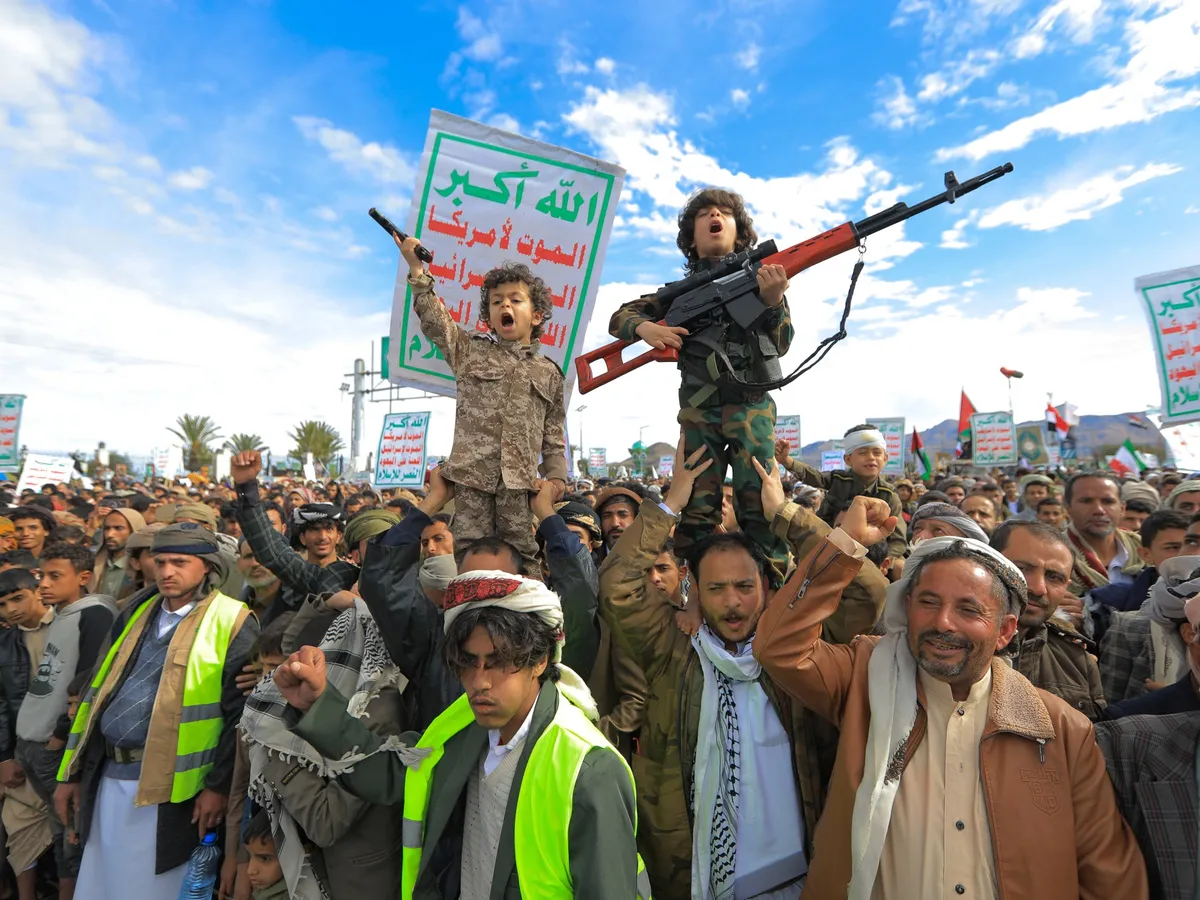
Houthi actions align with Iran’s strategy, but maintain autonomy to maximise regional influence and domestic objectives.Young Houthi supporters hold weapons during a rally in solidarity with Iran and Lebanon, amid the US-Israeli war with Iran, in the Yemeni capital Sanaa on March 27, 2026 [AFP]Published On 2 Apr 2026Having spent a month on the sidelines, Yemen’s Houthis have entered the regional conflict between their ally, Iran, and its enemies, the United States and Israel.So far, however, that involvement has been limited – with only the March 28 confirmed attack on Israel so far – and has not targeted shipping in the Red Sea, as the Houthis previously did following the beginning of Israel’s war on Gaza.Recommended Stories list of 3 itemslist 1 of 3Iran war: What is happening on day 33 of US-Israel attacks?list 2 of 3One month of war on Iran cost Arab countries up to $194bn: UNDPlist 3 of 3Iraq risks Arab ties as Iran-aligned groups strike Gulf nationsend of listThe question, therefore, is now how far the Houthis are willing to go in this war, in the knowledge that they are likely attempting to avoid a broad confrontation that could drain them materially, and in human terms, inside Yemen.It is first important to understand the degree to which the Houthis have acted independently of Iran in their decision to attack.The facts indicate that the relationship between the Houthis and Iran is based on an unequal partnership: Tehran provides the group with support, expertise, technology, and political cover within the Iran-led regional “Axis of Resistance”, while the Houthis retain a margin of manoeuvrability governed by their local calculations and their method of leveraging regional escalation to serve their project inside Yemen.Within this framework, the group’s decisions intersect with Iran’s interests without automatically mirroring the behaviour of Lebanon’s Hezbollah or some pro-Iran Iraqi factions, which are much more closely tied to Iranian decision-making.This margin of manoeuvre does not negate the depth of the Houthis’ connection to Iran, but it explains how the group manages this coordination to serve its domestic project in Yemen, where it controls the capital Sanaa, and much of the country’s northwest.The Houthis have much to thank Iran for their military expansion across Yemen in the years after 2014 and the start of the war in that country. A 2024 United Nations experts report said that support coming from Iran’s Islamic Revolutionary Guards Corps, as well as Hezbollah and Iraqi groups, played a decisive role in transforming the Houthis from a limited local group into a more organised and heavily armed military force.The report explained that Houthi members received tactical and technical training outside Yemen, and used advanced weapons systems, which contributed to their military rise in recent years.However, that does not mean that the Houthis have completely lost their independence. The group, despite aligning with Iran, views its own Yemeni agenda as an integral part of its project, rather than secondary to any Iranian calculations.To this end, the Houthis have important considerations to make, and among the most important right now are: How its decisions will be received by Saudi Arabia, and how will its decisions affect its ability to continue as the de facto authority in northwestern Yemen for a prolonged period?This explains the Houthis’ delayed official entry into the war, one that goes beyond mere hesitation, and instead was related to a careful calculation of timing and cost.Calculated and gradual escalationParticipating in the conflict allows the Houthis to highlight three matters: First, that they remain an active part of Iran’s regional axis. Second, they aim to raise the economic cost of the war by signalling a threat to the Red Sea. Third, they seek to improve their political position in Yemen and beyond, presenting themselves as a regional actor rather than merely a local de facto authority.In this context, the continued attacks against Iran may increase the importance of the Houthis. The more Tehran is subjected to direct pressure on its territory and its military and economic infrastructure, the greater its need for tools it can use against adversaries beyond its borders.The Houthis possess one of the most dangerous of these tools, as their location allows them to threaten navigation in the Red Sea and Bab al-Mandeb Strait – a route whose importance has increased since Iran made passage through the Strait of Hormuz difficult.The Iranians have already seen how damaging restricting shipping in the Strait of Hormuz can be to the global economy. Repeating that trick in Bab al-Mandeb, the entrance to the Red Sea, is tempting.Thus, the Houthis are one of the instruments that enable Iran to shift pressure to other arenas in the wider region, even as it faces heavy bombing from the US and Israel.At this stage, the Houthis’ strategy is based on calculated movements. The group may have declared itself part of the battle and launched an attack on Israel, but it has not yet used all the pressure tools at its disposal in the Red Sea.Previous Houthi attacks in the Red Sea pushed many shipping companies to avoid the route, while Western powers spent billions of dollars to protect navigation, but were unable to restore fully normal conditions, even as US and Israeli bombs rained down on Yemen.That past experience means that the Houthis do not necessarily need to enter a full-scale war. Instead, they can keep the threat present, and then use it when they see the timing as appropriate.Recent shifts in the energy market increase the seriousness of the Houthi threat. With a large portion of export movement through Hormuz disrupted, Saudi Arabia has increased its reliance on its Red Sea port of Yanbu, with crude exports rising to approximately 4 million barrels per day in mid-March, compared with an average of about 770,000 barrels per day in January and February, according to data cited by Reuters.That only plays into the hands of the Houthis, who can disrupt that shipping if they wish. Here, the interests of the Houthis and Iran converge: the Houthis seek to maximise their regional weight and highlight the damage they can do if they are targeted, and Iran seeks to signal that pressure on it in the Gulf can be answered in the Red Sea.Houthi risksNevertheless, it appears that the Houthis do not want to quickly escalate matters.The group understands that opening a broad maritime front could provoke a wider US and Israeli response and could also disrupt its political and military calculations inside Yemen, at a time when that country’s war has not been concluded and is instead capable of reigniting.The Yemeni government is currently the strongest it has been in years, following a Saudi decision to back it in a conflict with the United Arab Emirates-supported Southern Transitional Council. That has allowed the Yemeni government to consolidate its forces across southern and eastern Yemen, and attempt to stabilise those regions, with an eye to then moving towards Houthi territory.Any miscalculation from the Houthis risks giving the government an opportunity that it can take advantage of.Therefore, the Houthis’ current behaviour appears closer to gradual escalation: declaring an entry into the war, raising readiness, keeping the maritime threat present, and then waiting for the most suitable time to use it – in line with their own domestic considerations, and Iran’s.The relationship between the Houthis and Iran remains somewhere between dependency and independence.Tehran has clearly contributed to building the group’s military power and linking it to a broader regional network, but the Houthis still operate within a margin of decision-making that prevents them from being reduced to a mirror image of Iran’s other allies.And yet, that does not change the fact that the Houthi-Iran relationship runs deeper than a mere overlap of interests, and that Houthi decisions operate within a firmly rooted structure, even when they appear to be more independent.
SRCAl Jazeera
LANGEN
LEANCenter
WORDS1 300
ENT12
THU · 2026-04-02 · 10:36 GMTBRIEF NSR-2026-0402-49021
NSR-2026-0402-49021Analysis·EN·Political Strategy
Yemen’s Houthis coordinate with Iran, but retain independence, despite war
Yemen's Houthis have entered the regional conflict between Iran and its enemies, the US and Israel, with a confirmed attack on Israel in March 2026. While the Houthis align with Iran's broader strategy as part of the "Axis of Resistance," they maintain a degree of independence in their decision-making.
Saeed ThabetAl JazeeraFiled 2026-04-02 · 10:36 GMTLean · CenterRead · 6 min
Al JazeeraFIG 01
Reading time
6min
Word count
1 300words
Sources cited
1cited
Entities identified
12entities
Quality score
100%
§ 01
Briefing Summary
AI-generatedNEWSAR · AI
Yemen's Houthis have entered the regional conflict between Iran and its enemies, the US and Israel, with a confirmed attack on Israel in March 2026. While the Houthis align with Iran's broader strategy as part of the "Axis of Resistance," they maintain a degree of independence in their decision-making. Iran provides support, expertise, and political cover, but the Houthis prioritize their domestic objectives in Yemen, where they control Sanaa and much of the northwest. This allows them to leverage regional escalations to serve their own project within Yemen, without directly mirroring the actions of other Iran-backed groups like Hezbollah. The Houthis' relationship with Iran is an unequal partnership that allows them to act in their own interests.
Confidence 0.90Sources 1Claims 5Entities 12
§ 02
Article analysis
Model · rule-basedFraming
Political Strategy
Conflict
Tone
Measured
AI-assessed
CalmNeutralAlarmist
Factuality
0.60 / 1.00
Mixed
LowHigh
Sources cited
1
Limited
FewMany
§ 03
Key claims
5 extracted01
A 2024 UN report said Iranian support transformed the Houthis into a heavily armed force.
factual2024 United Nations experts report
Confidence
1.00
02
The Houthis control the capital Sanaa, and much of the country’s northwest.
factual
Confidence
0.90
03
Iran provides the Houthis with support, expertise, technology, and political cover.
factual
Confidence
0.90
04
Houthis actions align with Iran’s strategy, but maintain autonomy.
factual
Confidence
0.80
05
The Houthis retain a margin of manoeuvrability governed by their local calculations.
factual
Confidence
0.70
§ 04
Full report
6 min read · 1 300 words§ 05
Entities
12 identifiedKey playerOppositionContextPositiveNeutralNegative
Organizations3
§ 06
Keywords & salience
9 termshouthis
1.00
iran
0.90
yemen
0.80
regional conflict
0.70
axis of resistance
0.60
domestic objectives
0.50
political cover
0.50
sanaa
0.40
red sea
0.40
§ 07
Topic connections
Interactive graph Network visualization showing 51 related topics
View Full Graph Person Organization Location Event|Click node to navigate|Edge numbers = shared articles