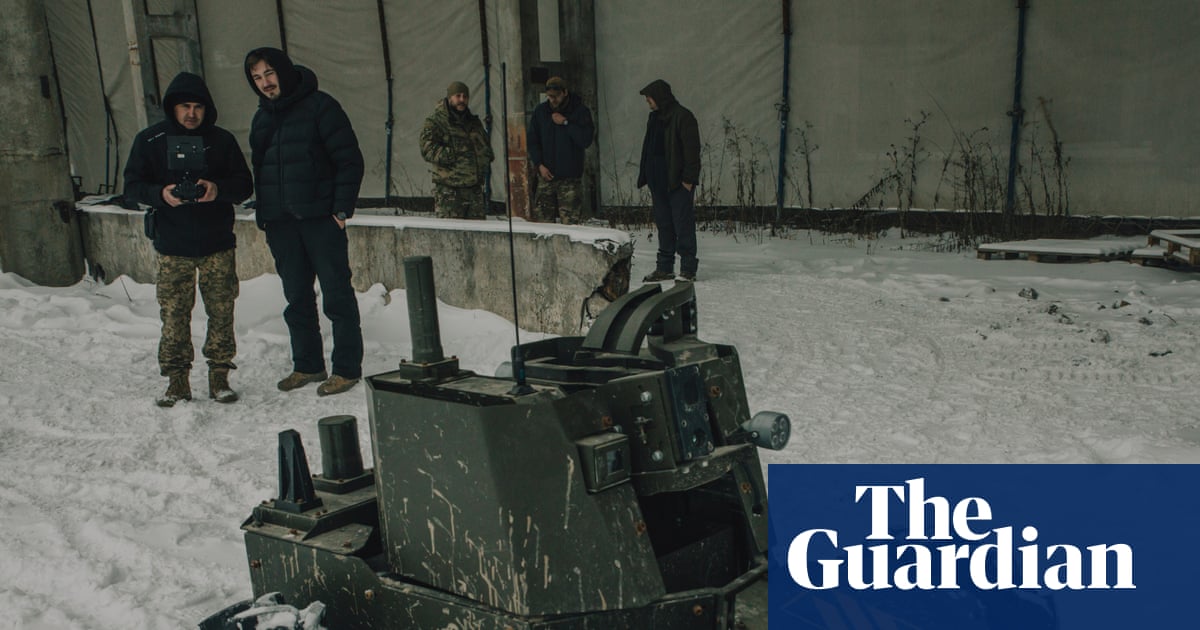
Victor Pavlov showed off Ukraine’s newest and most versatile weapon: a battery-powered land robot.The unmanned ground vehicles come in various shapes and sizes. One runs on caterpillar tracks and resembles a roofless milk float. Another has wheels and antennas. A third carries anti-tank mines. Since spring 2024 their use has grown exponentially.“This is what modern warfare looks like. Armies everywhere will have to robotise,” said Pavlov, a lieutenant with Ukraine’s 3rd army corps.Russia’s full-scale invasion of Ukraine is now in its fifth year and the conflict – Europe’s biggest since 1945 – has seen an astonishing transformation of battlefield weapons and tactics. The war has become a technological contest, fought not with expensive tanks but with cheap and expendable drones that can deliver bombs with deadly accuracy.Unmanned ground robots used by the Ukrainian armyUkraine’s drone expertise is now highly sought after amid the US-Israeli war against Iran. Last week Volodymyr Zelenskyy signed 10-year defence agreements with several Gulf states, including Saudi Arabia and Qatar, to provide them with low-cost Ukrainian interceptors. They can shoot down long-range kamikaze Shahed drones, used by Tehran in its attacks on its neighbours, and by Moscow.The Kremlin’s war has transformed Kyiv into a centre for the development of modern unmanned weapons. There is a unique ecosystem, where engineers design new products and frontline soldiers give instant feedback. Manufacturers then scale up supplies, building ground vehicles, anti-Shahed interceptors and pioneering sea drones.Land robots now account for 90% of Ukrainian army logistics. “It’s very difficult to move around because of enemy first-person-view drones. So we use robotic systems,” said Pavlov. In January, Ukraine’s armed forces carried out a record 7,000 operations using ground vehicles, or UGVS.Illustrations of different land dronesRobots are increasingly taking a key role in combat and replacing human infantry. They have been kitted out with remote control machine guns and grenade launchers. One system – a DevDroid TW 12.7 – defended a position for 45 days. Last summer a kamikaze robot carrying 200kgs of explosives trundled 12 miles (20km) to a school building used by Russian troops and blew it up.“It’s not Star Wars, where there are lots of lasers. The frontline is more like Terminator. A land robot arrives at your position and there is nothing you can do about it,” said Bambi, a drone operator with the 25th airborne brigade. He added: “You can shoot a person in the chest and they stop firing. If you shoot a ground robot it doesn’t feel pain. There is a guy looking at a screen who is going to fire back.”Victor Pavlov, a lieutenant with Ukraine’s 3rd army corps, with unmanned ground vehicles, known as UGVs. Photograph: Alessio Mamo/The GuardianLand drones also deliver food, ammunition and material such as logs, used by soldiers to construct underground shelters. They can evacuate up to three wounded soldiers from the frontline. Typically a robot can operate for eight hours. They are smaller and less visible than armoured vehicles, which can be easily spotted by Russian spy drones, and destroyed.Since December 2025 the robots have brought provisions to Ukrainian soldiers based around the ruined eastern city of Pokrovsk, the scene of intense fighting. “One rolled up to the entrance of our dugout. I felt like a caveman gazing at alien technology,” Bambi said. “It looked so futuristic. I couldn’t have imagined this two years ago.”In addition, UGVs conduct vital engineering tasks. The latest models can mine and de-mine, lay barbed wire, and tow and retrieve damaged and burned-out vehicles. Pavlov said his company lost around three robots a day to Russian aerial attacks – an attrition rate of 25%. “This is a small price to pay when you consider that we are saving the lives of our infantry,” he said.Ukraine’s defence minister, Mykhailo Fedorov, hailed the rapid expansion of remote operations. “As recently as six months ago, casualty evacuation using ground robotic systems was sporadic. Today, robots routinely enter high-risk areas – delivering ammunition, sustaining logistics and evacuating the wounded where deploying personnel would create additional risk,” he said.An unmanned ground robot is equipped with a remotely controlled machine gun. Photograph: Alessio Mamo/The GuardianLast summer for the first time in the history of warfare Russian soldiers even surrendered to an armed ground robot. The soldiers – one covered in blood – emerged from a wrecked building. Their position had previously come under sustained Ukrainian fire. The 3rd army corps said it was able to deploy robots to retake the area in a “well-planned offensive action”.The corps, which is based in north-eastern Ukraine, has pioneered the development of unmanned ground systems. Its school, the KillHouse academy, trains UGV pilots. Last month they practised driving vehicles over a snow-covered track, twiddling on a remote console. The droid-like machine manoeuvred between fir trees and headed off towards a course of black tyres.Unmanned ground robot driven on snow-covered trackUpstairs, a soldier tried a computer simulator with forest road and swamp terrains. Others listened in a classroom to a lecture.Oleksandr – an instructor with the call sign “Barman” – said robots performed many of the tasks carried out until recently by humans.“War has gone to a new level. There are lots of drones in the sky. This makes it very difficult to get to a position and to evacuate people,” he said. “Former gamers adapt very quickly to this technology. They are more effective than an ordinary serviceman.”Soldiers from the 3rd army corps at the KillHouse academy, a ground robot training school. Photograph: Alessio Mamo/The GuardianRussia also makes extensive use of ground systems. It has developed an electric vehicle known as “Courier”, which can transport 250kg of cargo to frontline troops, and conduct electronic warfare. According to Pavlov, Ukraine presently has the upper hand in ground robot technology. “We have more systems than Russia. The priority is to scale them up,” he said.Russia occupies about 20% of Ukraine, including Crimea. Since 2022 it has failed to make significant progress, despite 1.2 million of its soldiers being killed or wounded, in the east and south of the country. Speaking on the fourth anniversary of the invasion, Volodymyr Zelenskyy said: “Putin has not won this war.” He pointed out that his forces had clawed back about 116 sq miles (300 sq km) of territory in the southern Zaporizhzhia oblast.Andriy Biletsky, the 3rd Corps’ commander, said new tactical approaches would determine which side prevailed ultimately. He said Ukraine was on the “verge of another revolution”, alongside the ongoing revolution in aerial drones. He predicted: “Ground-based robotic system will radically change the battlefield and replace a significant share of soldiers, both in terms of logistics and combat use.”
SRCThe Guardian - World News
LANGEN
LEANCenter-Left
WORDS1 100
ENT10
SAT · 2026-04-04 · 06:00 GMTBRIEF NSR-2026-0404-51751
NSR-2026-0404-51751News Report·EN·Technology
‘The frontline is like Terminator’: fighting robots give Ukraine hope in war with Russia
In the ongoing war with Russia, Ukraine is increasingly relying on unmanned ground robots (UGVs) for logistics and combat. Since spring 2024, the use of these battery-powered robots has grown significantly, with the Ukrainian army carrying out 7,000 operations using UGVs in January alone.
Luke Harding in Kyiv. Photos and video by Alessio MamoThe Guardian - World NewsFiled 2026-04-04 · 06:00 GMTLean · Center-LeftRead · 5 min
The Guardian - World NewsFIG 01
Reading time
5min
Word count
1 100words
Sources cited
4cited
Entities identified
10entities
Quality score
100%
§ 01
Briefing Summary
AI-generatedNEWSAR · AI
In the ongoing war with Russia, Ukraine is increasingly relying on unmanned ground robots (UGVs) for logistics and combat. Since spring 2024, the use of these battery-powered robots has grown significantly, with the Ukrainian army carrying out 7,000 operations using UGVs in January alone. These robots, which come in various forms, are used to transport supplies, deliver explosives, and defend positions, reducing the need for human soldiers in dangerous areas. The conflict has transformed Ukraine into a hub for unmanned weapons development, with rapid innovation driven by feedback from frontline soldiers. Ukraine is also exporting its drone technology, signing agreements with Gulf states to provide anti-drone interceptors.
Confidence 0.90Sources 4Claims 5Entities 10
§ 02
Article analysis
Model · rule-basedFraming
Technology
National Security
Tone
Mixed Tone
AI-assessed
CalmNeutralAlarmist
Factuality
0.70 / 1.00
Factual
LowHigh
Sources cited
4
Well sourced
FewMany
§ 03
Key claims
5 extracted01
In January, Ukraine’s armed forces carried out a record 7,000 operations using ground vehicles.
statisticnull
Confidence
0.90
02
Land robots now account for 90% of Ukrainian army logistics.
statisticVictor Pavlov
Confidence
0.90
03
Since spring 2024 the use of unmanned ground vehicles in the Ukrainian army has grown exponentially.
factualVictor Pavlov
Confidence
0.80
04
Last summer a kamikaze robot carrying 200kgs of explosives blew up a school building used by Russian troops.
factualnull
Confidence
0.70
05
The frontline is more like Terminator. A land robot arrives at your position and there is nothing you can do about it.
quoteBambi
Confidence
0.60
§ 04
Full report
5 min read · 1 100 words§ 05
Entities
10 identifiedKey playerOppositionContextPositiveNeutralNegative
§ 06
Keywords & salience
10 termsukraine
0.90
unmanned ground vehicles
0.90
land robots
0.80
russia
0.70
robot warfare
0.70
modern warfare
0.60
drones
0.60
military technology
0.60
kamikaze drones
0.50
anti-tank mines
0.40
§ 07
Topic connections
Interactive graph Network visualization showing 51 related topics
View Full Graph Person Organization Location Event|Click node to navigate|Edge numbers = shared articles