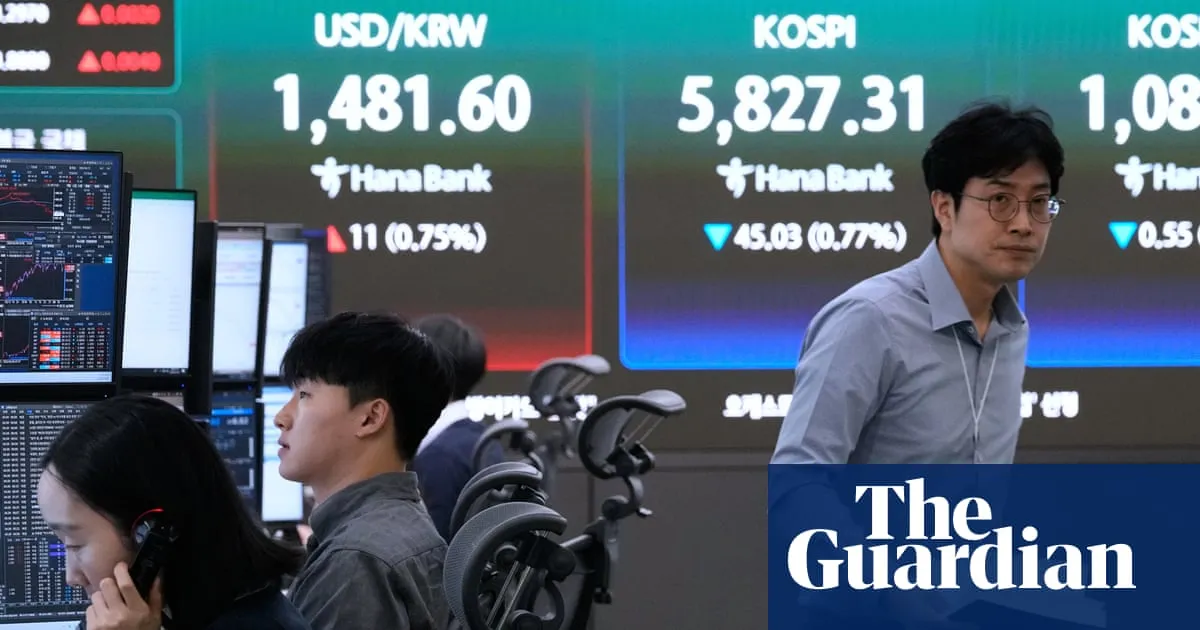
The boss of Abu Dhabi’s state-owned oil company has warned that the Strait of Hormuz is “not open” despite the US-Iran ceasefire agreed earlier this week, as uncertainty over the truce pushed the price of Brent crude towards $100 a barrel on Thursday.Sultan Al Jaber, the chief executive officer of the Abu Dhabi National Oil Company (Adnoc), said passage through the crucial waterway was subject to “permission, conditions and political leverage” by Iran. He insisted that energy security and global economic stability depend on the strait being opened “fully, unconditionally and without restriction”.Al Jaber wrote on LinkedIn: “The weaponisation of this vital waterway, in any form, cannot stand. This would set a dangerous precedent for the world – undermining the principle of freedom of navigation that underpins global trade and, ultimately, the stability of the global economy.“An estimated 230 vessels sit loaded with oil and ready to sail. They, and every vessel that follows, must be free to navigate this corridor without condition. No country has a legitimate right to determine who may pass and under what terms.”Iran effectively closed the strait, through which a fifth of oil and gas would normally flow, after the US and Israel began their attacks at the end of February. About 1,400 ships are estimated to remain anchored on both sides of the passage between the Persian Gulf and the Gulf of Oman.Concerns that few ships have passed through the strait since the US-Iran truce was announced pushed up energy prices on Thursday, while stock markets retreated across Asia and Europe as the two-week ceasefire in Iran looked increasingly shaky, with Israel continuing attacks on Lebanon and the US and Iran threatening a return to military action.A day after the US and Iran announced an 11th-hour ceasefire, including an agreement to reopen the Strait of Hormuz, many questions remain and there have been signs that the truce has already been broken, causing jitters in the markets.Brent crude, the global benchmark, rose by over 4% on Thursday to almost $99 a barrel, while New York light crude climbed by 5.8% to as high as $100.29 a barrel. On Wednesday, Brent had tumbled 13.29%, falling to a four-week low of $94.75 a barrel.Gas prices also crept up again, with the month-ahead UK gas contract up almost 1% at 115.23p a therm, having dropped 15% on Wednesday after the ceasefire was announced.European natural gas futures rose to €46.5 a megawatt hour on Thursday, rebounding from a five-week low. They had plummeted almost 15% to €45.30 a megawatt hour on Wednesday.Andrew Bailey, the chair of the Financial Stability Board, an international body that monitors the global financial system, said the war in the Middle East had been “a very big shock” in the past few weeks that had prompted “much greater market volatility”. Appearing before the EU parliament’s committee on economic and monetary affairs, Bailey – who is also the Bank of England governor – said: “At least we got up yesterday and found the world was still with us, but it obviously is very volatile. Yesterday was a good case in point to illustrate that.”He added that “the banking system is resilient”.Bailey also said, speaking personally, that one of the lessons from the Iran war was that it had changed the economics in favour of renewable energy, to reduce the UK’s reliance on natural gas.The UAE and Kuwait said their air defences had intercepted drones from Iran, while Tehran’s parliament speaker, Mohammad Bagher Ghalibaf, said Israel and the US had violated several points of the agreement.The Revolutionary Guards warned of a “regret-inducing response” if Israel did not stop its strikes against Lebanon. The Fars news agency reported that the passage of oil tankers through the strait was halted because of Israel’s barrage of strikes on Lebanon on Wednesday, the worst since the war started, killing at least 254 people and wounding at least 837.Donald Trump posted on his Truth Social platform that US forces would “remain in place in, and around, Iran, until such time as the REAL AGREEMENT reached is fully complied with”. He threatened that if it were not complied with, the military action would be “stronger than anyone has ever seen before”.In Asian stock markets, Japan’s Nikkei fell 0.7% after Wednesday’s 5.4% bounce, while South Korea’s Kospi lost 1.6% after rising 7.5% the day before, and Hong Kong’s Hang Seng dropped 0.5% lower.European stocks also fell, as the optimism from Wednesday’s rally faded. The UK’s FTSE 100 index slipped 04%, while the German Dax fell 1.2%, France’s Cac dropped 0.9% and Italy’s FTSE MiB was down 0.1%. The pan-European Stoxx 600 index dropped by 0.7% after Wednesday’s near 4% rise, its best day since 2022. The US stock market has opened slightly lower, as investors assessed the US-Iran ceasefire deal. The blue-chip S&P 500 slipped by 0.07%, while the Dow Jones Industrial Average is fell by 0.2%.Jim Reid, a strategist at Deutsche Bank, said: “Nevertheless, compared to 24 hours ago, the market stress has eased considerably, as the ceasefire news and hopes for a de-escalation pathway have created a lot more optimism.” He said fears had eased considerably about a stagflationary shock.There are still signs of progress, with the White House press secretary, Karoline Leavitt, saying that the vice-president, JD Vance, would lead a delegation to Islamabad, with a first round of talks scheduled for Saturday morning.Mohit Kumar, the chief European economist at Jefferies, said: “Despite the fragile nature of the ceasefire, we believe that the truce will hold. Not because we believe that a solution has been found but because of the MAD (mutually assured destruction) principle.“We have reached a stage where both parties would want a ceasefire as carrying on the war assures a negative fallout for both parties. Trump wants a deal as he does not have support from his Maga base to continue to war. US and Israel have realised that without a solution to cheap drone interceptors and some way to bypass the Strait of Hormuz, it’s a war that cannot be won.”
SRCThe Guardian - World News
LANGEN
LEANCenter-Left
WORDS1 004
ENT10
THU · 2026-04-09 · 09:17 GMTBRIEF NSR-2026-0409-59928
NSR-2026-0409-59928News Report·EN·Economic Impact
Oil price rises as markets question durability of Middle East ceasefire
Oil prices surged on Thursday as doubts arose regarding the durability of the US-Iran ceasefire and the reopening of the Strait of Hormuz. Despite the announced truce, the CEO of Abu Dhabi National Oil Company (Adnoc) warned that passage through the strait, a crucial waterway for oil and gas transport, remains subject to Iranian control.
Julia KolleweThe Guardian - World NewsFiled 2026-04-09 · 09:17 GMTLean · Center-LeftRead · 5 min
The Guardian - World NewsFIG 01
Reading time
5min
Word count
1 004words
Sources cited
2cited
Entities identified
10entities
Quality score
100%
§ 01
Briefing Summary
AI-generatedNEWSAR · AI
Oil prices surged on Thursday as doubts arose regarding the durability of the US-Iran ceasefire and the reopening of the Strait of Hormuz. Despite the announced truce, the CEO of Abu Dhabi National Oil Company (Adnoc) warned that passage through the strait, a crucial waterway for oil and gas transport, remains subject to Iranian control. His statement highlighted concerns about energy security and freedom of navigation. The uncertainty surrounding the ceasefire and continued attacks in the region, including Israeli actions in Lebanon, contributed to market jitters. Brent crude rose nearly 4% to almost $99 a barrel, and New York light crude climbed 5.8% to over $100 a barrel, reversing price drops seen after the initial ceasefire announcement.
Confidence 0.90Sources 2Claims 5Entities 10
§ 02
Article analysis
Model · rule-basedFraming
Economic Impact
Political Strategy
Tone
Mixed Tone
AI-assessed
CalmNeutralAlarmist
Factuality
0.70 / 1.00
Factual
LowHigh
Sources cited
2
Limited
FewMany
§ 03
Key claims
5 extracted01
War in the Middle East had been “a very big shock” that had prompted “much greater market volatility”.
quoteAndrew Bailey
Confidence
1.00
02
Brent crude rose by over 4% on Thursday to almost $99 a barrel.
statisticnull
Confidence
1.00
03
Strait of Hormuz is subject to “permission, conditions and political leverage” by Iran.
quoteSultan Al Jaber
Confidence
1.00
04
Iran effectively closed the strait after US and Israel began attacks at the end of February.
factualnull
Confidence
0.90
05
An estimated 230 vessels sit loaded with oil and ready to sail.
statisticnull
Confidence
0.80
§ 04
Full report
5 min read · 1 004 words§ 05
Entities
10 identifiedKey playerOppositionContextPositiveNeutralNegative
§ 06
Keywords & salience
9 termsoil price
0.90
strait of hormuz
0.90
ceasefire
0.80
energy security
0.70
freedom of navigation
0.60
global economy
0.60
gas prices
0.50
us-iran relations
0.50
brent crude
0.50
§ 07
Topic connections
Interactive graph Network visualization showing 51 related topics
View Full Graph Person Organization Location Event|Click node to navigate|Edge numbers = shared articles