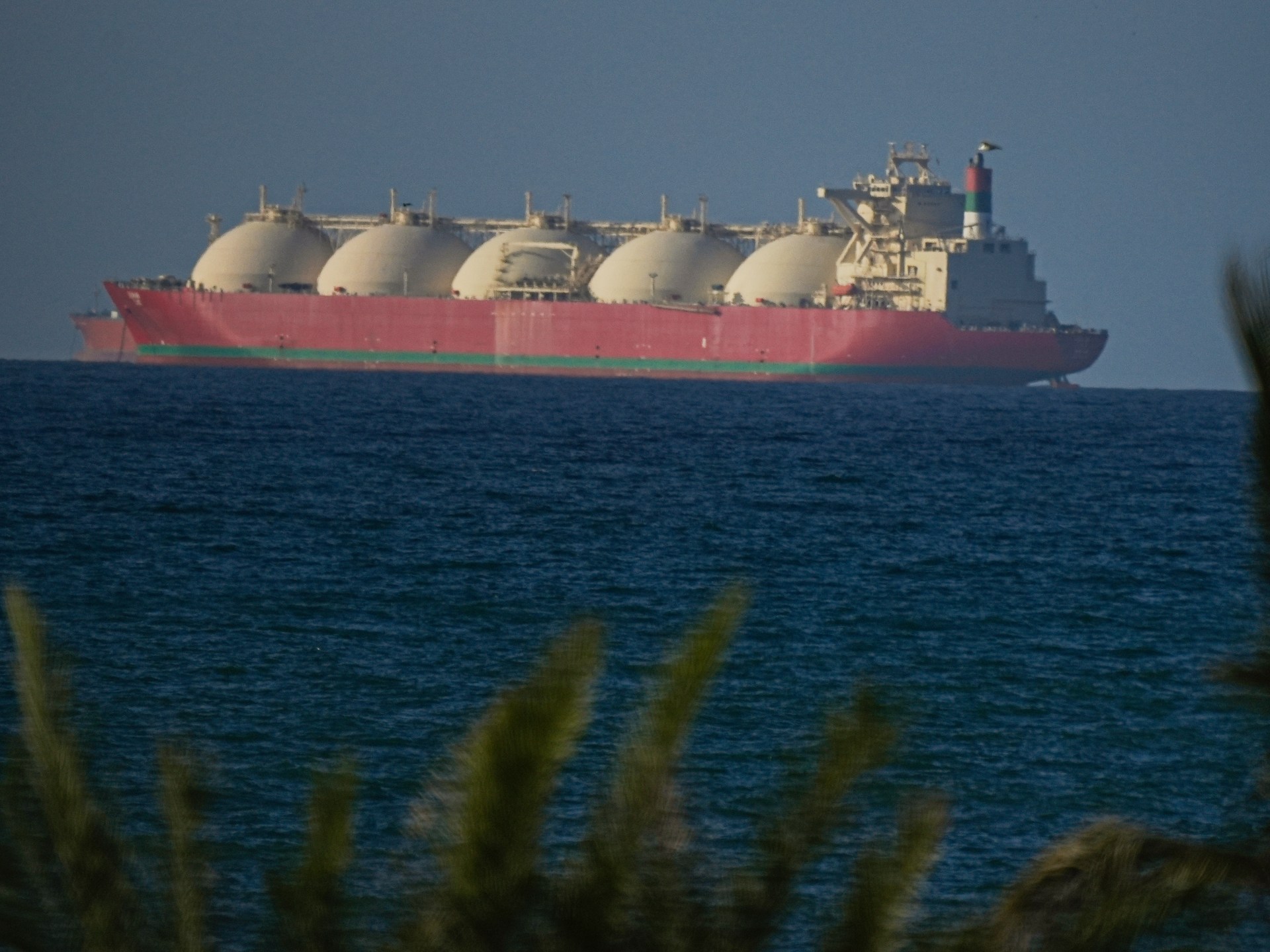
EXPLAINERTehran's plans to tax ships passing through the strait and raise money to rebuild is already seeing pushback.A tanker passing through Strait of Hormuz following news of the two-week temporary ceasefire reached between the United States and Iran, seen in Oman on April 08, 2026 [Shadi J H Alassar/Anadolu Agency]Published On 9 Apr 2026The Strait of Hormuz, which links the Gulf to the Oman" class="entity-link entity-location" data-entity-id="2457" data-entity-type="location">Gulf of Oman, has held global attention since Israel and the US began their war on Iran in February.Until fighting began, the narrow channel, through which 20 per cent of the world’s oil and liquefied natural gas (LNG) supplies are shipped from Gulf producers in peacetime, remained toll-free and safe for vessels. The strait is shared by Iran and Oman and does not fall into the category of international waters.Recommended Stories list of 4 itemslist 1 of 4Iran war day 41: What’s happening in Lebanon, Middle East and beyond?list 2 of 4For Gulf states, Hormuz uncertainty casts shadow over US-Iran ceasefirelist 3 of 4Iranians breathe a ‘ceasefire’ sigh of relief as all sides claim victorylist 4 of 4‘Israel must be restrained for US-Iran ceasefire to hold’end of listAfter the US and Israel began strikes, Iran retaliated by attacking “enemy” merchant ships in the strait, effectively halting passage for all, stranding shipping, and creating one of the worst-ever global energy distribution crises.Tehran continued to refuse to re-open the strait to all traffic at the start of this week, despite US President Donald Trump’s threats to bomb Iran’s power plants and bridges if it did not relent. Trump backed away from his threat on Tuesday night when a two-week ceasefire, brokered by Pakistan, was declared.That followed a 10-point peace proposal from Iran that Trump described as a “workable” basis on which to negotiate a permanent end to hostilities.As part of the truce, Tehran has now issued official terms it says will guide its control of the Strait going forward. The US has not directly acknowledged the terms ahead of talks set to begin in Islamabad on Friday. However, analysts say Tehran’s continued control will be unpopular with Washington, as well as other countries.During the crisis, only a few ships from specific countries deemed friendly to Iran and those which pay a toll have been granted safe passage. At least two tolls for ships are believed to have been paid in Chinese yuan, in what appears to be a strategy to weaken the US dollar, but also to avoid US sanctions. China, which buys 80 percent of Iran’s oil, already pays Tehran in yuan.Here’s what we know about how shipments will work from now on:(Al Jazeera)Who is controlling the strait now?On Tuesday, Iran’s Foreign Minister Abbas Aragchi said Iran would grant safe passage through the strait during the ceasefire in “coordination with Iran’s Armed Forces and with due consideration of technical limitations”.On Wednesday, the Islamic Revolutionary Guard Corps (IRGC) released a map of the strait showing a safe route for ships to follow. The map appears to direct ships further north towards the Iranian coast and away from the traditional route closer to the coast of Oman.In a statement, the IRGC said all vessels must use the new map for navigation due to “the likelihood of the presence of various types of anti-ship mines in the main traffic zone”.Alternative routes through the Strait of Hormuz have been announced by Iran’s Islamic Revolutionary Guard Corps (IRGC), providing new entry and exit pathways for maritime traffic [Screen grab/ Al Jazeera]It is unclear whether Iran is collecting toll fees during the ceasefire period.However, Trump said on Tuesday the US would be “helping with the traffic buildup” in the strait and that the US army would be “hanging around” as the negotiations go on.The Strait will be “OPEN & SAFE” he posted on his Truth Social media site on Thursday, adding that US troops would not leave the area, and threatening to resume attacks if the talks don’t go well.It’s not known to what extent US troops are directing what happens in the strait now.Delhi-based maritime analyst C Uday Bhaskar told Al Jazeera that there is a lot of “uncertainty” about who can sail through the strait, and that only between three and five ships have transited since the war was paused.How does Iran’s 10-point plan affect the Strait?Among Tehran’s main demands listed on its 10-point plan are that the US and Israel permanently cease all attacks on Iran and its allies – particularly Lebanon – lift all sanctions, and allow Iran to retain control over Hormuz. The plan has not been fully published but is understood to be a starting point for talks.Iranian media say Iran is considering a plan to charge up to $2m per vessel to be shared with Oman on the opposite side of the strait. Other reports suggest Iran could charge $1 per barrel of oil being shipped.Revenues raised would be used to rebuild military and civilian infrastructure damaged by US-Israeli strikes, Tehran said.Oman has rejected the idea. Transport minister Said Al-Maawali said on Wednesday that the Omanis previously “signed all international maritime transport agreements” which bar taking fees.What does international law say about tolls on shipping?Critics of Iran’s plan to charge tolls say it violates international law guiding safe maritime passage, and should not be part of a final ceasefire agreement.The United Nations Convention on the Law of the Sea (UNCLOS) says levies cannot be charged on ships sailing through international straits or territorial seas.The law allows coastal states to collect fees for services rendered, such as navigation assistance or port use, but not for passage itself.Neither the US nor Iran has ratified that particular convention, however.Even if they had, there could be ways to get around this law anyway. Analyst Bhaskar told Al Jazeera that if Iran instead charged fees to de-mine the strait and make it safe for passage again, that could be allowable under maritime laws.There is no precedent in recent history of countries officially taxing passage through international straits or waterways.In October 2024, a United Nations Security Council report alleged that the Iran-backed Houthis in Yemen were collecting “illegal fees” from shipping companies to allow vessels to pass through the Red Sea and the Bab-el-Mandeb strait, where it was targeting ships linked to Israel during the Gaza war.Last week, a top adviser to Supreme Leader Mojtaba Khamenei suggested the Houthis could shut the Bab al-Mandeb shipping route again in light of the war on Iran.(Al Jazeera)How might countries react to a Hormuz toll?Tolls for passage through the Strait of Hormuz would likely most affect oil and gas-producing countries in the Gulf, but ripple effects will spread to others as well, as the current supply shocks have shown.Gulf countries, which issued statements calling for the reopening of the passage and praising the ceasefire on Wednesday, would also face a continuing degree of uncertainty, analysts say, as Iran could again disrupt flows in the future.Before the ceasefire was announced, Bahrain had already proposed a resolution at the UN Security Council calling on member states to coordinate and jointly reopen the passage by “all necessary means”. It was backed by Qatar, the UAE, Saudi Arabia, Kuwait and Jordan. On April 7, 11 of 15 UNSC members voted in favour of that resolution.But Russia and China vetoed the resolution, saying it was biased against Iran and did not address the initial strikes on Iran by the US and Israel.Beyond the region, observers say the US is unlikely to accept indefinite toll demands by Iran as part of the negotiations expected to begin on Friday.A toll to pass through the Strait of Hormuz “is not going to go down well with President Trump and his expectations that the strait should be open for everyone”, Amin Saikal, a professor at the Australian National University, said.Other major powers have also voiced opposition. Ahead of the ceasefire, Britain had begun discussions with 40 other countries to find a way to reopen the strait.Practical realities in the strait might see a different scenario play out with ship owners losing millions each day their vessels remain stranded seeking to get them out quickly and undamaged experts say. They are more likely to comply with Iran, at least for now.“If I were the owner of a VLCC [very large crude carrier] which weighs about 300,000 tonnes, whose value could be a quarter billion dollars…I would believe the Iranians if they said we have laid mines,” Bhaskar said.
SRCAl Jazeera
LANGEN
LEANCenter
WORDS1 402
ENT9
THU · 2026-04-09 · 13:23 GMTBRIEF NSR-2026-0409-60484
NSR-2026-0409-60484News Report·EN·Political Strategy
What is Iran’s Strait of Hormuz protocol and will other nations accept it?
Following a US-Israeli war on Iran that began in February 2026, Iran retaliated by halting shipping through the Strait of Hormuz, a vital waterway for global oil and LNG transport. A ceasefire brokered by Pakistan led to Iran issuing official terms for controlling the Strait going forward.
Shola LawalAl JazeeraFiled 2026-04-09 · 13:23 GMTLean · CenterRead · 6 min
Al JazeeraFIG 01
Reading time
6min
Word count
1 402words
Sources cited
2cited
Entities identified
9entities
Quality score
100%
§ 01
Briefing Summary
AI-generatedNEWSAR · AI
Following a US-Israeli war on Iran that began in February 2026, Iran retaliated by halting shipping through the Strait of Hormuz, a vital waterway for global oil and LNG transport. A ceasefire brokered by Pakistan led to Iran issuing official terms for controlling the Strait going forward. As part of the truce, Iran is now taxing ships passing through the Strait, granting safe passage only to friendly nations or those paying tolls, some in Chinese yuan. The US has not acknowledged the terms, but analysts expect pushback from Washington and other countries. Talks are scheduled to begin in Islamabad to negotiate a permanent end to hostilities.
Confidence 0.90Sources 2Claims 5Entities 9
§ 02
Article analysis
Model · rule-basedFraming
Political Strategy
Economic Impact
Tone
Mixed Tone
AI-assessed
CalmNeutralAlarmist
Factuality
0.70 / 1.00
Factual
LowHigh
Sources cited
2
Limited
FewMany
§ 03
Key claims
5 extracted01
The Strait of Hormuz does not fall into the category of international waters.
factualAl Jazeera
Confidence
0.90
02
Iran would grant safe passage through the strait during the ceasefire in coordination with its Armed Forces.
quoteAbbas Aragchi, Iran’s Foreign Minister
Confidence
0.90
03
Iran has issued official terms that will guide its control of the Strait going forward as part of the truce.
factualAl Jazeera
Confidence
0.90
04
Only ships from countries friendly to Iran or those paying a toll have been granted safe passage during the crisis.
factualAl Jazeera
Confidence
0.80
05
At least two tolls for ships are believed to have been paid in Chinese yuan.
factualAl Jazeera
Confidence
0.70
§ 04
Full report
6 min read · 1 402 words§ 05
Entities
9 identifiedKey playerOppositionContextPositiveNeutralNegative
§ 06
Keywords & salience
9 termsstrait of hormuz
1.00
iran
0.90
shipping tolls
0.80
ceasefire
0.70
us-iran relations
0.60
energy distribution
0.60
oil and lng
0.50
global trade
0.50
international waters
0.40
§ 07
Topic connections
Interactive graph Network visualization showing 51 related topics
View Full Graph Person Organization Location Event|Click node to navigate|Edge numbers = shared articles