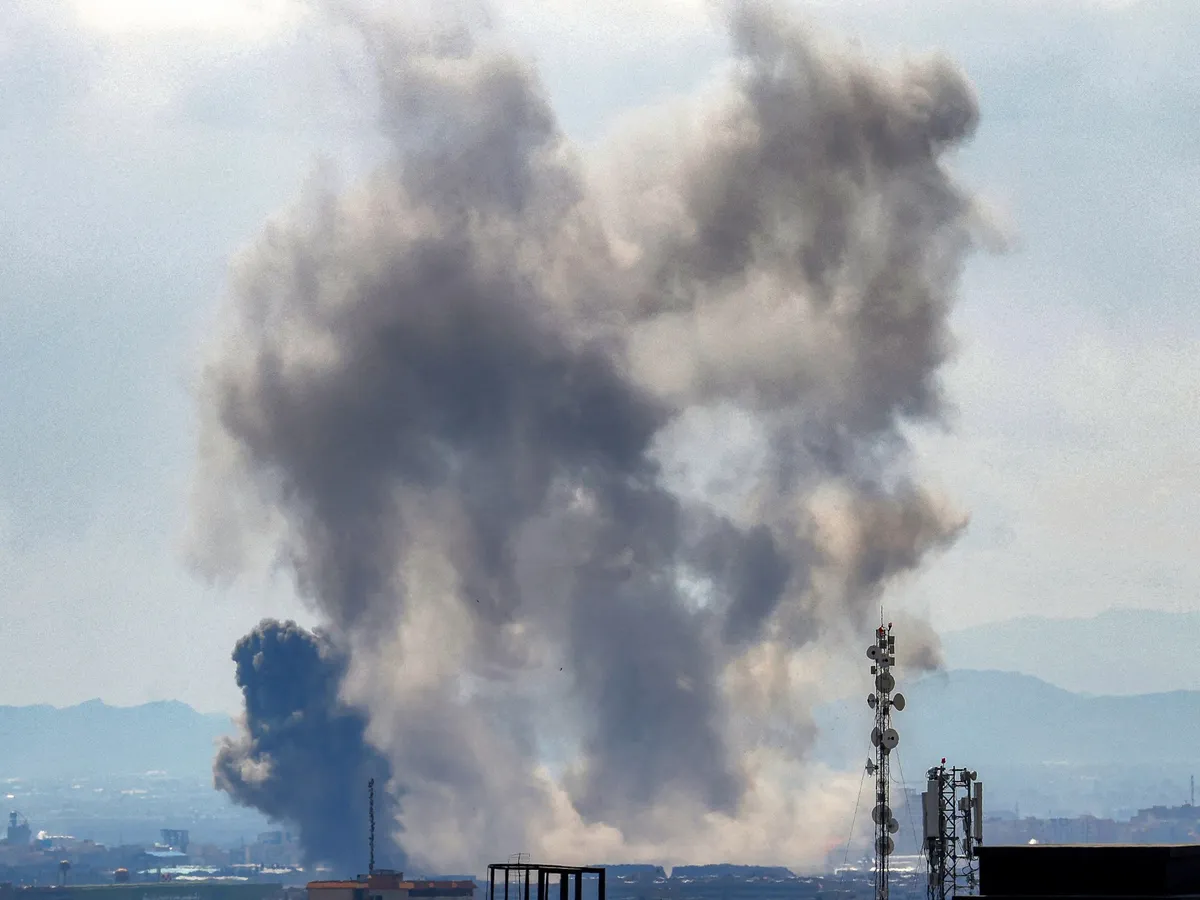
EXPLAINERProposal fuels uncertainty as US officials offer conflicting interpretations of the plan to permanently end hostilities.Smoke rises following strikes on Tehran on April 7, 2026 [AFP]Published On 9 Apr 2026Confusion over competing United States and Iranian proposals to end the war is deepening uncertainty about the fragile two-week ceasefire between the longtime foes, with officials presenting sometimes differing accounts of what has been agreed.At the centre of the dispute is an Iranian 10-point plan, which is the basis for the upcoming negotiations with the US in the Pakistani capital, Islamabad, this weekend. President Donald Trump has called the plan “workable”, despite initially handing Iran a 15-point plan that Tehran dismissed as “maximalist”.Recommended Stories list of 4 itemslist 1 of 4‘Israel must be restrained for US-Iran ceasefire to hold’list 2 of 4US VP JD Vance says Lebanon is not part of the US-Iran ceasefirelist 3 of 4Iran war day 41: What’s happening in Lebanon, Middle East and beyond?list 4 of 4Trump says US forces to stay near Iran, ready for ‘next conquest’end of listHowever, hours after the ceasefire, US officials, including Trump, offered mixed responses to Iran’s proposal and what Washington understood the key points of the document to be.Vice President JD Vance dismissed the publicised version as little more than a “random yahoo in Iran submitting it to public access television”.Adding to the confusion, the Persian version of the plan notably diverges from the English one on a key sticking point between Washington and Tehran – Iran’s right to enrich uranium.What was the US’s 15-point plan, and what was Iran’s response?The Trump administration presented Iran with what officials described as a 15-point framework aimed at ending the war, and potentially achieving a permanent end to hostilities between the longtime foes.While the full details have not been publicly released, reports by US media outlets and others included the following elements: Iran commits to never developing nuclear weapons. Iran must also no longer enrich uranium within the country, and hand over its stockpile of already enriched uranium to the International Atomic Energy Agency (IAEA). Tehran would also commit to allowing the IAEA to monitor all elements of the country’s remaining nuclear infrastructure. Reopening of the Strait of Hormuz. Ending Iran’s support for regional proxies such as Hezbollah in Lebanon and the Houthis in Yemen. A removal of all sanctions imposed on Iran, alongside the ending of the United Nations mechanism that allows sanctions to be reimposed. Limits on the range and number of Iran’s missiles. Donald Trump on Wednesday said that “many of the 15 points” in the proposal had been agreed upon, signalling optimism about a broader deal.“We are, and will be, talking tariff and sanctions relief with Iran,” the US president added.However, Iran rejected the US framework, with its Ministry of Foreign Affairs spokesperson Esmaeil Baghaei confirming that Tehran had received messages from the US via intermediaries. He dismissed Washington’s demands as “maximalist” and “illogical”.Tehran advanced its own positions in a 10-point counterproposal, which included demands of compensation for damages suffered by Iran during the war, a commitment to non-aggression by the US, Iran retaining its leverage over the Strait of Hormuz, and acceptance of Iran’s nuclear enrichment.How has the US reacted to the 10-point proposal?Trump on Wednesday said the US has received a 10-point proposal from Iran, which he called a “workable basis on which to negotiate”.However, later in the day, confusion over what the official US position was started to become apparent.Trump turned to his Truth Social platform to attack those he accused of spreading inaccurate accounts of supposed agreements.“There is only one group of meaningful ‘POINTS’ that are acceptable to the United States, and we will be discussing them behind closed doors during these Negotiations,” Trump said, without providing details. “These are the POINTS that are the basis on which we agreed to a CEASEFIRE.”The US president, in a separate post, said there will be “no enrichment of Uranium, and the United States will, working with Iran, dig up and remove all of the deeply buried (B-2 Bombers) Nuclear ‘Dust'”.White House press secretary Karoline Leavitt downplayed certain reports about the Iranian proposal and said that Trump would reject any uranium enrichment by Tehran.“The president’s red lines, namely the end of Iranian enrichment in Iran, have not changed,” Leavitt told reporters. While Iran says it is not seeking nuclear weapons, it insists on enriching its own uranium as a national right.Moreover, Leavitt said Iran’s initial 10-point proposal was “literally thrown in the garbage” by Trump’s team, but Tehran later put forward a revised “more reasonable and entirely different” plan, one which could be aligned with Trump’s own 15-point proposal.“The idea that President Trump would ever accept an Iranian wish list as a deal is completely absurd,” she said.Trump’s second-in-command, Vance, dismissed the publicised version as little more than a “random yahoo in Iran submitting it to public access television”.“We don’t really concern ourselves with what they claim they have the right to do; we concern ourselves with what they actually do,” he added in remarks made to reporters in Budapest.He said he had seen at least three different drafts of the proposals. “The first 10-point proposal was something that was submitted, and we think, frankly, was probably written by ChatGPT,” Vance said.In short, yes. At least two different versions of that same plan appear to exist, one in English and the other in Persian.In the Persian version, made public by Iran’s Supreme National Security Council, it said the “US has, in principle, committed to” a series of demands, most notably the “acceptance of enrichment”, signalling that any deal must recognise Iran’s right to continue enriching uranium.However, this phrase was allegedly omitted from the English-language version.Iran has consistently framed uranium enrichment as a sovereign right, while the Trump administration and its ally Israel call the demand a non-starter and a red line.For years, Tehran has maintained that its nuclear activities are strictly civilian and that it has no plans to build nuclear weapons.In 2015, it reached an agreement with the US to curb its nuclear programme in return for relief from sanctions. In 2018, however, Trump pulled Washington out of that landmark accord and reimposed sanctions on Iran.
SRCAl Jazeera
LANGEN
LEANCenter
WORDS1 029
ENT12
THU · 2026-04-09 · 14:47 GMTBRIEF NSR-2026-0409-60480
NSR-2026-0409-60480News Report·EN·Diplomatic
Has Iran’s 10-point plan changed, as JD Vance claims?
Negotiations between the US and Iran to end their ongoing war are facing uncertainty due to conflicting interpretations of Iran's proposed 10-point peace plan. The plan, the basis for upcoming talks in Islamabad, is meant to build upon a fragile two-week ceasefire.
Al Jazeera StaffAl JazeeraFiled 2026-04-09 · 14:47 GMTLean · CenterRead · 5 min
Al JazeeraFIG 01
Reading time
5min
Word count
1 029words
Sources cited
3cited
Entities identified
12entities
Quality score
100%
§ 01
Briefing Summary
AI-generatedNEWSAR · AI
Negotiations between the US and Iran to end their ongoing war are facing uncertainty due to conflicting interpretations of Iran's proposed 10-point peace plan. The plan, the basis for upcoming talks in Islamabad, is meant to build upon a fragile two-week ceasefire. While President Trump initially called the plan "workable," US officials, including Vice President Vance, have since offered mixed responses, with Vance dismissing the publicised version. A key point of contention is Iran's right to enrich uranium, with discrepancies existing between the English and Persian versions of the plan. The US had previously presented a 15-point plan that Iran rejected as "maximalist," which included demands such as Iran ending uranium enrichment and ceasing support for regional proxies.
Confidence 0.90Sources 3Claims 5Entities 12
§ 02
Article analysis
Model · rule-basedFraming
Diplomatic
Conflict
Tone
Measured
AI-assessed
CalmNeutralAlarmist
Factuality
0.70 / 1.00
Factual
LowHigh
Sources cited
3
Well sourced
FewMany
§ 03
Key claims
5 extracted01
VP JD Vance dismissed the publicised version as little more than a “random yahoo in Iran submitting it to public access television”.
quoteJD Vance
Confidence
1.00
02
US presented Iran with a 15-point framework aimed at ending the war.
factualnull
Confidence
1.00
03
President Trump called Iran's 10-point plan “workable”.
quoteDonald Trump
Confidence
1.00
04
Iran has a 10-point plan that is the basis for upcoming negotiations with the US.
factualnull
Confidence
1.00
05
Confusion over US and Iranian proposals is deepening uncertainty about the ceasefire.
factualnull
Confidence
0.80
§ 04
Full report
5 min read · 1 029 words§ 05
Entities
12 identifiedKey playerOppositionContextPositiveNeutralNegative
Organizations3
§ 06
Keywords & salience
9 termsus-iran ceasefire
0.90
10-point plan
0.80
15-point plan
0.70
uranium enrichment
0.70
hostilities
0.60
negotiations
0.60
regional proxies
0.50
international atomic energy agency (iaea)
0.50
strait of hormuz
0.40
§ 07
Topic connections
Interactive graph Network visualization showing 51 related topics
View Full Graph Person Organization Location Event|Click node to navigate|Edge numbers = shared articles