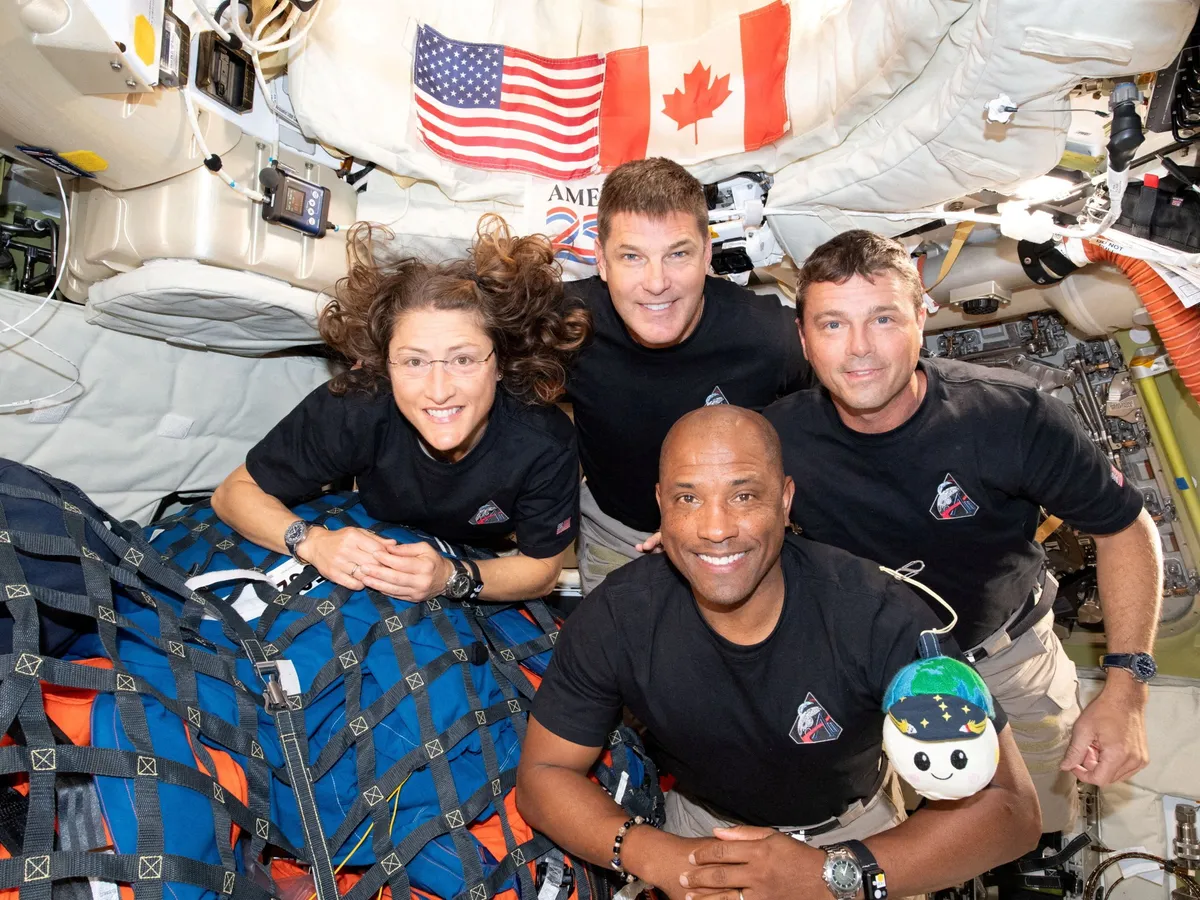
EXPLAINERArtemis II splashdown: When it lands, risks and how to watch liveThe Orion spacecraft will make its return to Earth at 00:07 GMT when it re-enters the atmosphere and splashes down off the San Diego coast.Published On 10 Apr 2026NASA’s Artemis II mission is nearing its final stage, with the Orion spacecraft set for a high-speed return to Earth and splashdown in the Pacific Ocean.The splashdown is a critical moment for the mission, testing systems that the space agency plans to use in future crewed moon landings, including Artemis III.Recommended Stories list of 2 itemslist 1 of 2What is NASA’s Artemis II moon mission, and when will it launch?list 2 of 2Photos: NASA releases picture of ‘Earthset’ shot by Artemis crewend of list“To every engineer, every technician that’s touched this machine — tomorrow belongs to you,” said NASA Associate Administrator Amit Kshatriya, during a mission update briefing on Thursday. “The crew has done their part. Now we have to do ours.”Over the course of their mission, NASA astronauts Reid Wiseman, Victor Glover and Christina Koch, together with Canada’s Jeremy Hansen, pushed beyond any previous human distance from Earth during their journey around the Moon.Here’s what to know about when the splashdown will happen, where the spacecraft is expected to land and how it works.NASA says the Orion spacecraft, named Integrity by the crew, will make its return to Earth on April 11 at about 00:07 GMT (8:07pm ET on April 10), when it re-enters the atmosphere and splashes down in the Pacific Ocean off the San Diego coast, the final and most critical stage of the Artemis II mission.Recovery teams will retrieve the crew by helicopter and transfer them to the USS John P Murtha, the amphibious ship leading the operation.NASA has set strict “go” conditions for splashdown, including wave heights below six feet (1.8 metres), winds under 28.7mph (46 km/h), and no rain or lightning within a 30-nautical-mile radius. Clear visibility is also essential for tracking Orion and safely recovering the astronauts.Most of the weather criteria are now in order to have a safe recovery mission by sea and by air.Artemis II marks the first time since Apollo 17 in 1972 that NASA and the Department of Defense are recovering a crewed spacecraft returning from the moon.Their Orion capsule will come hurtling back to Earth, hitting the atmosphere at about 34,965 feet (10,657 metres) per second, roughly 23,800mph (38,300km/h), fast enough to travel from New York to Tokyo in less than 20 minutes, according to Space.com.How does Artemis II return to Earth?The Orion spacecraft, Integrity, is already on its way back to Earth using the planet’s gravity to help pull it home.As it travels, a part of the spacecraft called the service module fires its thrusters a few times to gently adjust its path. These small corrections make sure Orion is lined up perfectly.This is important because re-entry only works if the spacecraft hits the atmosphere at the right angle; too steep or too shallow can be dangerous.The final adjustment happens a few hours before re-entry. After that, the astronauts put on their protective suits and prepare for the most intense part of the journey: passing through Earth’s atmosphere and splashing down safely in the ocean.About 42 minutes before the splashdown, the crew and service modules separate, leaving only the crew module to continue the final descent to Earth. The service module is then discarded and burns up in the atmosphere, while the crew module turns its heat shield forward for re-entry.What happens when Artemis II re-enters Earth’s atmosphere?As Orion enters the atmosphere, it slows dramatically, from 23,840mph (38,367 km/h) to about 325mph (523km/h) in 10 to 15 minutes. The most intense deceleration happens in the first few minutes, as the air acts like a powerful brake, creating extreme heat and friction that rapidly reduces the spacecraft’s speed before parachutes deploy.Then, a system of 11 parachutes deploys in sequence, slowing the capsule further to about 20mph (32km/h) for a relatively gentle splashdown in the Pacific Ocean.From the time it enters Earth’s atmosphere, the Artemis II spacecraft will fly 1,775 nautical miles (3,287km) to its landing spot in the Pacific Ocean.What is the heat shield, and why is it so critical?The heat shield is a protective layer on the bottom of the Orion spacecraft that absorbs and deflects the extreme heat generated as it re-enters Earth’s atmosphere.Returning from the moon, as the Orion slams into the atmosphere, air in front of the capsule compresses and heats up, creating temperatures of about 2,700 degrees Celsius (4,900 degrees Fahrenheit), hotter than lava.To survive this, Orion uses a specially designed ablative heat shield made from a material called Avcoat. Instead of just resisting heat, it slowly burns and erodes away, carrying heat with it and protecting the astronauts inside. If the shield fails, the underlying metallic structure could melt, rupture and disintegrate.And there is no way for the astronauts to escape.During the uncrewed Artemis I in 2022, Orion successfully returned from the moon, with its heat shield protecting the capsule from temperatures of up to 2,760C (5,000F).However, engineers later found the spacecraft had lost more heat shield material than expected, including pitting and missing sections, something NASA does not want repeated with astronauts on board: Artemis II uses the same design.An image provided by NASA shows the Orion spacecraft heat shield following the Artemis I test flight after it was removed from the crew module at the Kennedy Space Center in Cape Canaveral [NASA/AP]Some experts have raised concerns about these findings. Aerospace engineer and former NASA astronaut Charles Camarda told US media:“I do not believe that we should launch with the crew right now, it’s too risky. NASA does not understand what caused the failure on Artemis I … so there is no pressing need to fly a crew on this mission,” Camarda said a day before the launch.“The heat shield we have right now is deviant … and NASA cannot predict accurately how or when it will fail,” he added.Mission leaders say they are confident they now fully understand the heat shield’s behaviour and the steps needed to keep the crew safe.Because the shield is already integrated into the Orion spacecraft, replacing it would have caused major delays. Instead, engineers chose to adjust how the capsule returns to Earth. By using a steeper, more direct re-entry path, Orion will pass through the most intense heating more quickly, limiting the stress on the shield and improving overall safety for the astronauts.Artemis II commander Reid Wiseman said the updated flight path addresses the issue: “If we stick to the new re-entry profile NASA has planned, then this heat shield will be safe to fly.”Is there a blackout period during re-entry?As Orion plunges back into Earth’s atmosphere, the superheated, ionised gas that surrounds the spacecraft will block radio signals, temporarily cutting off communication with mission control.For missions like Artemis, the blackout typically lasts about three to six minutes.Those six minutes of radio silence are also when Orion’s heat shield does its most critical work, protecting Orion and its crew from intense temperatures. Onboard manoeuvring thrusters ensure Orion maintains the orientation required to keep the heat shield pointed towards Earth during re-entry.The blackout is expected and carefully planned for, but mission control must wait until communications are restored to confirm everything is proceeding as expected. This means the astronauts are alone during the harshest part of the trajectory.After Orion completes its passage through the outer atmosphere and emerges from its communications blackout, it will still be travelling too fast for it to survive the splashdown into the Pacific.To slow it down, a carefully timed parachute sequence begins: small parachutes deploy first to steady the capsule, followed by others that pull out three large main parachutes, which open fully to gently bring Orion down.Is there a timeline for key moments and where can you follow it?Yes. NASA has outlined a detailed timeline for the final stages of the Artemis II mission, from when the crew wake up to splashdown and recovery. Crew wakeup (15:35 GMT): Mission control wakes the astronauts for their final day as they begin preparing for the return to Earth. Cabin configuration (17:50 GMT): The crew secures all loose items and gets the capsule ready for re-entry. They put on their Orion Crew Survival System (OCSS) suits and special garments to help their bodies adjust back to Earth’s gravity. Trajectory correction (18:53 GMT): Orion fires its thrusters to make a last, precise correction to its path, aiming for the planned landing site off the coast of San Diego. Module separation (23:33 GMT): About 42 minutes before splashdown, the service module detaches. The crew capsule then reorients so its heat shield faces forward. Here is where the NASA coverage starts. Atmospheric entry (23:53 GMT): This is the moment the capsule officially hits Earth’s atmosphere and begins re-entry. Communication blackout (23:53-23:59 GMT): Contact with the spacecraft is temporarily lost as intense heat creates a plasma layer around the capsule. Splashdown (00:07 GMT): Parachutes slow the capsule before it lands in the Pacific Ocean. Recovery teams from the USS John P Murtha move in to retrieve the crew and spacecraft. Within two hours after splashdown: The Artemis II crew is flown to the USS John P Murtha and undergoes medical checkups prior to being flown back to shore. News conference (02:30 GMT): NASA officials hold a briefing from the Johnson Space Center with updates on the crew’s condition and the mission’s outcome. The splashdown and recovery will be broadcast live on NASA+, the NASA app, and its YouTube channel.What happens when the crew return to Earth?When a crew returns to Earth, they experience intense gravitational forces as the spacecraft barrels into the atmosphere and rapidly decelerates. Depending on the vehicle and trajectory, these forces typically peak between three and seven times the normal gravity that we experience on Earth.The higher the gravitational pull, the heavier a person feels: if the gravitational force is five times gravity on Earth, an astronaut who normally weighs 100kg will feel like their weight is 500kg.The crew are strapped tightly into their seats as the capsule shakes and decelerates during re-entry. While the experience is physically demanding, these forces are well within the range humans can safely withstand for short periods.Within two hours of splashdown, the crew will be taken out of the Orion capsule and flown by helicopter to the USS John P Murtha. Once on board, the astronauts will undergo medical checks before returning to shore and flying back to NASA’s Johnson Space Center in Houston.What have the astronauts said so far?As the Artemis II crew prepares for the journey back to Earth, they have described re-entry as both a highly technical and deeply emotional moment.“I’ve actually been thinking about entry since April 3, 2023, when we got assigned to this mission,” pilot Victor Glover said on WednesdayDespite the risks, he emphasised the significance of the return, not just physically, but in terms of what the crew is bringing back.“We have to get back. There’s so much data that you’ve seen already, but all the good stuff is coming back with us. There are so many more pictures, so many more stories,” said Glover, adding that “riding a fireball through the atmosphere is profound as well.”But beyond the speed and danger of re-entry, the journey has left the astronauts with a deeper perspective on Earth itself.“We live on a fragile planet in the vacuum and the void of space,” astronaut Jeremy Hansen said. “We’re very fortunate to live on planet Earth.”“And the other perspective that I’ve sort of learned from others through life is that our purpose on the planet as humans is to find joy, to find the joy in lifting each other up by creating solutions together instead of destroying. And when you see it from out here, it doesn’t change it, it just absolutely reaffirms that. It’s almost like seeing living proof of it,” Hansen added.For commander Reid Wiseman, one of the most powerful moments came when Earth disappeared from view altogether.“It is amazing to watch your home planet disappear behind the moon. You could see the atmosphere, you could actually see the terrain in the moon projected across the Earth as the Earth was eclipsing behind the moon. It was really just an unbelievable sight. And then it was gone, it was out of sight,” Wiseman explained.“But what we really hoped in our soul is that we could for just a moment have the world pause and remember that this is a beautiful planet in a very special place in our universe, and we should all cherish what we have been gifted. And I think for the folks that decided to tune in, and it sounds like it was quite a few, this has happened. And for that, we are eternally grateful,” he added.
SRCAl Jazeera
LANGEN
LEANCenter
WORDS2 138
ENT12
FRI · 2026-04-10 · 14:13 GMTBRIEF NSR-2026-0410-62207
NSR-2026-0410-62207News Report·EN·Technology
Artemis II splashdown: When it lands, risks and how to watch live
The Artemis II mission, NASA's first crewed lunar mission since 1972, is nearing completion with the Orion spacecraft's return to Earth. On April 11, 2026, at 00:07 GMT, the Orion capsule, carrying astronauts Reid Wiseman, Victor Glover, Christina Koch, and Jeremy Hansen, will re-enter the atmosphere and splash down in the Pacific Ocean off the coast of San Diego.
Elizabeth MelimopoulosAl JazeeraFiled 2026-04-10 · 14:13 GMTLean · CenterRead · 9 min
Al JazeeraFIG 01
Reading time
9min
Word count
2 138words
Sources cited
2cited
Entities identified
12entities
Quality score
100%
§ 01
Briefing Summary
AI-generatedNEWSAR · AI
The Artemis II mission, NASA's first crewed lunar mission since 1972, is nearing completion with the Orion spacecraft's return to Earth. On April 11, 2026, at 00:07 GMT, the Orion capsule, carrying astronauts Reid Wiseman, Victor Glover, Christina Koch, and Jeremy Hansen, will re-enter the atmosphere and splash down in the Pacific Ocean off the coast of San Diego. This splashdown is a critical test for systems planned for future crewed moon landings, including Artemis III. Recovery teams will retrieve the crew and transfer them to the USS John P Murtha. NASA has established strict weather conditions for a safe splashdown and recovery, including wave height, wind speed, and visibility requirements. The mission marks the first time NASA and the Department of Defense have recovered a crewed spacecraft returning from the moon since Apollo 17.
Confidence 0.90Sources 2Claims 5Entities 12
§ 02
Article analysis
Model · rule-basedFraming
Technology
Human Interest
Tone
Measured
AI-assessed
CalmNeutralAlarmist
Factuality
0.90 / 1.00
Factual
LowHigh
Sources cited
2
Limited
FewMany
§ 03
Key claims
5 extracted01
To every engineer, every technician that’s touched this machine — tomorrow belongs to you.
quoteAmit Kshatriya, NASA Associate Administrator
Confidence
1.00
02
NASA has set strict “go” conditions for splashdown, including wave heights below six feet.
factualNASA
Confidence
1.00
03
Orion will hit the atmosphere at about 23,800mph.
statisticSpace.com
Confidence
1.00
04
Recovery teams will retrieve the crew by helicopter and transfer them to the USS John P Murtha.
factualNASA
Confidence
1.00
05
The Orion spacecraft will return to Earth on April 11 at about 00:07 GMT.
factualNASA
Confidence
1.00
§ 04
Full report
9 min read · 2 138 words§ 05
Entities
12 identifiedKey playerOppositionContextPositiveNeutralNegative
People5
Organizations3
§ 06
Keywords & salience
9 termsartemis ii
1.00
splashdown
0.90
orion spacecraft
0.80
nasa
0.70
moon mission
0.60
pacific ocean
0.50
crewed spacecraft
0.50
re-entry
0.40
recovery mission
0.40
§ 07
Topic connections
Interactive graph Network visualization showing 24 related topics
View Full Graph Person Organization Location Event|Click node to navigate|Edge numbers = shared articles