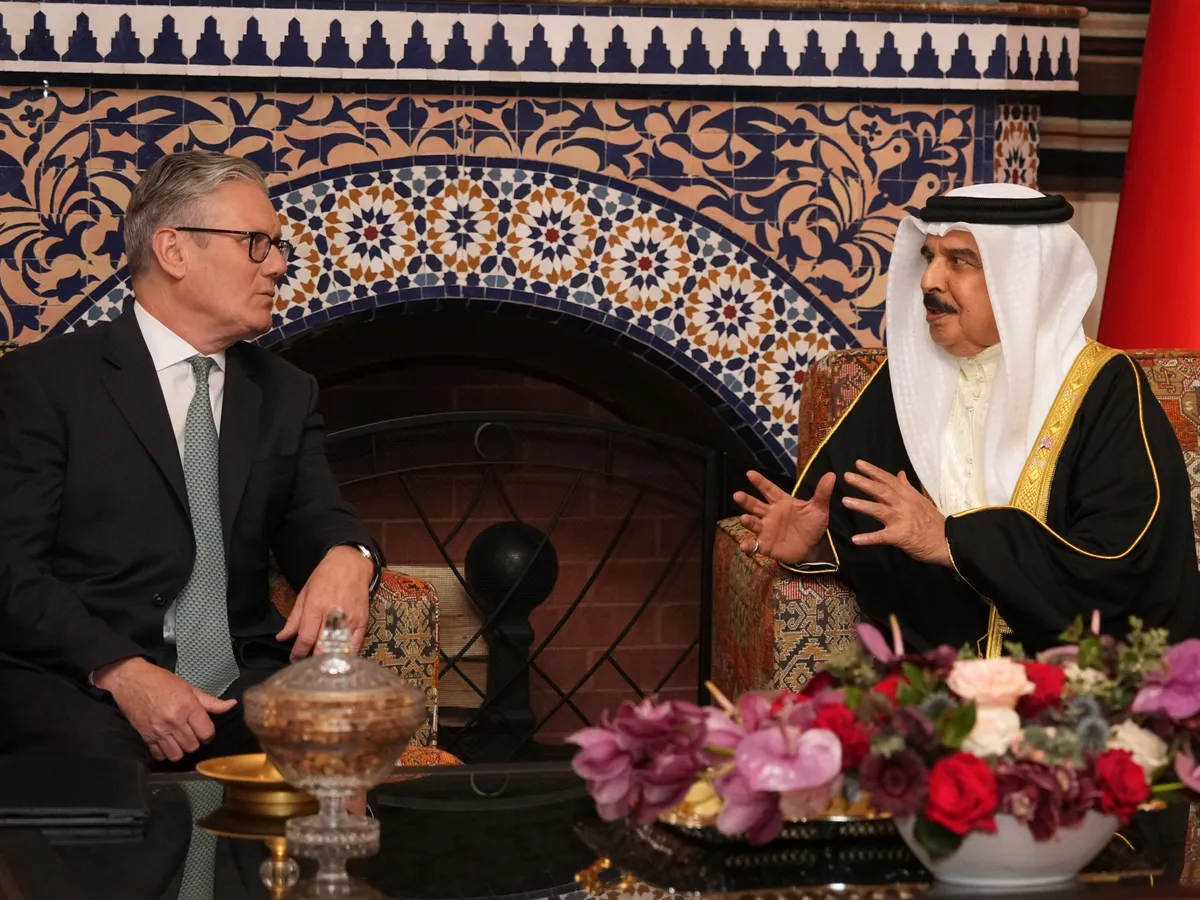
The UK PM visited the Gulf, and said many of the right things. But when you do the wrong things, words don’t matter.Palestinian political analyst and playwright.Published On 10 Apr 2026Britain's Prime Minister Keir Starmer meets Bahrain's King Hamad bin Isa Al Khalifa at the Al Sakhir Palace in Bahrain, Thursday, April 9, 2026 [Alastair Grant/ AP Photo]When UK Prime Minister Keir Starmer arrived in the Gulf this week, the message was clear: Britain was back, ready to play a stabilising diplomatic role in a region once again on the brink. Meetings were held, statements issued, alliances reaffirmed.The choreography of diplomacy was all there.But the reality unfolding around him told a different story.As Starmer moved between Saudi Arabia, the UAE, Bahrain and Qatar, the decisions that actually mattered were happening elsewhere. The fragile ceasefire between the United States and Iran was being shaped in Washington and Tehran.Israel continued its strikes on Lebanon, threatening to derail the entire process. Regional powers were recalibrating their positions in real time.Britain, despite its presence, was not driving any of it. This is not a temporary misstep. It is the clearest demonstration yet of a longer decline: the United Kingdom is no longer a decisive actor in the Middle East. It is, at best, a supporting voice in a conversation led by others.The British government insists this is a moment for diplomacy, not military escalation. Starmer has been careful to distance the UK from direct involvement in the conflict, emphasising legality, restraint and the need for long-term stability. On the surface, this appears measured — perhaps even wise.But diplomacy without influence is performance. The uncomfortable truth is that Britain is not being ignored by accident. It is being bypassed because it no longer carries the weight it once did.The centre of gravity has shifted. Washington still dominates Western engagement, however inconsistently. Regional powers — from Iran to the Gulf states — are increasingly assertive, shaping outcomes on their own terms. Even within Europe, other actors occasionally project more clarity and purpose.Britain, by contrast, appears uncertain of its role.This did not happen overnight. The erosion has been gradual, but deliberate. The Iraq war shattered trust across the region, embedding a perception of Britain as a follower rather than a leader. Brexit diminished its diplomatic reach, narrowing its influence without replacing it with a coherent global strategy.But if there is one issue that has crystallised this decline, it is Gaza.Since the start of Israel’s war on Gaza — widely described by legal scholars, human rights organisations, and growing parts of the international community as a genocide — Britain has aligned itself closely with Israeli policy, while struggling to respond meaningfully to the scale of destruction.It hesitated to call for a ceasefire as civilian casualties mounted. It maintained political and military support at moments when international pressure might have altered the trajectory. As humanitarian catastrophe unfolded, Britain’s voice was cautious, conditional, and, to many in the region, complicit.Credibility in the Middle East is not abstract. It is earned—and lost—through actions. A country that is seen as selectively applying international law cannot convincingly position itself as a mediator. A government that speaks of restraint while enabling excess cannot expect to be trusted to de-escalate conflict.This is the context in which Starmer arrived. Critics have already warned that Starmer’s visit risks appearing as diplomacy without consequence — words without action. Amnesty International has cautioned that without meaningful policy shifts, particularly on Israel, Britain’s calls for stability will carry little weight. Across the region, the UK is increasingly seen not as an independent actor, but as a partisan one. These are not ideological critiques. They reflect how Britain is now perceived.And perception, in diplomacy, is reality.The events of the past week have made this unmistakably clear. While Britain talks about securing shipping routes and supporting ceasefires, others are determining whether those ceasefires hold at all. While Starmer calls for de-escalation, Israel escalates. While the UK positions itself as a bridge, it is increasingly absent from the conversations taking place on either side.Even its closest ally appears to view it differently. The United States, under Donald Trump, has not only sidelined Britain but openly mocked its hesitation. That public dismissal, once unthinkable, now passes almost without surprise.Starmer’s strategy seems to rest on the belief that a more serious, professional tone can restore Britain’s standing. That competence can substitute for influence. But diplomacy is not branding. It cannot be rebuilt through posture alone. It requires consistency, independence, and a willingness to take positions that carry consequences.Britain has not done that. Instead, it has attempted to balance alignment with relevance — and ended up with neither.There is a deeper shift underway. The Middle East is no longer a region where Western powers can assume centrality. Regional actors are asserting themselves, forming new alignments, and, increasingly, bypassing traditional intermediaries. In this landscape, relevance is not inherited. It must be earned.Britain has yet to adjust. For now, Starmer’s visit stands as a revealing moment — not because of what it achieved, but because of what it exposed. A country that once claimed a central role now finds itself navigating the edges, speaking into a conversation that is no longer shaped by its voice.Britain did not lose its place in the Middle East overnight. It traded it — slowly, deliberately — for alignment, silence, and convenience.And now, when it tries to speak, it finds that no one is listening.The views expressed in this article are the author’s own and do not necessarily reflect Al Jazeera’s editorial stance.
SRCAl Jazeera
LANGEN
LEANCenter
WORDS920
ENT12
FRI · 2026-04-10 · 11:53 GMTBRIEF NSR-2026-0410-62209
NSR-2026-0410-62209Analysis·EN·Diplomatic
Sorry Keir Starmer, the Middle East does not listen to Britain any more
In April 2026, UK Prime Minister Keir Starmer visited Saudi Arabia, the UAE, Bahrain, and Qatar, aiming to reassert Britain's diplomatic role in the Middle East. However, a Palestinian political analyst argues that Britain's influence in the region has significantly declined.
Ahmed NajarAl JazeeraFiled 2026-04-10 · 11:53 GMTLean · CenterRead · 4 min
Al JazeeraFIG 01
Reading time
4min
Word count
920words
Sources cited
1cited
Entities identified
12entities
Quality score
100%
§ 01
Briefing Summary
AI-generatedNEWSAR · AI
In April 2026, UK Prime Minister Keir Starmer visited Saudi Arabia, the UAE, Bahrain, and Qatar, aiming to reassert Britain's diplomatic role in the Middle East. However, a Palestinian political analyst argues that Britain's influence in the region has significantly declined. Critical decisions regarding the US-Iran ceasefire and Israeli strikes on Lebanon were being made elsewhere, bypassing the UK. The article asserts that Britain is now a supporting voice rather than a decisive actor, a consequence of the Iraq war and Brexit. The UK's emphasis on diplomacy is undermined by its lack of influence, as regional powers and other Western nations take the lead in shaping outcomes.
Confidence 0.90Sources 1Claims 5Entities 12
§ 02
Article analysis
Model · rule-basedFraming
Diplomatic
Political Strategy
Tone
Mixed Tone
AI-assessed
CalmNeutralAlarmist
Factuality
0.30 / 1.00
Opinion-Heavy
LowHigh
Sources cited
1
Limited
FewMany
§ 03
Key claims
5 extracted01
Starmer has been careful to distance the UK from direct involvement in the conflict.
factualnull
Confidence
1.00
02
Britain has aligned itself closely with Israeli policy since the start of Israel’s war on Gaza.
factualnull
Confidence
0.90
03
Brexit diminished its diplomatic reach.
factualnull
Confidence
0.80
04
The UK is no longer a decisive actor in the Middle East.
predictionnull
Confidence
0.80
05
The Iraq war shattered trust across the region.
factualnull
Confidence
0.70
§ 04
Full report
4 min read · 920 words§ 05
Entities
12 identifiedKey playerOppositionContextPositiveNeutralNegative
§ 06
Keywords & salience
9 termsmiddle east
1.00
british influence
0.90
diplomacy
0.80
keir starmer
0.70
uk foreign policy
0.60
gulf states
0.60
regional powers
0.50
brexit
0.40
iraq war
0.40
§ 07
Topic connections
Interactive graph Network visualization showing 51 related topics
View Full Graph Person Organization Location Event|Click node to navigate|Edge numbers = shared articles