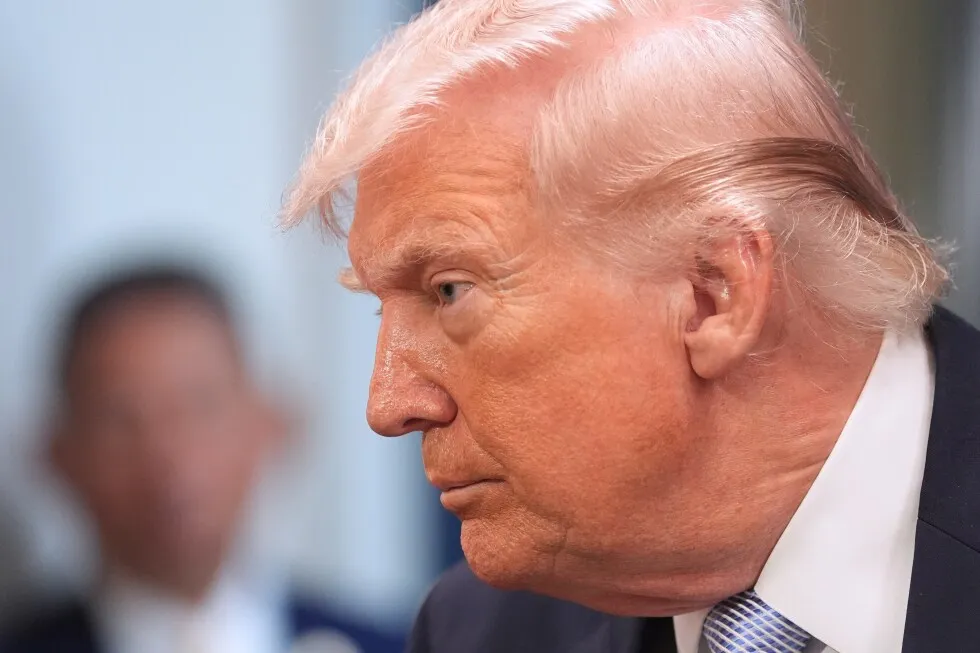
President Donald Trump speaks with reporters in the James Brady Press Briefing Room at the White House, Monday, April 6, 2026, in Washington. (AP Photo/Alex Brandon) 2026-04-10T16:03:38Z New York (AP) — The centerpiece of President Donald Trump’s economic policy — sweeping taxes on global imports — is under legal assault again. The U.S. Court of International Trade , a specialized court in New York, is hearing oral arguments Friday in an attempt to overturn the temporary tariffs Trump turned to after the Supreme Court in February struck down his preferred choice — even bigger, even more sweeping tariffs. In his first attempt to impose global tariffs, the president last year invoked the 1977 International Emergency Economic Powers Act (IEEPA), using the law to declare America’s longstanding trade deficit a national emergency and to impose double-digit worldwide taxes on imports to combat it. He interpreted the law broadly to justify tariffs of whatever size he wanted, whenever he wanted to impose them, on whatever country he wanted to target. The Supreme Court struck those tariffs down on Feb. 20, saying IEEPA did not authorize the use of tariffs to counter national emergencies. But Trump had alternatives to IEEPA. The quickest option was Section 122 of the Trade Act of 1974, which allows the president to impose global tariffs of up to 15% for 150 days, after which congressional approval is needed to extend them. After his defeat at the Supreme Court, Trump quickly announced 10% Section 122 tariffs. He said he’d raise them to the maximum 15% but hasn’t yet done so. The tariffs are scheduled to expire July 24. Section 122 is aimed at what it calls “fundamental international payments problems.’’ At issue is whether that wording covers trade deficits, the gap between what the U.S. sells other countries and what it buys from them. (
SRCAssociated Press (AP)
LANGEN
LEANCenter
WORDS306
ENT8
FRI · 2026-04-10 · 16:23 GMTBRIEF NSR-2026-0410-62370
NSR-2026-0410-62370News Report·EN·Legal & Judicial
Federal court hears new case against Trump’s latest global tariffs
The U.S. Court of International Trade is hearing a case challenging President Trump's latest global tariffs.
Associated Press (AP)Filed 2026-04-10 · 16:23 GMTLean · CenterRead · 2 min
Associated Press (AP)FIG 01
Reading time
2min
Word count
306words
Sources cited
0cited
Entities identified
8entities
Quality score
100%
§ 01
Briefing Summary
AI-generatedNEWSAR · AI
The U.S. Court of International Trade is hearing a case challenging President Trump's latest global tariffs. These tariffs were implemented after the Supreme Court struck down his initial attempt to impose broader tariffs under the International Emergency Economic Powers Act (IEEPA) in February 2026. Trump then invoked Section 122 of the Trade Act of 1974, allowing temporary tariffs of up to 15%. He imposed 10% tariffs, arguing that America's trade deficit constitutes a "fundamental international payments problem," the justification required by Section 122. The lawsuit aims to overturn these tariffs, which are scheduled to expire in July, by arguing that trade deficits do not qualify under Section 122.
Confidence 0.90Claims 5Entities 8
§ 02
Article analysis
Model · rule-basedFraming
Legal & Judicial
Economic Impact
Tone
Measured
AI-assessed
CalmNeutralAlarmist
Factuality
0.80 / 1.00
Factual
LowHigh
Sources cited
0
No named sources
FewMany
§ 03
Key claims
5 extracted01
The current tariffs are scheduled to expire July 24.
factual
Confidence
1.00
02
Section 122 of the Trade Act of 1974 allows the president to impose global tariffs of up to 15% for 150 days.
factual
Confidence
1.00
03
Trump then announced 10% Section 122 tariffs after the Supreme Court ruling.
factual
Confidence
1.00
04
The Supreme Court struck down Trump's initial tariffs based on the IEEPA in February.
factual
Confidence
1.00
05
The U.S. Court of International Trade is hearing oral arguments in an attempt to overturn President Trump's temporary tariffs.
factual
Confidence
1.00
§ 04
Full report
2 min read · 306 words§ 05
Entities
8 identifiedKey playerOppositionContextPositiveNeutralNegative
Organizations4
§ 06
Keywords & salience
10 termsglobal tariffs
1.00
trade deficit
0.70
section 122
0.70
u.s. court of international trade
0.60
trade act of 1974
0.60
international emergency economic powers act
0.60
imports
0.50
economic policy
0.50
supreme court
0.50
legal challenge
0.40
§ 07
Topic connections
Interactive graph Network visualization showing 51 related topics
View Full Graph Person Organization Location Event|Click node to navigate|Edge numbers = shared articles