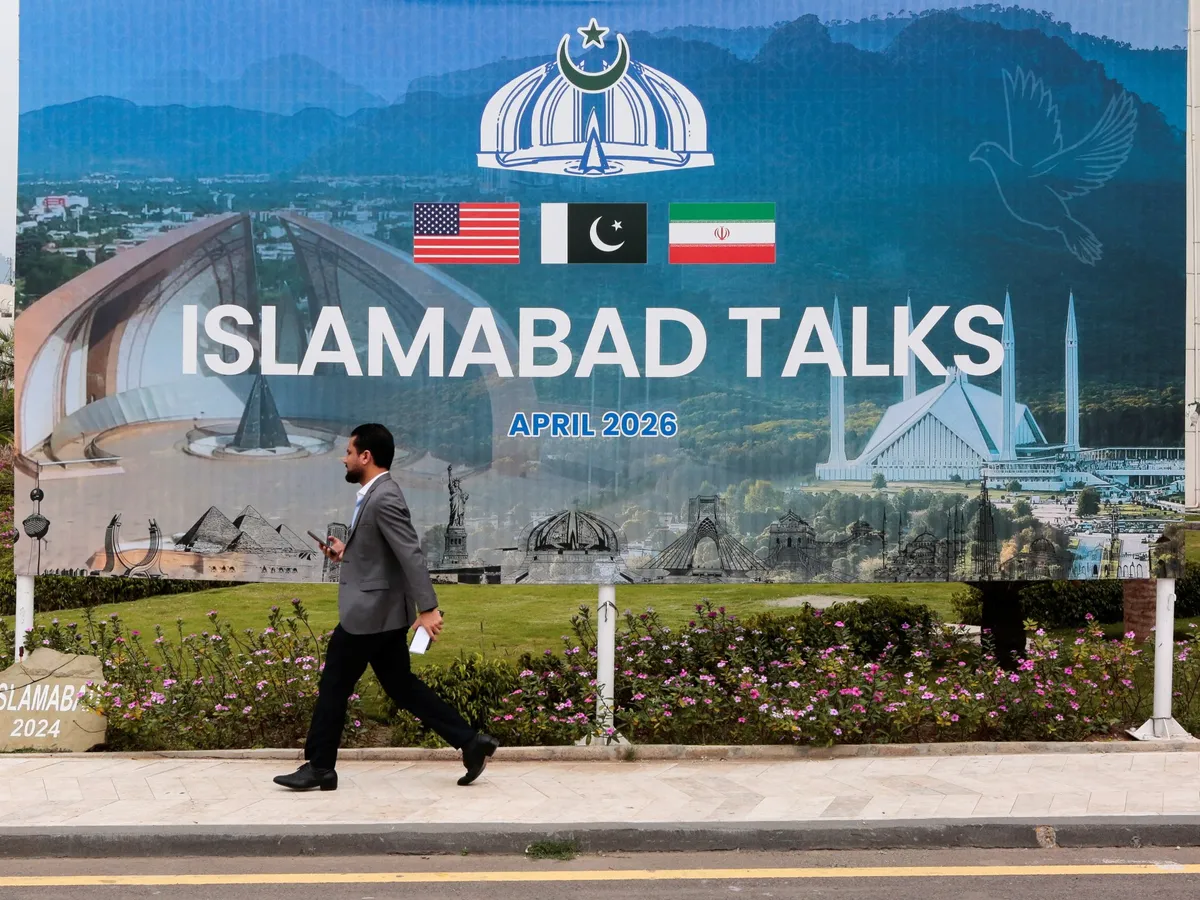
Discussions between Iran and US delegations begin following separate bilateral meetings with Pakistani prime minister.A man walks past a billboard announcing US and Iran negotiations outside a media centre in Islamabad, Pakistan, on Saturday, April 11, 2026 [Asim Hafeez/Reuters]Published On 11 Apr 2026|Updated: 11 Apr 2026 03:57 PM (GMT)The United States and Iran are holding in-person talks in Pakistan to end their six-week-old war, days after a fragile ceasefire was agreed.Face-to-face discussions between the two sides began in Islamabad on Saturday afternoon, the White House confirmed, following earlier bilateral meetings each side held separately with Pakistani Prime Minister Shehbaz Sharif.Recommended Stories list of 3 itemslist 1 of 3Pakistan sets modest goal for US-Iran summit: A deal to keep talks goinglist 2 of 3Is the US-Iran ceasefire already doomed?list 3 of 3Can Iran negotiations lead to peace?end of listIranian state media reported that three-party talks had begun after Iranian preconditions, including a reduction in Israeli attacks on Lebanon, were met.Al Jazeera’s Abid Hussain, reporting from Islamabad, said the talks were initially meant to be “proximate talks”, but “our sources close to the mediation say the two teams are [now] involved in direct negotiations, with the Pakistani mediators also present” in the room.The US delegation is led by US Vice President JD Vance and includes special envoy Steve Witkoff and President Donald Trump’s son-in-law Jared Kushner.Iran’s delegation of more than 70 people is being led by parliamentary Speaker Mohammad Bagher Ghalibaf and Foreign Minister Abbas Araghchi.Vance and Ghalibaf met separately with Pakistan’s Sharif earlier on Saturday, with Sharif’s office saying Islamabad looked forward to continuing its facilitation of both sides.“The Prime Minister expressed the hope that these talks would serve as a stepping stone toward durable peace in the region,” Sharif’s office said in a statement.The negotiations proceeded despite earlier assertions from Tehran that they would not take place without commitments on Lebanon’s inclusion in the ceasefire and US sanctions.Earlier, Ghalibaf wrote on X that Washington had previously agreed to unblock Iranian assets and to a ceasefire in Lebanon, where Israeli attacks on Iran-backed Hezbollah fighters have killed nearly 2,000 people since the start of the fighting in March.Israel and the US have said the Lebanon campaign is not part of the Iran-US ceasefire, while Tehran and Pakistan say it is.Al Jazeera’s Osama Bin Javaid, reporting from Islamabad, cited sources as saying that “there has been some progress made on basic conditions, including on the need for a ceasefire in Lebanon”.While no Lebanon ceasefire has been agreed, he said there are reports of a possible understanding to limit strikes to southern Lebanon.Sources are also saying that “there could be some movement on the unfreezing” of Iranian assets, said Bin Javaid. However, he also said that “it is still early hours and a lot of this needs to be confirmed,” but that Pakistan is still very hopeful about the possibility of a breakthrough.Ghalibaf said earlier that Iran was ready to reach a deal if Washington offered what he described as a genuine agreement and granted Iran its rights, Iranian state media reported.“Our experience in negotiating with the Americans has always been met with failure and broken promises,” Ghalibaf said, shortly after landing in Pakistan.Trump posted on social media that the only reason the Iranian officials were alive was to negotiate a deal.“The Iranians don’t seem to realize they have no cards, other than a short term extortion of the World by using International Waterways. The only reason they are alive today is to negotiate!” he said.Vance, speaking as he headed to Pakistan, said he expected a positive outcome but added: “If they’re going to try to play us, then they’re going to find the negotiating team is not that receptive.”Trump announced a two-week ceasefire in the war on Tuesday, which has halted US and Israeli air strikes on Iran.But it has not ended Iran’s blockade of the Strait of Hormuz, which has caused the biggest-ever disruption to global energy supplies, or secured a ceasefire in the parallel war between Israel and Iran-backed Hezbollah in Lebanon.
SRCAl Jazeera
LANGEN
LEANCenter
WORDS672
ENT12
SAT · 2026-04-11 · 13:26 GMTBRIEF NSR-2026-0411-63392
NSR-2026-0411-63392News Report·EN·Diplomatic
US-Iran talks on ending war begin in Pakistan
The United States and Iran began direct talks in Islamabad, Pakistan on April 11, 2026, to negotiate an end to their six-week-old war, following a fragile ceasefire. The discussions are being mediated by Pakistan, whose Prime Minister Shehbaz Sharif met separately with both delegations beforehand.
Al Jazeera StaffAl JazeeraFiled 2026-04-11 · 13:26 GMTLean · CenterRead · 3 min
Al JazeeraFIG 01
Reading time
3min
Word count
672words
Sources cited
5cited
Entities identified
12entities
Quality score
100%
§ 01
Briefing Summary
AI-generatedNEWSAR · AI
The United States and Iran began direct talks in Islamabad, Pakistan on April 11, 2026, to negotiate an end to their six-week-old war, following a fragile ceasefire. The discussions are being mediated by Pakistan, whose Prime Minister Shehbaz Sharif met separately with both delegations beforehand. The US delegation is led by Vice President JD Vance, while Iran's delegation is headed by parliamentary Speaker Mohammad Bagher Ghalibaf and Foreign Minister Abbas Araghchi. The talks proceeded after Iran stated preconditions were met, including a reduction in Israeli attacks on Lebanon, though the US and Israel maintain the Lebanon campaign is separate from the US-Iran ceasefire. The goal of the negotiations is to achieve a durable peace in the region.
Confidence 0.90Sources 5Claims 5Entities 12
§ 02
Article analysis
Model · rule-basedFraming
Diplomatic
Conflict
Tone
Measured
AI-assessed
CalmNeutralAlarmist
Factuality
0.80 / 1.00
Factual
LowHigh
Sources cited
5
Well sourced
FewMany
§ 03
Key claims
5 extracted01
US Vice President JD Vance and Iranian parliamentary Speaker Mohammad Bagher Ghalibaf met separately with Pakistan’s Sharif earlier on Saturday.
factualSharif’s office
Confidence
1.00
02
Face-to-face discussions between the two sides began in Islamabad on Saturday afternoon.
factualWhite House
Confidence
1.00
03
The United States and Iran are holding in-person talks in Pakistan to end their six-week-old war.
factualAl Jazeera
Confidence
1.00
04
Iranian state media reported that three-party talks had begun after Iranian preconditions, including a reduction in Israeli attacks on Lebanon, were met.
factualIranian state media
Confidence
0.90
05
Israeli attacks on Iran-backed Hezbollah fighters have killed nearly 2,000 people since the start of the fighting in March.
statisticGhalibaf on X
Confidence
0.80
§ 04
Full report
3 min read · 672 words§ 05
Entities
12 identifiedKey playerOppositionContextPositiveNeutralNegative
People6
Organizations1
§ 06
Keywords & salience
9 termsus-iran talks
1.00
ceasefire
0.80
negotiations
0.70
pakistan
0.60
war
0.60
israeli attacks
0.50
lebanon
0.50
sanctions
0.40
mediation
0.40
§ 07
Topic connections
Interactive graph Network visualization showing 51 related topics
View Full Graph Person Organization Location Event|Click node to navigate|Edge numbers = shared articles