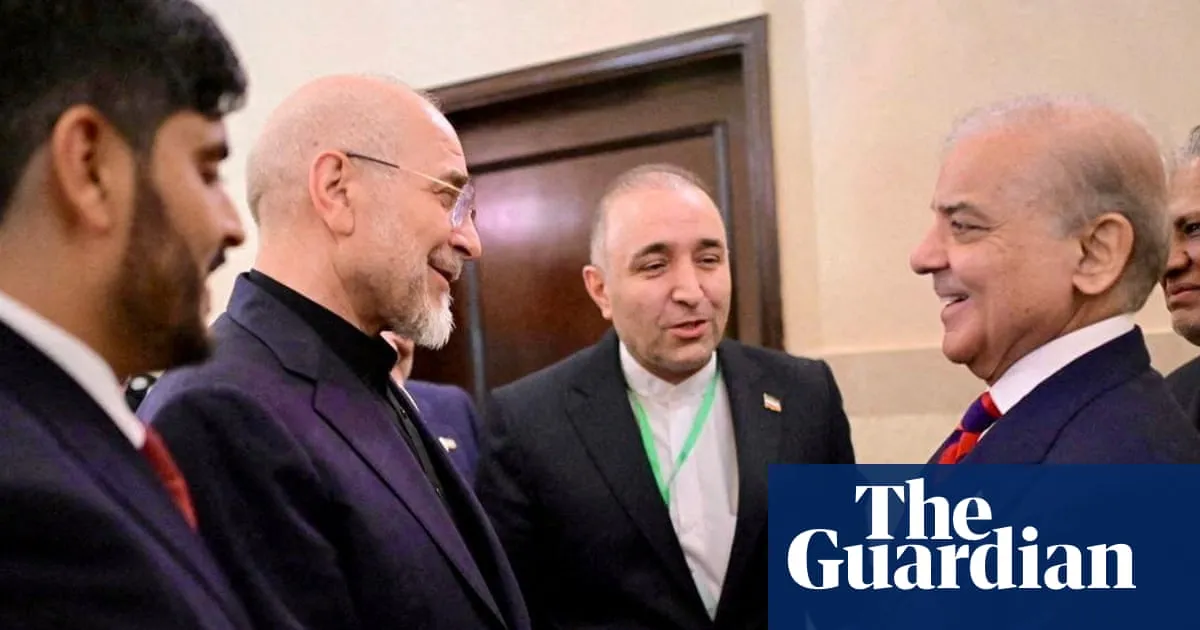
Peace talks between Iran and the US began in Islamabad this afternoon, with senior negotiators from both countries meeting face to face at the highest level for the first time since 1979, in the presence of mediators from Pakistan.Pakistani state TV said US and Iranian officials were “sitting directly at the same table” – which was later confirmed by the White House – and discussions were beginning in a positive atmosphere, despite fighting continuing in Lebanon.JD Vance, the US vice-president, is leading the American delegation, while Iran’s negotiators in Islamabad are headed by Mohammad Bagher Ghalibaf, the parliamentary speaker, and Abbas Araghchi, the foreign minister.Pakistani sources also said that Pakistan’s army chief, Asim Munir, was present in the room. The field marshal, who was key in brokering the ceasefire earlier this week, is reported to have a good relationship with the US president, Donald Trump.The first round of discussions went on for about two hours, a political source said, and was followed by a second round of more technical discussions. These technical talks were divided into key topics, with a focus on security, finance and the strait of Hormuz, the source added.It was then planned that there would be a break for dinner, to be hosted by Pakistan’s prime minister, Shehbaz Sharif, at his residence.Earlier, the Iranian negotiators demanded a ceasefire in Lebanon, reparations and commitment to unblock frozen assets as part of a peace deal in a preliminary meeting with Pakistani mediators, led by Sharif.However, the US warned it would not allow itself to be manipulated by a weakened Tehran. On his arrival, Vance said: “If they’re going to try to play us, then they’re going to find the negotiating team is not that receptive.”The US vice-president, JD Vance, meets Pakistan’s prime minister, Shehbaz Sharif, in Islamabad. Photograph: ReutersIn previous negotiations, the US and Iranian teams have been based separately.During the nuclear negotiations held in Geneva in late February, diplomats from Oman shuttled between the two sides, though the talks collapsed when the US and Israel bombed Iran on 28 February, killing supreme leader Ali Khamenei.Israel is not present at the talks as its military said it had bombed 200 Hezbollah targets in southern Lebanon in the past 24 hours. Strikes on the towns of Kfar Sir, Zefta and Toul killed 10 people overnight, while Hezbollah fired rockets at cities in Israel’s north. Israeli troops and Hezbollah fighters clashed in the city of Bint Jbeil.Trump said the US was “now starting the process of clearing out the strait of Hormuz” and that all of Iran’s mine-laying vessels had been sunk during the US and Israel’s 40-day bombing campaign.There were further reports that US navy warships had crossed west and returned east to establish freedom of navigation, but Iran denied this. Iranian state TV then said any US warship crossing Hormuz would be attacked within 30 minutesOther members of the US negotiating team in Islamabad include Steve Witkoff, the real estate developer who is Trump’s personal envoy, and Jared Kushner, who holds no formal White House position but is the president’s son-in-law.A senior Pakistani official expressed optimism as the discussions began: “Like us, the entire world is looking for a breakthrough and an end of the war. The talks are in a strong position because both delegations have come to Islamabad with complete authority from their capitals and have stepped back from extreme positions.”Al-Araby Al-Jadeed, a Qatari newspaper based in the UK, reported that China “may offer guarantees” to secure a deal, citing a Pakistani source. It also claimed that a delegation from the country had travelled for the talks.However, other Pakistani sources said later that, contrary to the newspaper report, a Chinese delegation had not flown in. “They did not need to come, as the Chinese ambassador is in constant contact and they are on board with the talks,” one said.Iranian media reported that the US had agreed to unblock $6bn of Iranian assets frozen in Qatar, though this was promptly denied by US officials.Direct talks between Lebanese and Israeli ambassadors are due to be held in Washington at the US state department. The two sides will discuss “declaring a ceasefire and the start date for negotiations between Lebanon and Israel under US auspices”, Lebanon’s presidency said.Israel has indicated it is willing to negotiate directly with the Lebanese government, of which Hezbollah is a part, but has said it is not prepared to agree a ceasefire with the pro-Iran proxy group. The two sides have been fighting since early March, when Hezbollah entered the war in support of Iran.Hezbollah supporters staged a rally against the negotiations in front of the prime ministers’ office on Saturday afternoon, with protesters waving Hezbollah flags and pictures of the organisation’s late chief Hassan Nasrallah.Protesters carry pictures of Hassan Nasrallah in a rally against the talks in Beirut on Saturday. Photograph: Wael Hamzeh/EPAThe Lebanese army deployed troops around the area and warned that it would not tolerate any attempts to destabilise the country at “this sensitive moment”.Internal tensions in Lebanon had been on the rise since Israeli bombing over the last month displaced more than 1.2 million people across the country. Disagreements over Lebanon’s engagement with Israel threatened to further fracture the divided country as they pitted Hezbollah against the government.The Lebanese prime minister, Nawaf Salam, announced he was cancelling a planned trip to Washington on Thursday, where he was supposed to meet with the US secretary of state, Marco Rubio, to further negotiations with Israel.Mahmoud Qamati, the vice-head of Hezbollah’s deputy political council, warned in an interview on Saturday that the armed group viewed the government in an increasingly confrontational light.
SRCThe Guardian - World News
LANGEN
LEANCenter-Left
WORDS938
ENT12
SAT · 2026-04-11 · 16:59 GMTBRIEF NSR-2026-0411-63608
NSR-2026-0411-63608News Report·EN·Diplomatic
US and Iran hold talks in Islamabad as Pakistan seeks to broker peace deal
The US and Iran have begun direct peace talks in Islamabad, Pakistan, the first high-level meeting between the two countries since 1979. The talks, mediated by Pakistan, are led by US Vice-President JD Vance and Iranian parliamentary speaker Mohammad Bagher Ghalibaf, with Pakistan's army chief Asim Munir also present.
Dan Sabbagh, Shah Meer Baloch, William Christou and Hannah Ellis-PetersenThe Guardian - World NewsFiled 2026-04-11 · 16:59 GMTLean · Center-LeftRead · 4 min
The Guardian - World NewsFIG 01
Reading time
4min
Word count
938words
Sources cited
6cited
Entities identified
12entities
Quality score
100%
§ 01
Briefing Summary
AI-generatedNEWSAR · AI
The US and Iran have begun direct peace talks in Islamabad, Pakistan, the first high-level meeting between the two countries since 1979. The talks, mediated by Pakistan, are led by US Vice-President JD Vance and Iranian parliamentary speaker Mohammad Bagher Ghalibaf, with Pakistan's army chief Asim Munir also present. Initial discussions focused on security, finance, and the Strait of Hormuz, following Iranian demands for a Lebanon ceasefire, reparations, and asset unblocking. The US has cautioned against manipulation. These talks follow previous failed negotiations in Geneva and ongoing conflict between Israel and Hezbollah in Lebanon. Pakistan's Prime Minister Shehbaz Sharif is hosting a dinner for the negotiating teams.
Confidence 0.90Sources 6Claims 5Entities 12
§ 02
Article analysis
Model · rule-basedFraming
Diplomatic
National Security
Tone
Mixed Tone
AI-assessed
CalmNeutralAlarmist
Factuality
0.80 / 1.00
Factual
LowHigh
Sources cited
6
Well sourced
FewMany
§ 03
Key claims
5 extracted01
The US was “now starting the process of clearing out the strait of Hormuz”.
quoteDonald Trump
Confidence
1.00
02
Iran’s negotiators are headed by Mohammad Bagher Ghalibaf and Abbas Araghchi.
factualArticle
Confidence
1.00
03
JD Vance is leading the American delegation.
factualArticle
Confidence
1.00
04
US and Iranian officials were “sitting directly at the same table”.
quotePakistani state TV
Confidence
1.00
05
Peace talks between Iran and the US began in Islamabad.
factualArticle
Confidence
1.00
§ 04
Full report
4 min read · 938 words§ 05
Entities
12 identifiedKey playerOppositionContextPositiveNeutralNegative
People6
Organizations1
§ 06
Keywords & salience
10 termspeace talks
1.00
us iran relations
0.90
islamabad
0.80
pakistan
0.70
negotiations
0.60
lebanon
0.50
ceasefire
0.50
finance
0.40
strait of hormuz
0.40
security
0.40
§ 07
Topic connections
Interactive graph Network visualization showing 51 related topics
View Full Graph Person Organization Location Event|Click node to navigate|Edge numbers = shared articles