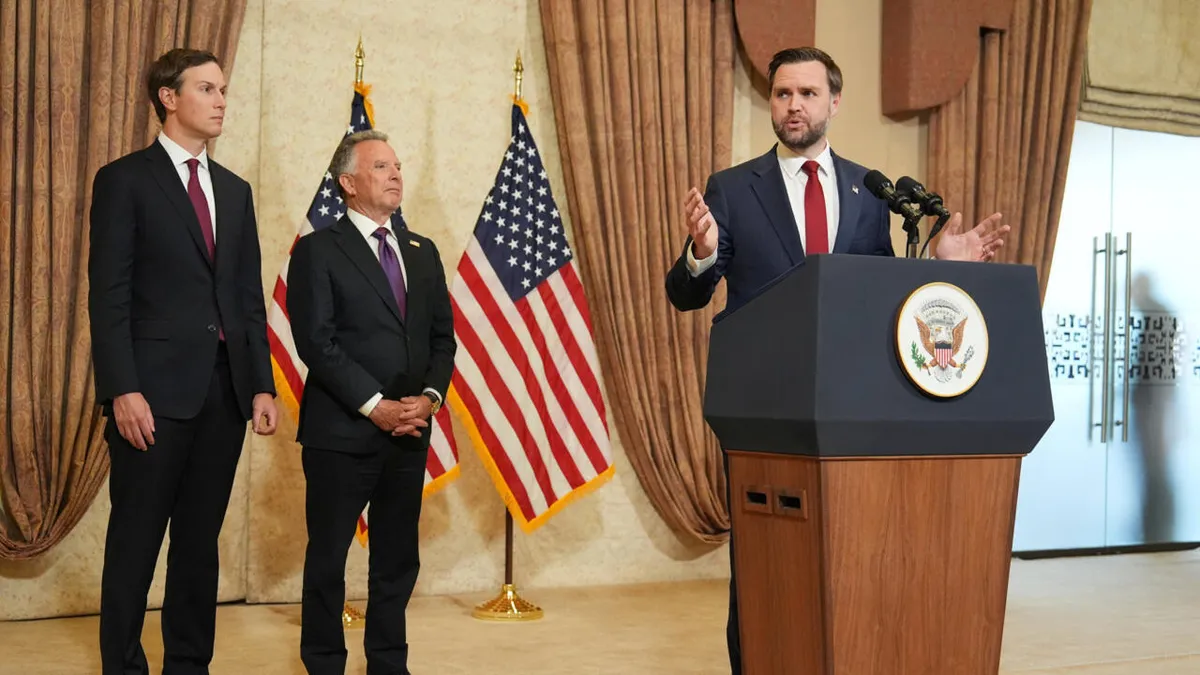
Les États-Unis et l'Iran ont échoué à trouver un accord pour mettre fin à la guerre au Moyen-Orient, au terme de négociations marathon à Islamabad, a annoncé dimanche le vice-président américain J.D. Vance, qui rentre aux États-Unis après avoir fait, selon lui, une « offre finale et la meilleure possible » à l'Iran. Publié le : 12/04/2026 - 09:22 3 min Temps de lecture Le vice-président américain JD Vance s'exprime lors d'une conférence de presse après avoir rencontré des représentants du Pakistan et de l'Iran, le dimanche 12 avril 2026, à Islamabad, au Pakistan © Pool / via Reuters « Nous rentrons aux États-Unis sans être parvenus à un accord », a déclaré J.D. Vance lors d'une brève conférence de presse à Islamabad, où Américains et Iraniens négociaient depuis samedi, à un niveau inédit entre les deux pays depuis la Révolution islamique de 1979. « Je pense que c'est une mauvaise nouvelle pour l'Iran bien plus que ce ne l'est pour les États-Unis d'Amérique », a-t-il considéré. Malgré des échanges intenses de plus de 20 heures, les discussions n’ont pas permis de rapprocher les positions. Avant de décoller du Pakistan, le vice-président américain J.D. Vance affirme ne pas avoir obtenu les garanties jugées indispensables sur le renoncement de Téhéran à l’arme nucléaire, une ligne rouge absolue pour Washington, qui pointe du doigt un manque de flexibilité de la partie iranienne, rapporte notre correspondante à Islamabad, Ondine de Gaulle. Le vice-président a laissé entendre qu'il accordait encore du temps à l'Iran pour examiner l'offre américaine. « Nous avons besoin d'un engagement formel de leur part, par lequel ils ne chercheront pas à se doter d'une arme nucléaire et qu'ils ne chercheront pas à se procurer les moyens qui leur permettraient d'en fabriquer une rapidement », a déclaré M. Vance. « Nous n'avons pas encore vu cela. Nous espérons le voir », a-t-il poursuivi. Les « demandes déraisonnables » des Américains En face, Téhéran retourne l’accusation : les positions américaines sont jugées trop rigides et trop maximalistes, des « demandes déraisonnables ». Une source proche de la délégation iranienne va même plus loin, estimant que l’équipe américaine cherchait surtout un prétexte pour quitter la table des négociations. Côté iranien, le principal point de blocage reste le détroit d’Ormuz. Téhéran refuse catégoriquement tout mécanisme de patrouille conjoint, pourtant évoqué dans les discussions. « Lors de ce cycle, de nouveaux sujets ont été ajoutés, notamment la question du détroit d'Ormuz et les dossiers régionaux, chacun avec ses propres conditions et considérations spécifiques », a expliqué le porte-parole de la diplomatie iranienne, Esmaeil Baqaei, dénonçant « la complexité des problèmes et des conditions entourant les négociations ». « Il était évident dès le départ que nous ne devions pas nous attendre à atteindre un accord en une seule session (de négociations). Personne ne s'y attendait », a déclaré Esmaeil Baqaei, évoquant « une atmosphère de suspicion et de méfiance ». Appel à respecter le cessez-le-feu Pour certains observateurs proches de la République islamique, ces pourparlers avaient surtout une autre fonction : montrer au monde que Washington n’était pas de bonne foi. Après le départ de la délégation américaine, le ministre pakistanais des Affaires étrangères a appelé les deux parties à respecter le cessez-le-feu alors que ni Washington ni Téhéran ne se sont exprimés sur la poursuite ou non de cette trêve fragile. Désormais, le message américain est clair : une offre finale est sur la table, « la meilleure que nous puissions faire », selon JD Vance. À prendre ou à laisser. Sauf que côté iranien, les médias d’État citant des sources officielles assurent que Téhéran, à ce stade, ne veut pas ouvrir un nouveau cycle de négociations. Reste Islamabad, où l’on insiste sur un point, le canal de médiation pakistanais, lui, n’est pas totalement fermé. L'armée américaine a affirmé samedi que deux de ses destroyers avaient franchi le détroit dans une opération préalable à son déminage. Les Gardiens de la révolution, armée idéologique de la République islamique d'Iran, ont eux averti tôt dimanche qu'ils agiraient avec « sévérité » contre les navires militaires transitant par le détroit.« Cela m'est égal » si un accord est conclu ou non avec l'Iran, a également affirmé samedi Donald Trump, alors que les discussions étaient encore en cours au Pakistan. « Nous les avons vaincus militairement », avait-il assuré. Recevez toute l'actualité internationale directement dans votre boite mail
SRCRFI
LANGFR
LEANCenter
WORDS730
ENT10
SUN · 2026-04-12 · 07:22 GMTBRIEF NSR-2026-0412-64100
NSR-2026-0412-64100News Report·FR·Diplomatic
Guerre au Moyen-Orient: les États-Unis et l'Iran échouent à trouver un accord à Islamabad
Les négociations entre les États-Unis et l'Iran à Islamabad, Pakistan, visant à mettre fin à la guerre au Moyen-Orient, ont échoué le 12 avril 2026. Le vice-président américain J.D.
RFI avec agencesRFIFiled 2026-04-12 · 07:22 GMTLean · CenterRead · 3 min
RFIFIG 01
Reading time
3min
Word count
730words
Sources cited
4cited
Entities identified
10entities
Quality score
100%
§ 01
Briefing Summary
AI-generatedNEWSAR · AI
Les négociations entre les États-Unis et l'Iran à Islamabad, Pakistan, visant à mettre fin à la guerre au Moyen-Orient, ont échoué le 12 avril 2026. Le vice-président américain J.D. Vance a annoncé qu'il retournait aux États-Unis sans accord, après avoir présenté ce qu'il considérait comme une offre finale. Le principal point de désaccord semble être le programme nucléaire iranien, Washington exigeant des garanties formelles que Téhéran ne cherchera pas à acquérir l'arme nucléaire. L'Iran, de son côté, accuse les États-Unis de demandes déraisonnables et de chercher un prétexte pour quitter les négociations, le détroit d'Ormuz constituant un autre point de blocage. Malgré plus de 20 heures de discussions, les deux parties n'ont pas réussi à rapprocher leurs positions.
Confidence 0.90Sources 4Claims 5Entities 10
§ 02
Article analysis
Model · rule-basedFraming
Diplomatic
National Security
Tone
Measured
AI-assessed
CalmNeutralAlarmist
Factuality
0.70 / 1.00
Factual
LowHigh
Sources cited
4
Well sourced
FewMany
§ 03
Key claims
5 extracted01
Iran categorically refuses any joint patrol mechanism in the Strait of Hormuz.
factualArticle
Confidence
1.00
02
Iran considers the American positions too rigid and maximalist, calling them 'unreasonable demands'.
quoteSource proche de la délégation iranienne
Confidence
1.00
03
The US wants guarantees that Tehran will not seek nuclear weapons.
factualArticle
Confidence
1.00
04
J.D. Vance stated that the US made a 'final and best possible offer' to Iran.
quoteJ.D. Vance
Confidence
1.00
05
The United States and Iran failed to reach an agreement to end the war in the Middle East after negotiations in Islamabad.
factualArticle
Confidence
1.00
§ 04
Full report
3 min read · 730 words§ 05
Entities
10 identifiedKey playerOppositionContextPositiveNeutralNegative
§ 06
Keywords & salience
8 termsguerre au moyen-orient
0.90
arme nucléaire
0.80
négociations
0.70
accord
0.70
téhéran
0.60
islamabad
0.60
détroit d’ormuz
0.50
demandes déraisonnables
0.40
§ 07
Topic connections
Interactive graph Network visualization showing 51 related topics
View Full Graph Person Organization Location Event|Click node to navigate|Edge numbers = shared articles