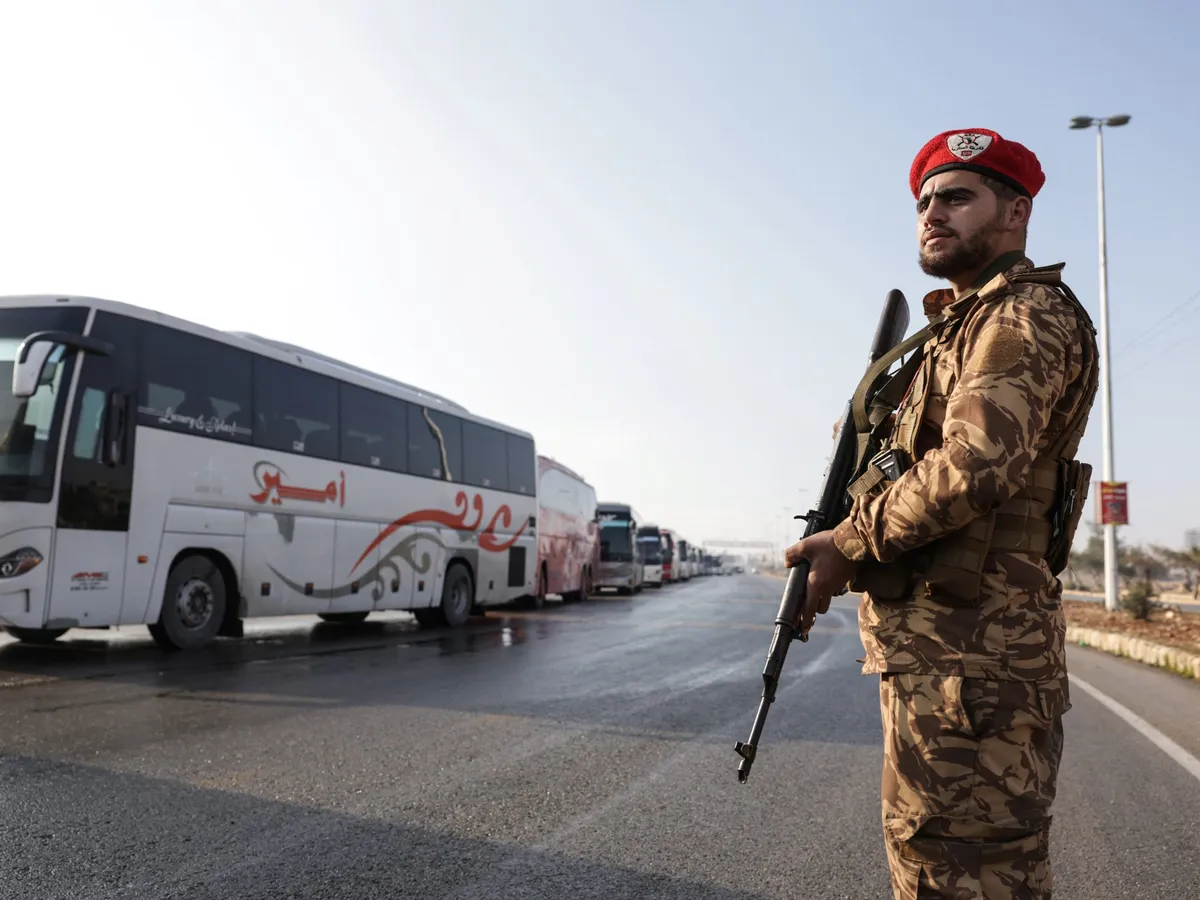
Analysts say a temporary ceasefire may bring relief, but the complex issues behind the violence must be addressed.Buses stand by close to the Lairamoun roundabout as they wait to enter the Sheikh Maqsoud neighbourhood to evacuate Democratic Forces (SDF) fighters from two districts of Aleppo, northern Syria, January 9, 2026 [AFP]Published On 9 Jan 2026The outbreak of clashes between the Syrian Army and the Kurdish-led Syrian Democratic Forces (SDF) has highlighted the political and security challenges the country continues to face more than a year after the fall of former President Bashar al-Assad.The fighting in Aleppo, which has killed at least 22 people this week, brought to the forefront fundamental tensions between Damascus and the SDF – both of which are backed by the United States.Recommended Stories list of 3 itemslist 1 of 3Thousands flee Aleppo as clashes between Syria’s army and SDF escalatelist 2 of 3Can tension in Aleppo be contained?list 3 of 3Israel, Syria agree to dedicated communication line in US-brokered talksend of listThe SDF and the Syrian government had signed an agreement to integrate the Syrian-dominated forces into a state institution in March of last year. But little progress has been made on that front, and the sporadic violence between the two sides turned into intense fighting this week.A truce to halt the clashes was announced on Friday, but it appears to be already unravelling. Analysts warn that without a comprehensive resolution to the tensions, more fighting is all but inevitable.While it appears that there is no domestic or international appetite for an all-out war in Syria, experts say that with the merger of the SDF – which controls large parts of northeast Syria – into the state stalled, the threat of renewed violence persists.“I don’t think there’s a lot of international interest in major fighting at the moment, especially from the US side — so that could help tamp things down,” said Aron Lund, a fellow at Century International.“It’s far from over, however. All the main issues remain unresolved, and neither side is willing to compromise on fundamentals, so we’re going to see more clashes eventually.”The clashesThis week’s fighting has displaced tens of thousands of people in the predominantly Kurdish Sheikh Maqsoud, Ashrafieh and Bani Zeid neighbourhoods, with both sides accusing each other of initiating the violence.Early on Friday, the Syrian Ministry of Defence announced a six-hour temporary ceasefire in the three neighbourhoods, which was later extended to give the SDF fighters more time to leave.Syria’s Defence Ministry said SDF fighters based in Aleppo’s neighbourhoods will be redeployed to areas east of the Euphrates River.However, Kurdish councils that run Sheikh Maqsoud and Ashrafieh said in a statement that calls to leave were “a call to surrender” and that Kurdish forces would instead “defend their neighbourhoods”.The fighting casts its shadow over the March 2025 deal between Syrian President Ahmed al-Sharaa’s government and the SDF to bring the Kurdish-led forces under state institutions.The agreement provides for a nationwide ceasefire, SDF cooperation with the state in confronting pro-al-Assad armed groups, and formal recognition of the Kurds as an integral part of Syria, with guaranteed citizenship and constitutional rights.It also places all border crossings with Iraq and Turkiye, along with airports and oilfields in northeastern Syria, under the authority of the central government.[Al Jazeera]The SDFSo far, no meaningful progress has been made towards integration. Both sides remain at odds over a number of issues, including the process and structure of integration, for example, whether the SDF would join as a unified bloc or dissolve into individual recruits.A meeting on January 4 between senior SDF commanders and government officials concluded with no “tangible” outcomes according to state media, with talks suspended pending further negotiation.The SDF rose to prominence as Syria began to fragment under the strain of civil unrest in 2011.It was officially established in 2015, with the People’s Protection Units (YPG), a Kurdish militia linked to the Kurdistan Workers’ Party (PKK), forming the bulk of its fighting force.Despite the PKK being listed as a “terrorist” group by the US and most Western countries, Washington quickly allied itself with the SDF in the fight against ISIL (ISIS).The group continues to be backed by a US-led international coalition and retains advanced equipment and training that were provided by the US and its partners.It is estimated to have 50,000 to 90,000 well-trained, battle-hardened fighters.But Turkiye, which struggled with a decades-long PKK rebellion and attacks, views the SDF as a threat to its security.In the recent clashes, official Syrian government media outlets have referred to the SDF as “PKK terrorists”.Regional influencesWith Turkiye, a NATO ally of the US, distrustful of the SDF, the country’s defence ministry has said it is ready to “support” Syria in its fight against the group.Ankara, an ally of al-Sharaa’s government, has criticised Washington for years over its support for the SDF and launched several military operations in northern Syria to push the group off its border.The intensifying rivalry between Turkiye and Israel has also raised concerns that the Israeli government may put its weight behind the SDF to provide a counterweight to Ankara’s influence in Syria.Israel has already intervened in the internal Syrian conflict when it bombed Damascus in July in support of Druze fighters battling government forces in the south of the country.The Israeli military has also expanded its occupation beyond the Golan Heights, and it has been establishing checkpoints and abducting people deep inside Syria’s territory.The US, which has troops stationed in eastern Syria, is allied with all the parties involved: Turkiye, Israel, the Syrian government and the SDF.And so, Washington has been trying to mediate between all the sides. Last week, Syria and Israel agreed to establish an intelligence-sharing mechanism after US-brokered talks.US envoy Tom Barrack has urged the “utmost restraint” after the clashes in Aleppo and hailed the short-lived ceasefire.“Together with our allies and responsible regional partners, we stand ready to facilitate efforts to de-escalate tensions and to afford Syria and its people a renewed opportunity to choose the path of dialogue over division,” Barrack said in a statement calling for de-escalation from all sides.“Let us prioritize the exchange of ideas and constructive proposals over the exchange of fire. The future of Aleppo, and of Syria as a whole, belongs to its people and must be shaped through peaceful means, not violence.”US ‘can do the most’Nanar Hawach, senior Syria analyst at the International Crisis Group, said with both the government and SDF maintaining relationships with the US, it could limit the risk of the March agreement’s total collapse, saying it keeps a “ceiling on escalation”.“American involvement does not guarantee resolution, but it constrains the range of outcomes and keeps both parties tethered to a negotiating framework neither can afford to abandon,” he told Al Jazeera.Reporting from Damascus, Al Jazeera’s Ayman Oghanna said Washington can “do the most” to boost talks between the Syrian government and the SDF.“The US has enjoyed a strong relationship with the SDF for over a decade. The US helped build up and train the SDF, it fought alongside the SDF, and 1,000 US troops remain in SDF territory where they work closely together in the effort to eradicate ISIL from Syria,” Oghanna said.“But the US has also recently strengthened its ties with Damascus.”What comes next?Rob Geist Pinfold, an international security lecturer at King’s College London, said the temporary ceasefire in Aleppo simply pushes “the more complicated issues” down the road.“Yes, we’ve got a temporary ceasefire … which makes everyone’s lives better, but this means that we are arguably further away from getting to a comprehensive deal.”
SRCAl Jazeera
LANGEN
LEANCenter
WORDS1 255
ENT7
FRI · 2026-01-09 · 16:25 GMTBRIEF NSR-2026-0109-6649
NSR-2026-0109-6649News Report·EN·Conflict
Aleppo clashes highlight challenge of SDF integration for Syria
Clashes between the Syrian army and the Kurdish-led Syrian Democratic Forces (SDF) in Aleppo, Syria, have killed at least 22 people this week, highlighting ongoing political and security challenges. The fighting stems from tensions regarding the integration of the SDF into Syrian state institutions, an agreement made in March 2025 that has seen little progress.
Usaid SiddiquiAl JazeeraFiled 2026-01-09 · 16:25 GMTLean · CenterRead · 6 min
Al JazeeraFIG 01
Reading time
6min
Word count
1 255words
Sources cited
1cited
Entities identified
7entities
Quality score
100%
§ 01
Briefing Summary
AI-generatedNEWSAR · AI
Clashes between the Syrian army and the Kurdish-led Syrian Democratic Forces (SDF) in Aleppo, Syria, have killed at least 22 people this week, highlighting ongoing political and security challenges. The fighting stems from tensions regarding the integration of the SDF into Syrian state institutions, an agreement made in March 2025 that has seen little progress. A temporary ceasefire was announced on Friday, January 9, 2026, but analysts warn it is already unraveling and further clashes are likely without a comprehensive resolution. The violence has displaced tens of thousands of people in Kurdish neighborhoods, with each side blaming the other for initiating the conflict. Experts suggest that while there is little appetite for a large-scale war, the unresolved issues between the Syrian government and the SDF pose a continued threat of renewed violence.
Confidence 0.90Sources 1Claims 5Entities 7
§ 02
Article analysis
Model · rule-basedFraming
Conflict
Political Strategy
Tone
Measured
AI-assessed
CalmNeutralAlarmist
Factuality
0.70 / 1.00
Factual
LowHigh
Sources cited
1
Limited
FewMany
§ 03
Key claims
5 extracted01
Syria’s Defence Ministry said SDF fighters will be redeployed to areas east of the Euphrates River.
factualSyria’s Defence Ministry
Confidence
1.00
02
Aron Lund said all the main issues remain unresolved, and neither side is willing to compromise.
quoteAron Lund
Confidence
1.00
03
The SDF and the Syrian government signed an agreement to integrate the Syrian-dominated forces in March of last year.
factual
Confidence
1.00
04
Fighting in Aleppo has killed at least 22 people this week.
statistic
Confidence
1.00
05
Clashes between the Syrian army and the SDF have highlighted political and security challenges in Syria.
factual
Confidence
0.90
§ 04
Full report
6 min read · 1 255 words§ 05
Entities
7 identifiedKey playerOppositionContextPositiveNeutralNegative
Organizations2
§ 06
Keywords & salience
9 termssyria
1.00
syrian democratic forces (sdf)
0.90
aleppo clashes
0.80
integration
0.70
ceasefire
0.60
violence
0.50
tensions
0.50
political challenges
0.40
security challenges
0.40
§ 07
Topic connections
Interactive graph No topic relationship data available yet. This graph will appear once topic relationships have been computed.