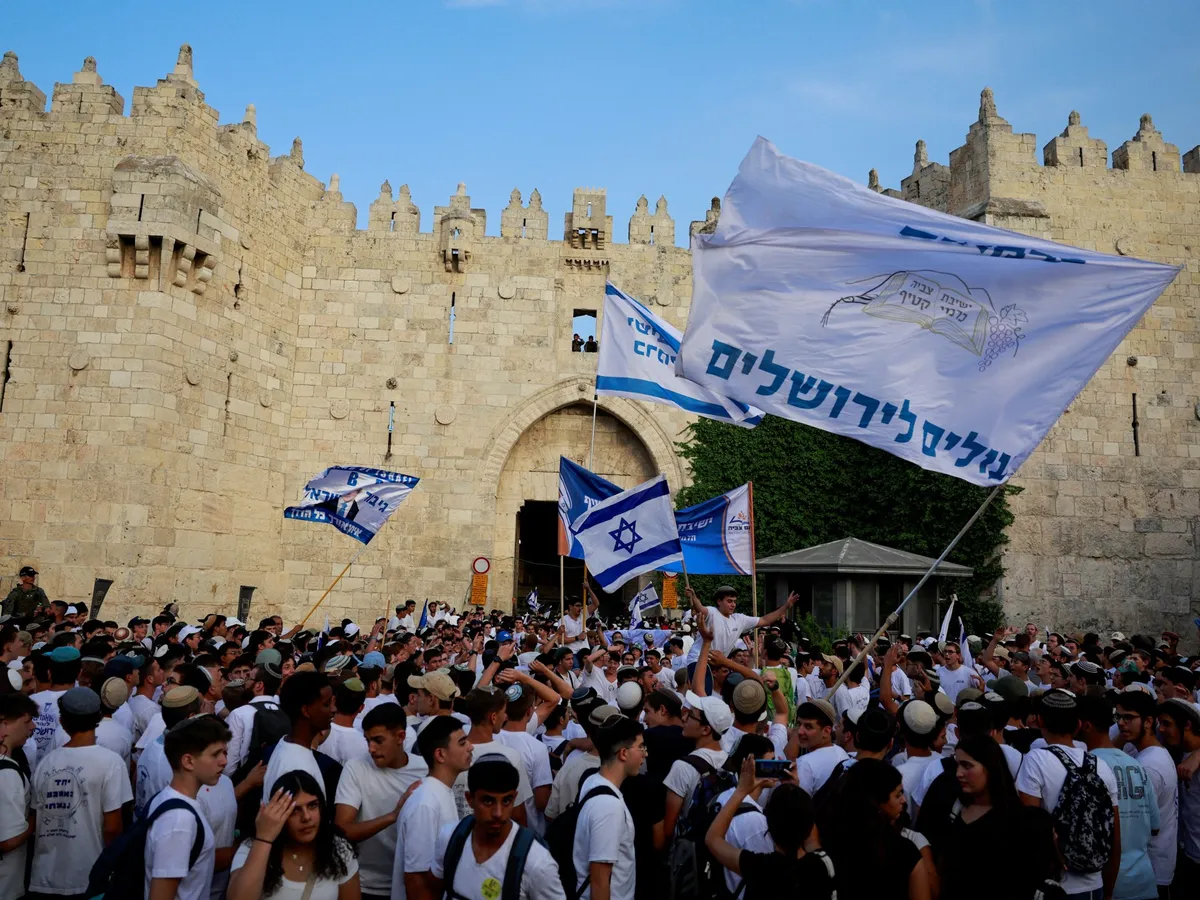
Israel wants to expand in the Middle East. Its failure to defeat Iran is a major setback for its hegemonic plans.Published On 14 Apr 2026Israelis gather with flags by Damascus Gate in occupied East Jerusalem's Old City as they mark Jerusalem Day on May 26, 2025 [Ammar Awad/Reuters]Ahead of the deadline United States President Donald Trump set for Iran last week, Israeli Prime Minister Benjamin Netanyahu made an urgent call to the White House. He warned the president against pursuing a ceasefire with Tehran.After the temporary truce was announced, Netanyahu was quick to clarify that the Israeli army would not stop its operations in Lebanon. Many saw in his actions his urge to ensure his own political survival by prolonging the war.However, it is not just Netanyahu and his allies that want the US to continue the Iran war; it is also his opponents. That is because the defeat of Iran is seen by the Israeli political and security elites as a key step towards realising the project of “Greater Israel”.“Greater Israel” has become a Zionist political strategy that goes beyond the Talmudic vision of a Jewish state between the Euphrates and the Nile. To realise it, Israel is pursuing not just the occupation of more land, but also military dominance over large swaths of the Middle East, as well as ever-expanding spheres of influence. Iran has stood in the way of all of these goals.Border expansionsAt the heart of the “Greater Israel” vision is territorial expansion. For decades, Israel has engaged in the colonisation of Palestinian territory it occupied in 1967, which by now is perceived as de-facto annexed. The Palestinian population there is facing a looming “transfer”.Having secured control over Palestinian land, Israel is now seeking to expand north, east and south. Its territorial ambitions correspond to plans put forward by the World Zionist Organisation in 1919, which include parts of southern Lebanon and Syria, the left bank of the Jordan River (in today’s Jordan), and parts of Egypt’s Sinai Peninsula.Israel has occupied and colonised Syria’s Golan Heights for nearly 60 years, and in the past two years has sought to grab more Syrian land. Expansion to the north and south of the Golan Heights would enhance access to water resources and strengthen Israel’s strategic positioning overlooking Damascus. Such presence could place the Syrian capital under sustained military pressure, potentially compelling the Syrian regime to pursue political accommodation in order to preserve stability.Southern Lebanon is territory Israel has long sought to retain control over and has repeatedly invaded. Its army currently occupies it and has started obliterating villages to prevent the return of its inhabitants. The area is strategic not only due to its mountainous terrain but also its water resources.Israel also desires the East Bank of the Jordan River for economic and strategic reasons. Establishing control over it would not only increase access to arable land but also provide greater strategic depth against potential eastern threats, historically associated with Iraq and Iran. Control over this area would also place key regional transit routes under Israeli influence, particularly those linking the Arabian Peninsula to the eastern Mediterranean.Taken together, these expansionist scenarios would grant Israel enhanced access to strategic waterways such as the Red Sea and proximity to major energy resources. This, in turn, could significantly increase its geopolitical leverage in shaping regional dynamics.Military dominanceThe “Greater Israel” project is not merely about territorial expansion; it is also about establishing regional control to secure the freedom to conduct military operations with minimal constraint. This mirrors what Israel has been doing in the West Bank and the Gaza Strip since 1948, in Lebanon since September 2024, and in Syria since the collapse of the al-Assad regime in December 2024.In this context, “dominance” implies the capacity to act unilaterally and project force across borders. Israel wants freedom of operation not only over its neighbouring states – Jordan, Syria, and Lebanon, but also over Egypt, Iraq, Iran, Yemen, the Gulf states, and even parts of the Horn of Africa, such as Somalia.Israel has made progress on this aspect of the project by using force against its neighbours. It has also concluded various peace and security agreements with countries in the Eastern Mediterranean.A major step was also its successful lobbying effort to be moved under the jurisdiction of the United States Central Command (CENTCOM), which covers the Middle East, instead of the US European Command. Joining CENTCOM allowed Israel access to Identification Friend or Foe (IFF) systems within the region, enabling its warplanes to operate across it.Moving forward, to achieve regional military dominance, Israel could use normalisation agreements with military cooperation clauses. This could include basing Israeli warplanes in United States and United Kingdom facilities in the region and potentially securing its own bases in Arab countries.Such arrangements could be justified under security and military collaboration that grants Israel the ability to launch preemptive attacks against perceived imminent threats. This would also include demilitarised zones with Early Warning Systems (EWS) and intelligence facilities.Similar mechanisms already exist in the Sinai Peninsula under the Camp David Accords. The agreement serves Israel’s security interests by maintaining a demilitarised buffer zone, imposing limits on Egyptian forces, including restrictions on airspace, and maintaining the Multinational Force and Observers (MFO), which provides an early-warning system.Current negotiations with the emerging Syrian leadership appear to be aimed at establishing a comparable security arrangement.Intelligence infrastructure may also be embedded within surveillance and cloud-based technologies offered to Arab countries, with data processing linked to Israeli-controlled systems.Sphere of influenceThe third element of the “Greater Israel” project is establishing a geopolitical sphere of influence. Within this strategy, Israel seeks to become a pivotal actor in shaping domestic politics in countries it perceives as falling within this sphere.In doing so, it seeks to emulate historical great powers, such as colonial Britain. In the past two years, Israel has tested elements of this approach in Lebanon, where it has actively sought to shape the political landscape and government formation by leveraging military pressure and empowering groups more open to accepting Israeli political arrangements.Israel wants to expand its sphere of influence mainly by leveraging US soft and hard power projection in the region. The pro-Israel lobby in Washington has been successful in inserting Israeli regional interests into US foreign policy on the Middle East.US military and financial support for several states in the region has been conditional on their accepting Israeli diktats in regional affairs.International organisations dominated by the US have also played a role, alongside financial networks that influence credit markets. Through US and major investment bodies, pressure can be exerted on states to adopt certain policies, aligning them more closely with Israeli strategic interests.Iran as a barrierOver the past few decades, Israel has removed, one by one, various obstacles to its “Greater Israel” project. Iran has stood as one of the last remaining.In this sense, the reports in US media that Israel played a key role in convincing the US to start the war on Iran are unsurprising. What is unexpected – at least for the Israeli government – is the extent to which it underestimated Iranian resilience.A month and a half into the conflict, Iran has achieved a geopolitical win by consolidating itself as a dominant regional power. It has tightened its grip over the Strait of Hormuz, through which about 20 percent of global oil supplies pass.
SRCAl Jazeera
LANGEN
LEANCenter
WORDS1 222
ENT12
TUE · 2026-04-14 · 12:33 GMTBRIEF NSR-2026-0414-67458
NSR-2026-0414-67458Analysis·EN·Political Strategy
Iran remains an obstacle to the ‘Greater Israel’ project
According to this article published on April 14, 2026, a key obstacle to Israel's "Greater Israel" project is Iran. The "Greater Israel" project aims for territorial expansion and military dominance over the Middle East.
Samer JaberAl JazeeraFiled 2026-04-14 · 12:33 GMTLean · CenterRead · 5 min
Al JazeeraFIG 01
Reading time
5min
Word count
1 222words
Sources cited
1cited
Entities identified
12entities
Quality score
100%
§ 01
Briefing Summary
AI-generatedNEWSAR · AI
According to this article published on April 14, 2026, a key obstacle to Israel's "Greater Israel" project is Iran. The "Greater Israel" project aims for territorial expansion and military dominance over the Middle East. Israel's political and security elites view defeating Iran as crucial for realizing this project, which includes annexing occupied territories and expanding into parts of Lebanon, Syria, Jordan, and Egypt's Sinai Peninsula. Israel has already occupied and colonized Syria’s Golan Heights and seeks to acquire more Syrian land to enhance access to water resources and strategically position itself overlooking Damascus.
Confidence 0.90Sources 1Claims 4Entities 12
§ 02
Article analysis
Model · rule-basedFraming
Political Strategy
Conflict
Tone
Mixed Tone
AI-assessed
CalmNeutralAlarmist
Factuality
0.30 / 1.00
Opinion-Heavy
LowHigh
Sources cited
1
Limited
FewMany
§ 03
Key claims
4 extracted01
Israel has occupied and colonised Syria’s Golan Heights for nearly 60 years.
factualArticle's own claim
Confidence
1.00
02
Israeli Prime Minister Benjamin Netanyahu made an urgent call to the White House warning the president against pursuing a ceasefire with Tehran.
factualArticle's own claim
Confidence
0.90
03
Israel is pursuing not just the occupation of more land, but also military dominance over large swaths of the Middle East.
factualArticle's own claim
Confidence
0.80
04
The defeat of Iran is seen by Israeli political and security elites as a key step towards realising the project of “Greater Israel”.
factualArticle's own claim
Confidence
0.70
§ 04
Full report
5 min read · 1 222 words§ 05
Entities
12 identifiedKey playerOppositionContextPositiveNeutralNegative
Organizations1
§ 06
Keywords & salience
10 termsgreater israel
1.00
territorial expansion
0.80
iran
0.80
middle east
0.70
israeli
0.70
zionist
0.60
military dominance
0.50
land occupation
0.50
political strategy
0.50
syria
0.40
§ 07
Topic connections
Interactive graph Network visualization showing 51 related topics
View Full Graph Person Organization Location Event|Click node to navigate|Edge numbers = shared articles