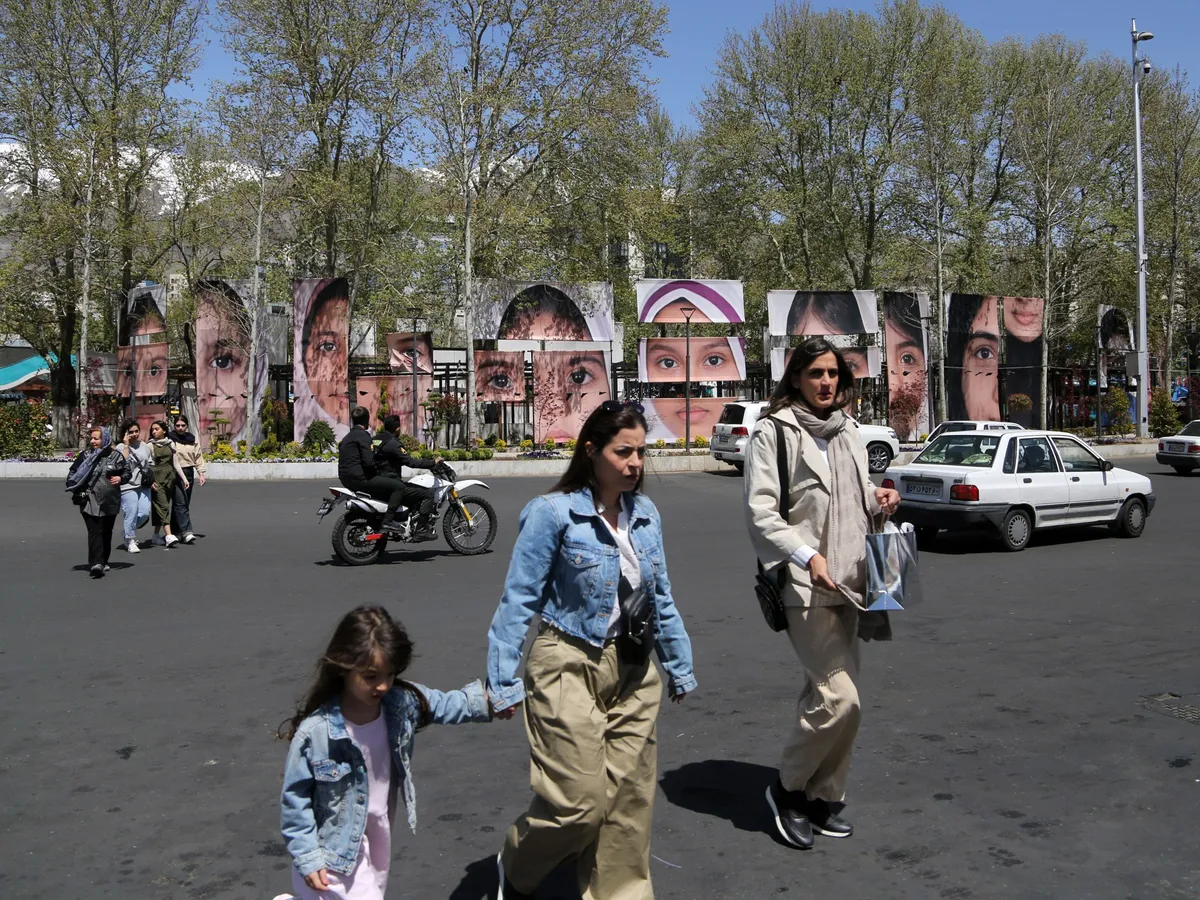
Iran demands compensation for war damages caused by US and Israeli attacks on critical infrastructure.Photographs displayed in Tajrish Square place particular focus on the eyes of children who lost their lives in the Minab attack, as part of the 'Eyes of Minab' exhibition organised to commemorate the victims, in Tehran, on April 14, 2026 [Fatemeh Bahrami/Anadolu]Published On 15 Apr 2026Tehran, Iran – Iran has demanded that it receive compensation for the destruction caused by the United States and Israel’s attacks, as the country remains defiant and regional powers continue their attempts to mediate an end to the conflict.Tehran’s envoy to the United Nations said on Tuesday that five regional countries must pay compensation, based on his accusation that their territories were used for launching attacks on Iran.Recommended Stories list of 3 itemslist 1 of 3Israel and Lebanon hold rare talks in Washington, DC, amid Iran warlist 2 of 3Pakistan PM heads to Saudi Arabia, Qatar, Turkiye in bid to end war on Iranlist 3 of 3IMF cuts global growth forecast during Hormuz blockadeend of listIran has also raised the idea of compensation for damages to come through a Strait of Hormuz protocol, which would include a tax on ships passing through the waterway.An early estimate indicates that Iran has suffered about $270bn in direct and indirect damages since the start of the US-Israel war on February 28, Iranian government spokeswoman Fatemeh Mohajerani said during an interview with Russia’s RIA Novosti news agency, published on Tuesday.She did not provide further information, such as a breakdown of the damages, but said the issue of compensation was discussed in last week’s negotiations between Tehran and Washington in Pakistan, and will be raised in any potential future talks with the US and mediators.The government has said it is still assessing the extensive damage dealt to Iran’s critical infrastructure, after oil and gas facilities, petrochemical companies, steel plants, and aluminium factories were repeatedly targeted, in addition to military complexes. These will take years to fully rebuild.Bridges, ports and railway networks, universities and research centres, and several power plants and water desalination plants were also directly hit, while a large number of hospitals, schools and civilian homes were damaged or destroyed.‘Economic realities’Spokeswoman Mohajerani told Iranian state media earlier this week that “existing economic realities” mean that the government does not have the resources to repay civilians if their homes have been damaged or destroyed by US-Israeli attacks.Meanwhile, the secretary of the Association of Iranian Airlines, Maghsoud Asadi Samani, told Iranian media that 60 civilian aircraft had been put out of commission, with 20 completely destroyed by the US and Israel.The official said that Iran only has about 160 passenger aircraft still in operation, most of them decades old and kept in the air through maintenance work that has been difficult due to the shortage of parts and services as a result of stringent US sanctions.Samani said airlines also lost much of the revenue they had expected to come in during the Nowruz or Persian New Year holidays in late March, and that their accumulated losses exceeded 300 trillion rials (about $190 million at the current exchange rate) in 40 days of war.Several of the country’s international airports, including in Tehran, Tabriz, Urmia and Khorramabad, were significantly damaged after numerous attacks hit their runways, control towers and hangars.Despite the scope and depth of the damage, as well as the impact of the US naval blockade on Iranian ports that began on Monday, Iranian authorities have signalled that they do not intend to give major concessions in negotiations with Washington, including on nuclear enrichment.Ebrahim Rezaei, the spokesman for the hardline-dominated parliament’s National Security and Foreign Policy Commission, said in a social media post that the two-week ceasefire announced last week must not be extended, arguing that it would give the US and Israel a chance to replenish their arms stocks and improve positions for attack.“They must either recognise Iran’s rights, including our control over the Strait of Hormuz, or return to war,” he wrote.Iran dedicated close to $8bn for military spending in 2024, according to the Stockholm International Peace Research Institute (SIPRI) think tank, and officials pledged to triple that budget after missile exchanges with Israel in October that year. But the government has also faced years of a budget crunch, linked with local mismanagement and corruption, and paired with US sanctions.Internet shutdown deals damageThe near-total internet shutdown imposed by the state against more than 90 million Iranians has been compounding Iran’s economic woes and frustrating citizens for a seventh week.After huge waves of layoffs and lost business opportunities as a result of the blackout, the government has said that it holds no authority over the matter, instead pinning the blame on the Supreme National Security Council.Afshin Kolahi, the head of an Iran Chamber of Commerce commission, told a video conference with state-affiliated and private executives on Monday that the shutdown was leading to up to $80m per day in direct and indirect economic damages.“We are losing [the equivalent of] four B1 bridges every day. We are losing two medium-capacity power plants every day, and we are doing this ourselves,” he said about the cost of the internet shutdown, and in reference to the US-Israeli bombing of a major bridge near Tehran earlier this month.The Information and Communications Technology Ministry reposted the video of the comments on its social media account. In January, when the state imposed a 20-day near-total internet shutdown as thousands were killed during nationwide anti-establishment protests, the ministry had said that many online businesses could not last without the internet for more than three weeks.Now, with no prospects of a full reconnect in sight, the ministry is advancing with plans to create a tiered internet system.This week, it announced that several business representatives nominated through their communities have signed up to get access to a global internet connection, while the rest of the population remains bound to a limited local intranet.Telecommunications companies are offering select customers deemed eligible by the state a new service called “Internet Pro”, which costs more than regular data packs but offers less filtered access to the internet. Some users have reported that they have made payments and are waiting for the service to be activated.But even in the comments section of state-linked sites, which are one of the few places Iranians can currently express themselves online, the internet is the main talk of the day. On the website of the Fars news agency, affiliated with the Islamic Revolutionary Guard Corps (IRGC), the main hashtags demand “internet freedom”.On Monday, security authorities ordered Digiato, a prominent technology-focused media outlet, to remove a countdown clock from its website, which was documenting how long Iran has been plunged into digital darkness.A profitable black market continues to exist for those selling virtual private networks (VPNs) and any other method potentially offering a link to the outside world.
SRCAl Jazeera
LANGEN
LEANCenter
WORDS1 143
ENT10
WED · 2026-04-15 · 06:28 GMTBRIEF NSR-2026-0415-68655
NSR-2026-0415-68655News Report·EN·Economic Impact
Iran says $270bn war loss must be compensated, as fresh talks with US loom
Iran is demanding compensation, estimated at $270 billion, from the US and Israel for damages caused by attacks on its critical infrastructure since the start of their war on February 28, 2026. The demand was made by Iran's envoy to the UN, who also stated that five regional countries should pay compensation for allegedly allowing their territories to be used for attacks.
Maziar MotamediAl JazeeraFiled 2026-04-15 · 06:28 GMTLean · CenterRead · 5 min
Al JazeeraFIG 01
Reading time
5min
Word count
1 143words
Sources cited
4cited
Entities identified
10entities
Quality score
100%
§ 01
Briefing Summary
AI-generatedNEWSAR · AI
Iran is demanding compensation, estimated at $270 billion, from the US and Israel for damages caused by attacks on its critical infrastructure since the start of their war on February 28, 2026. The demand was made by Iran's envoy to the UN, who also stated that five regional countries should pay compensation for allegedly allowing their territories to be used for attacks. Iranian government spokeswoman Fatemeh Mohajerani said the issue of compensation was discussed in recent negotiations with the US in Pakistan and will be raised in future talks. The damages include destruction to oil and gas facilities, power plants, transportation networks, universities, and civilian infrastructure. Iran is also proposing a Strait of Hormuz protocol with a tax on ships to generate compensation funds.
Confidence 0.90Sources 4Claims 5Entities 10
§ 02
Article analysis
Model · rule-basedFraming
Economic Impact
Conflict
Tone
Mixed Tone
AI-assessed
CalmNeutralAlarmist
Factuality
0.70 / 1.00
Factual
LowHigh
Sources cited
4
Well sourced
FewMany
§ 03
Key claims
5 extracted01
Existing economic realities mean that the government does not have the resources to repay civilians.
quoteFatemeh Mohajerani, Iranian government spokeswoman
Confidence
1.00
02
Issue of compensation was discussed in negotiations between Tehran and Washington in Pakistan.
factualFatemeh Mohajerani, Iranian government spokeswoman
Confidence
1.00
03
Iran demands compensation for damages caused by US and Israeli attacks.
factualArticle
Confidence
1.00
04
60 civilian aircraft had been put out of commission, with 20 completely destroyed by the US and Israel.
factualMaghsoud Asadi Samani, secretary of the Association of Iranian Airlines
Confidence
0.90
05
Iran suffered about $270bn in direct and indirect damages since the start of the US-Israel war.
statisticFatemeh Mohajerani, Iranian government spokeswoman
Confidence
0.80
§ 04
Full report
5 min read · 1 143 words§ 05
Entities
10 identifiedKey playerOppositionContextPositiveNeutralNegative
Organizations1
§ 06
Keywords & salience
8 termscompensation
1.00
war damages
0.90
critical infrastructure
0.80
us-israel war
0.70
strait of hormuz
0.60
negotiations
0.50
economic realities
0.50
regional powers
0.40
§ 07
Topic connections
Interactive graph Network visualization showing 51 related topics
View Full Graph Person Organization Location Event|Click node to navigate|Edge numbers = shared articles