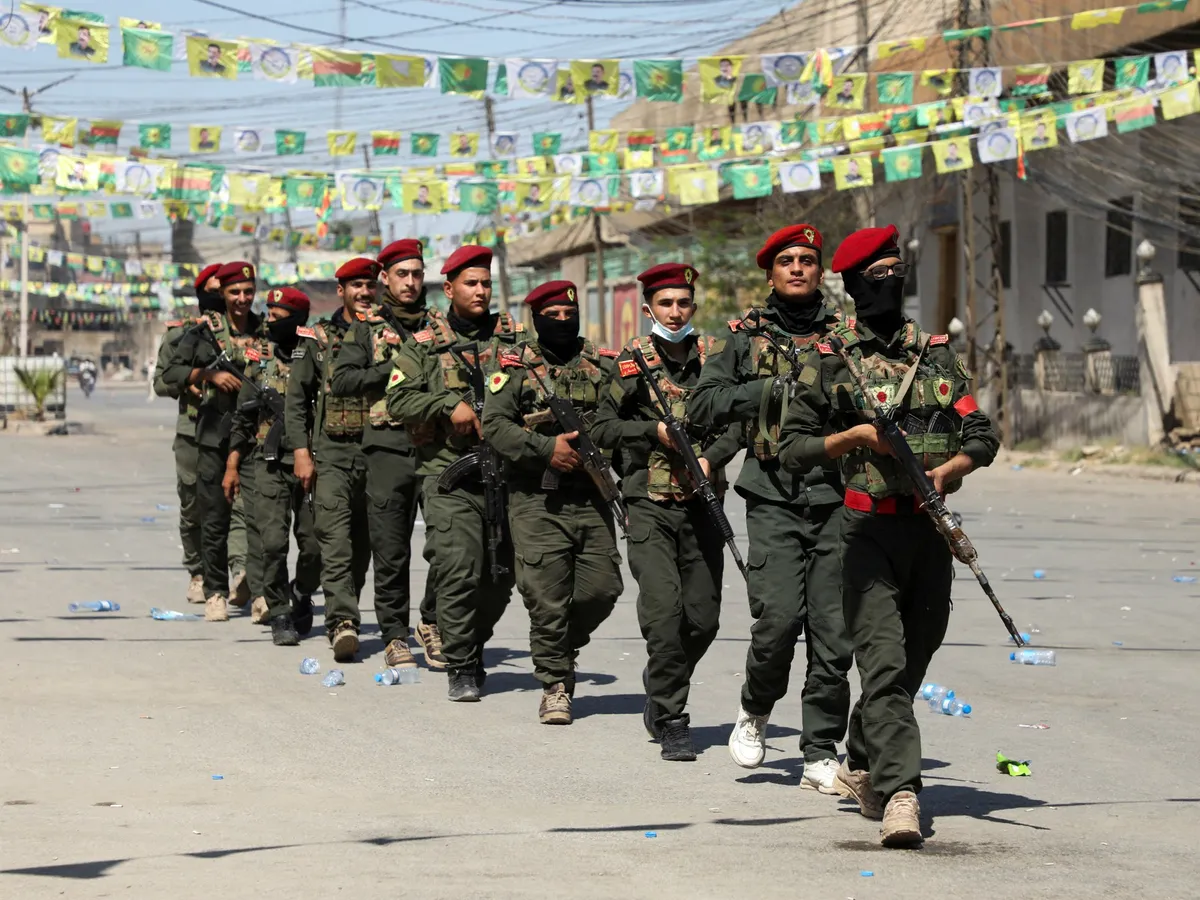
It is also at the centre of the post-war state building project.Published On 12 Jan 2026Members of the Syrian Democratic Forces (SDF) take part in a demonstration in Qamishli, Syria on September 17, 2025 [File: Orhan Qereman/Reuters]When Syria’s civil conflict ended in December 2024 with the fall of Bashar al-Assad’s regime, hundreds of thousands of citizens were still bearing arms. Throughout the nearly 14 years of war, armed factions proliferated: from the broad spectrum of armed opposition factions in the northwest and the regime’s array of military and militia forces in central and western Syria, to the Syrian Democratic Forces (SDF) in the northeast and a complex network of militias throughout the south, and not to forget the likes of ISIS and al-Qaeda.In this context, the task of demilitarising society and reunifying the country has posed a truly formidable challenge for Syria’s transitional authority. Indeed, the process of disarming, demobilising, and reintegrating armed groups while simultaneously establishing new armed forces and a reformed security sector stands at the core of Syria’s transitional state building project. Days of heavy conflict between government forces and the SDF in Aleppo this past week highlighted the consequences of a failure to resolve the integration challenge.As a first step in December 2024, the al-Assad regime’s armed forces were swiftly dissolved and a process of status settlement was initiated, whereby all previous soldiers – both officers and conscripts – could register using their national ID and apply for release to civilian life or to re-enlist in the new army.Thousands of men chose to undertake this settlement process across the country, to clear their names and start life anew. But thousands of others abstained, especially in the coastal region, where the Alawite minority dominates. While many of those who avoided the process melted back into rural communities, hundreds ended up forming anti-government factions that conducted low-level attacks on government forces, culminating in a huge coordinated campaign on March 6 that killed more than 100 government personnel – triggering a chaotic and brutal week of violence that left more than 1,000 people dead.In the months since, several thousand former regime personnel have undergone training and joined Syria’s new security forces across the country. Nevertheless, the fighting persists, due in part to financial support from prominent al-Assad regime figures now in exile in neighbouring Lebanon, as well as in Russia.That continues to undermine Syria’s ability to heal ties with Lebanon and Russia, but also complicates the geopolitical standing of such countries among the wider region, which has stood squarely behind the new government in Damascus in the hope of transforming Syria into a base of stability and prosperity.Meanwhile, Syria’s transitional government is also seeking to rebuild the Ministry of Defence (MOD) with an army, navy and air force and the Ministry of Interior (MOI) with provincial public security directorates, and dedicated “counterterrorism”, counternarcotics and cyber forces.In this transitional phase, the MOD has emerged as the umbrella under which the broad spectrum of opposition armed factions have been folded. While all former opposition groups have technically dissolved, some remain largely in form, constituting the army’s nearly 20 divisions. Those factions with longstanding ties to Turkiye – particularly from the northern Aleppo-based Syrian National Army (SNA) – appear to have benefitted from greater levels of military support and arms supplies than others previously based in Idlib. Some have leaders with controversial pasts, including outstanding international sanctions designations for violent crimes and corruption.In the earlier phases of Syria’s transition, the MOD was the force tasked with responding to security challenges and with securing territory through checkpoints and local deployments. This was not an effective “post-war” approach to security, and the ministry’s serious shortcomings in terms of discipline, cohesion and command and control gave way to grievous errors of judgement and restraint – most notoriously on the coast in March 2025, but also in Suwayda in July, when MOD forces intervened in bloody clashes between local Druze and Bedouin communities.Through the second half of 2025, the MOD took a back seat when it came to domestic security and was replaced by the MOI, whose public security forces have assumed responsibility for local security across the country.Unlike the MOD’s divisions, the MOI’s forces are dominated by newly recruited men from across the country. While the MOI’s specialist units remain dominated by Hayat Tahrir al-Sham (HTS) personnel, the relative lack of previous factional affiliations in the broader public security forces has led to significant improvements in some of the most challenging environments.In fact, Syria’s coastal region has transformed from being the most consistently dangerous and deadly region of the country in the first half of 2025 to the most stable and least violent region at the end of the year – even with a low-level rebellion continuing. That is almost entirely due to the MOI’s assumption of security responsibility, and a months-long effort to engage and build trust with local communities.The most strategically significant challenge Syria’s transition faces today is from its unresolved territorial issues in the northeast with the Kurdish-dominated SDF and in the southern Druze-majority governorate of Suwayda. In both regions, armed groups are presenting themselves as alternatives to Damascus’s rule – and both are resulting in persistent tensions and conflict.While the United States government has worked intensively to facilitate and mediate talks to achieve the SDF’s integration into Syria, those negotiations have yet to bear fruit. With multiple deadlines for such a deal now passed, tensions have been sky-high for weeks.An SDF drone attack on a checkpoint manned by government forces in eastern rural Aleppo late on January 5 triggered a spiral of hostilities that ended in the expulsion of SDF-linked militia from northwestern districts of Aleppo city by January 10. This latest bout of fighting has dealt a blow to integration talks, but also highlighted the consequences of their failure. The very real prospect of hostilities now spreading to front lines in eastern Aleppo could kill the talks altogether.In Suwayda, a tense standoff remains after the violence in July that killed more than 1,400 people. Druze militias have united under a “National Guard” that is receiving support from Israel. The dominant role played by former al-Assad regime officers within this formation’s leadership has driven a more than 400 percent rise in drug trafficking towards Jordan, according to data collected by the Syria Weekly media outlet – triggering Jordanian air strikes in late December.Persistent reports of inter-factional violence within the National Guard and increasing numbers of extrajudicial attacks on Druze figures willing to criticise Suwayda’s new de facto authorities suggest the status quo does not offer stability.It is in Suwayda where geopolitics have proven to be most acute – with Israel’s backing of Druze authorities presenting a direct challenge not just to Syria’s transition, but to Jordanian security, to regional support for Damascus, and to the desire of US President Donald Trump’s administration to see Syria’s new government assume nationwide control.The de facto Druze leader in Suwayda, Hikmat al-Hijri, is also in regular contact with SDF leaders in northeast Syria, with both sides appearing at times to be coordinating their positions vis-a-vis Damascus. Alawite figures on the coast, meanwhile, including protest leader Ghazal Ghazal, have also been in communication with both the SDF and al-Hijri in an attempt to unite behind a political vision that stands in opposition to Damascus.Ultimately, Syria’s process of resolving the challenges of armed factions is intrinsically political and tied both to the civil war and to the tensions and challenges that have emerged out of the transition itself. The fact that a vast majority of the international community has united in support of Syria’s transitional government has helped to provide the time and space for dissolving and integrating armed factions and fighters across the country. However, as long as geopolitical challenges to the transition remain, the process of integration will remain incomplete and continue to be a source of instability.The views expressed in this article are the author’s own and do not necessarily reflect Al Jazeera’s editorial stance.
SRCAl Jazeera
LANGEN
LEANCenter
WORDS1 331
ENT7
MON · 2026-01-12 · 06:58 GMTBRIEF NSR-2026-0112-6984
NSR-2026-0112-6984News Report·EN·Conflict
Integration of armed factions remains one of Syria’s biggest challenges
Following the end of Syria's civil conflict in December 2024 and the fall of Bashar al-Assad's regime, integrating numerous armed factions has become a major obstacle in the country's post-war state building. The transitional authority faces the challenge of disarming, demobilizing, and reintegrating groups like the Syrian Democratic Forces (SDF) and former regime forces while establishing new security forces.
Charles ListerAl JazeeraFiled 2026-01-12 · 06:58 GMTLean · CenterRead · 6 min
Al JazeeraFIG 01
Reading time
6min
Word count
1 331words
Sources cited
1cited
Entities identified
7entities
Quality score
100%
§ 01
Briefing Summary
AI-generatedNEWSAR · AI
Following the end of Syria's civil conflict in December 2024 and the fall of Bashar al-Assad's regime, integrating numerous armed factions has become a major obstacle in the country's post-war state building. The transitional authority faces the challenge of disarming, demobilizing, and reintegrating groups like the Syrian Democratic Forces (SDF) and former regime forces while establishing new security forces. A status settlement process was initiated, allowing former soldiers to register and either return to civilian life or re-enlist. However, many abstained, leading to the formation of anti-government factions and continued violence, particularly after a coordinated attack in March 2025. Despite efforts to train and integrate former regime personnel into new security forces, fighting persists, fueled in part by financial support from exiled al-Assad regime figures.
Confidence 0.90Sources 1Claims 5Entities 7
§ 02
Article analysis
Model · rule-basedFraming
Conflict
Political Strategy
Tone
Measured
AI-assessed
CalmNeutralAlarmist
Factuality
0.70 / 1.00
Factual
LowHigh
Sources cited
1
Limited
FewMany
§ 03
Key claims
5 extracted01
The al-Assad regime’s armed forces were swiftly dissolved in December 2024.
factualnull
Confidence
1.00
02
Syria’s civil conflict ended in December 2024 with the fall of Bashar al-Assad’s regime.
factualnull
Confidence
1.00
03
Thousands of men chose to undertake this settlement process across the country, to clear their names and start life anew.
factualnull
Confidence
0.90
04
Integration of armed factions remains one of Syria’s biggest challenges.
factualnull
Confidence
0.90
05
Days of heavy conflict between government forces and the SDF in Aleppo this past week highlighted the consequences of a failure to resolve the integration challenge.
factualnull
Confidence
0.80
§ 04
Full report
6 min read · 1 331 words§ 05
Entities
7 identifiedKey playerOppositionContextPositiveNeutralNegative
Organizations4
§ 06
Keywords & salience
10 termsarmed factions
1.00
syria
0.90
post-war state building
0.80
integration
0.80
demilitarization
0.70
syrian democratic forces
0.60
security sector reform
0.60
transitional authority
0.50
bashar al-assad regime
0.50
reintegration
0.40
§ 07
Topic connections
Interactive graph Network visualization showing 51 related topics
View Full Graph Person Organization Location Event|Click node to navigate|Edge numbers = shared articles