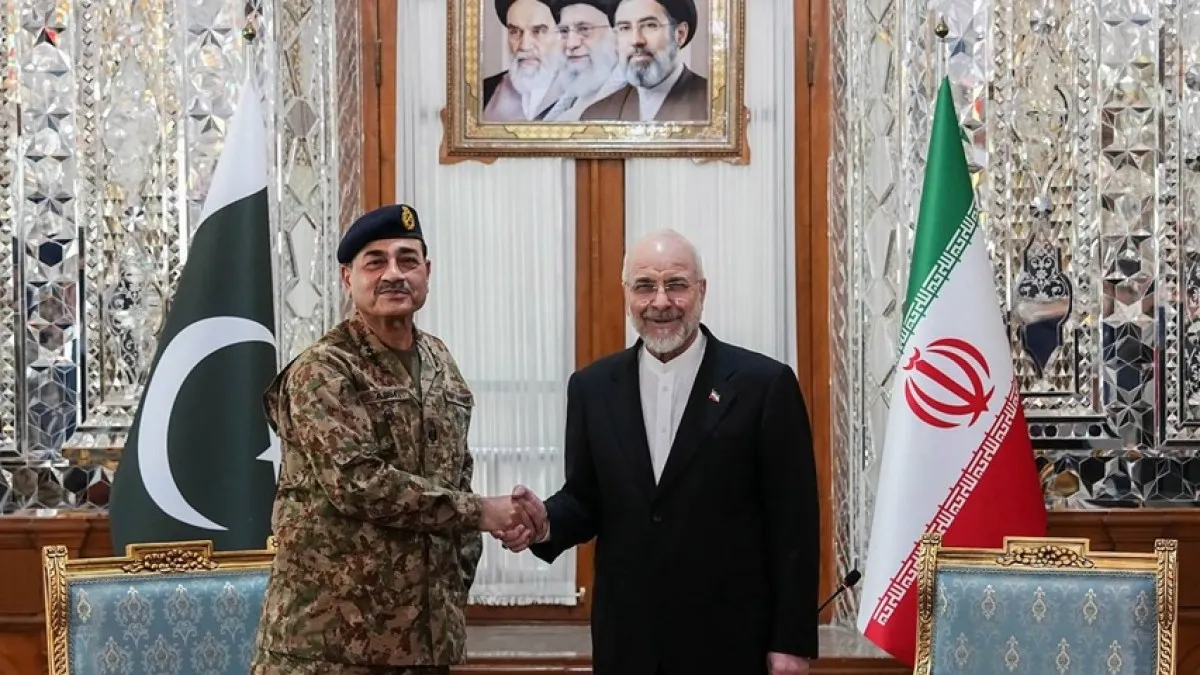
Pakistan’s prime minister and army chief are both travelling to key players in the war, attempting to keep talks going.Iranian Parliament Speaker Mohammad Bagher Ghalibaf holds a meeting with Pakistan's Chief of Defence Forces Field Marshal Asim Munir in Tehran, Thursday, April 16[Handout/Iranian Parliament Public Relations Office]Published On 16 Apr 2026Islamabad, Pakistan – Pakistan’s Foreign Ministry on Thursday confirmed that the United States and Iran were in discussions – through Islamabad – to hold a second meeting between their negotiators to end their now nearly seven-week war, with a fragile ceasefire announced on April 8 days away from expiring.But it added that no date had been set for that next round of negotiations, even as Islamabad stepped up a parallel diplomatic push to keep the process alive.Recommended Stories list of 4 itemslist 1 of 4How Pakistan managed to get the US and Iran to a ceasefirelist 2 of 4Pakistan eyes narrow window to resuscitate US-Iran talks after breakdownlist 3 of 4Pakistan army chief in Tehran to advance next round of US-Iran talkslist 4 of 4Hopes grow for a breakthrough in US-Iran talks as Pakistan mediatesend of list“Who will come, how big the delegation will be, who will stay, and who will go is for the parties to decide,” Foreign Ministry spokesperson Tahir Andrabi told reporters in Islamabad, referring to what upcoming talks might look like. “As a mediator, it’s important for us to keep the talks confidential. We had the details and information of the talks entrusted to us by the negotiating parties.” Speaking of the first round of talks on April 12 in Islamabad, which concluded without a deal, Andrabi said: “There was neither a breakthrough nor a breakdown.”The spokesperson confirmed that nuclear issues remained among the key subjects under discussion, but declined to elaborate.His comments came as Pakistan’s civil and military leadership is travelling across the region in what some observers have begun calling the “Islamabad Process”, reflecting the government’s attempt to frame negotiations as an ongoing diplomatic effort rather than a one-off engagement.Parallel diplomatic tracksPakistan’s Prime Minister Shehbaz Sharif arrived in Doha on Thursday, the second stop of a four-day regional tour that began with Jeddah on Wednesday, and will see him visiting Antalya next.Meanwhile, Pakistan’s Chief of Defence Forces (CDF) Asim Munir arrived in Tehran on Wednesday with a delegation that included Interior Minister Mohsin Naqvi.Munir was received at the airport with a warm hug from Iranian Foreign Minister Abbas Araghchi, who said he was “delighted” to welcome the field marshal and expressed gratitude for Pakistan’s “gracious hosting of dialogue”.On Thursday, Iranian Parliamentary Speaker Mohammad Bagher Ghalibaf, who led Tehran’s delegation at the Islamabad talks, also met Munir.Reza Amiri Moghadam, Iran’s ambassador to Pakistan, said at an event in Islamabad that Tehran would not consider any venue other than Pakistan for talks with Washington.“We will do talks in Pakistan and nowhere else, because we trust Pakistan,” he said.Muhammad Faisal, a Pakistani security analyst and scholar at the University of Technology Sydney, said the parallel outreach reflected a deliberate division of labour.“Pakistan’s strategy appears to be dual-tracked: PM Sharif is reassuring Gulf allies and attempting to build a broader support coalition, while CDF Munir is engaged in hard negotiations between the two sides to narrow gaps between Iran and the US, with an eye on extending the ceasefire and reaching a broader understanding,” he told Al Jazeera.Reports that Munir might travel to Washington, DC after Tehran were denied by security officials, who called them “speculative”. Andrabi said he was not aware of any such development.Saudi Arabia’s Crown Prince Mohammed bin Salman (right) greeting Pakistan’s Prime Minister Shehbaz Sharif prior to their meeting in Jeddah, Saudi Arabia on Wednesday [Handout/Prime Minister’s Office via AFP]In Jeddah on Wednesday, Sharif met Saudi Crown Prince Mohammed bin Salman and expressed “full solidarity and support” for the kingdom following regional escalation, according to Pakistan’s Foreign Ministry. The crown prince praised what Riyadh described as the “constructive role” played by both Sharif and Munir.In Doha, Sharif met Qatar’s Emir Sheikh Tamim bin Hamad Al Thani and discussed “the regional situation, particularly in the Gulf region”, underscoring “the importance of de-escalation, dialogue and close international coordination to ensure peace and stability”, the prime minister’s office said.From Doha, Sharif heads to Antalya with Deputy Prime Minister and Foreign Minister Ishaq Dar. They are expected to meet counterparts from Saudi Arabia, Turkiye and potentially Egypt on the sidelines of the Antalya Diplomacy Forum on April 17.Regional security pushThe Antalya meeting is part of a broader diplomatic effort. Turkiye is preparing to host talks on a regional security platform involving Pakistan, Saudi Arabia and possibly Egypt, according to officials familiar with the discussions.It would be the third such meeting in a month, following earlier rounds of talks in Riyadh and Islamabad.The goal is to establish a platform for regular, structured cooperation on regional security issues, the officials said, stressing the discussions are distinct from current efforts to end the Iran war.Turkish Foreign Minister Hakan Fidan confirmed that discussions were under way, but said no agreement had been finalised.“This pact is necessary so that countries can be assured of one another,” he told the state-run Anadolu Agency on Monday.Turkiye also reaffirmed support for the US-Iran peace process on Thursday.“We will continue to provide the necessary support for the ongoing ceasefire to turn into a permanent truce and eventually lasting peace, without becoming more complex and difficult to manage,” the Defence Ministry said, adding that it expected “the parties will be constructive in the ongoing negotiation process”.Pakistan’s Foreign Ministry said senior officials from the four countries had also met in Islamabad earlier this week to prepare recommendations for Antalya.Ceasefire under strainThe two-week ceasefire brokered by Pakistan on April 8, which halted attacks in Iran and the Gulf, is due to expire on April 22. While still holding, it is under increasing strain.A US naval blockade on Iranian ports remains in place, with the US Central Command saying its forces had turned away nine ships as of Wednesday.Kamran Yousuf, an Islamabad-based journalist and expert on diplomatic affairs, said he expected the ceasefire to be extended.“I would be really surprised if the current ceasefire is not extended. There is little appetite on both sides to go back to war. There are enough signs on the ground that if there is no deal before the truce expires, the ceasefire will be extended,” he told Al Jazeera.Faisal offered a more cautious assessment, warning that failure to secure a second round would shift Pakistan’s role.“Pakistan’s mediation will not collapse immediately, but Islamabad’s role will change from mediator to crisis manager. If hostilities resume, Pakistan will focus again on brokering a ceasefire,” he said.Despite uncertainty, signals from both Washington and Tehran have remained cautiously optimistic.White House press secretary Karoline Leavitt said further talks would “very likely” take place in Islamabad, adding, “We feel good about the prospects of a deal.”Iran’s Foreign Ministry spokesperson Esmaeil Baghaei said multiple messages had been exchanged with Washington through Pakistan since April 12.US President Donald Trump said on Tuesday that talks could resume within two days and that Washington was “more inclined to go” to Pakistan.Sticking points remainThe path to a second round remains complicated by unresolved disputes.Iran has insisted that Lebanon be included in any agreement, arguing that ongoing Israeli strikes there, which have killed more than 2,000 people and displaced 1.2 million, cannot be separated from the wider conflict.On April 14, the United States convened a trilateral meeting in Washington with the ambassadors of Israel and Lebanon, the first direct engagement between the two sides since 1993.US Secretary of State Marco Rubio mediated the talks, which both sides described as “productive”, but no ceasefire or follow-up meeting was agreed.Washington has maintained that any Lebanon deal must remain separate from US-Iran negotiations, rejecting Tehran’s position. On Thursday, Israel said its Prime Minister Benjamin Netanyahu would speak on the phone with Lebanese President Joseph Aoun — but Beirut had not confirmed any plans for a telephone conversation. The two countries do not have formal diplomatic relations.At Thursday’s briefing, Andrabi aligned Pakistan with Iran on this issue.“Peace in Lebanon is essential for US-Iran peace talks,” he said, adding that “signs of improvement on the Israel-Lebanon front over the past two days are encouraging.”Yousuf said a Lebanon ceasefire would send an important signal to Iran.“Extending the ceasefire to Lebanon will be an important confidence-building measure, a signal from the US that it is serious about a second round. It will also give Tehran good reason to return to the table,” he said.But he added that the deeper challenge remained Iran’s nuclear programme.“The nuclear issue is at the heart of the real problem. The flurry of shuttle diplomacy initiated by Pakistan is aimed at bridging the gap between the two sides,” he said.Grace Wermenbol, a former US national security official and senior visiting fellow at the German Marshall Fund, said Washington’s approach to Lebanon would hinge on Trump’s willingness to pressure Israel.“A clear pathway to a cessation of hostilities in Lebanon exists,” she told Al Jazeera. “The question is whether Trump will be willing to apply the pressure necessary on Israel to halt its military offensive and allow the Lebanese government to continue its military disarmament efforts. So far, and this is also true for the months preceding the latest escalation between Israel and Hezbollah, we have not seen this pressure materialise.”The Strait of Hormuz remains another major obstacle.The waterway, through which roughly a fifth of the world’s oil passes during peacetime, has effectively been blocked by Iran since early in the war, except for ships belonging to countries that have struck individual deals with Tehran.Starting Monday, the US imposed its own naval blockade on the strait, to prevent any Iran-linked vessel from passing through.“Iran’s effective closure of the Strait of Hormuz has emerged as the primary issue in US-Iranian negotiations. Opening it is crucial to easing upward pressure on oil prices and instilling confidence in global markets,” Wermenbol said.She added that Tehran appeared to be betting Washington would eventually back down.“There is no easy military option here,” she said. “The only way to resolve this issue and remove the threat to maritime traffic will need to involve a diplomatic deal.”
SRCAl Jazeera
LANGEN
LEANCenter
WORDS1 698
ENT7
THU · 2026-04-16 · 17:03 GMTBRIEF NSR-2026-0416-70072
NSR-2026-0416-70072News Report·EN·Diplomatic
No date set for US-Iran talks, as Pakistan pushes to keep diplomacy alive
Pakistan is mediating discussions between the United States and Iran to end their seven-week war, with a fragile ceasefire nearing expiration. While a first round of talks occurred in Islamabad on April 12th, no date has been set for a second meeting.
Abid HussainAl JazeeraFiled 2026-04-16 · 17:03 GMTLean · CenterRead · 7 min
Al JazeeraFIG 01
Reading time
7min
Word count
1 698words
Sources cited
5cited
Entities identified
7entities
Quality score
100%
§ 01
Briefing Summary
AI-generatedNEWSAR · AI
Pakistan is mediating discussions between the United States and Iran to end their seven-week war, with a fragile ceasefire nearing expiration. While a first round of talks occurred in Islamabad on April 12th, no date has been set for a second meeting. Pakistan's Foreign Ministry confirmed ongoing discussions but emphasized the need for confidentiality. Nuclear issues are a key subject of negotiation. Simultaneously, Pakistani leadership is engaged in extensive regional diplomacy, with Prime Minister Shehbaz Sharif touring Jeddah, Doha, and Antalya, and Chief of Defence Forces Asim Munir visiting Tehran, in an effort to keep the negotiation process alive. These efforts are framed by the Pakistani government as the "Islamabad Process," highlighting their ongoing diplomatic role.
Confidence 0.90Sources 5Claims 5Entities 7
§ 02
Article analysis
Model · rule-basedFraming
Diplomatic
Tone
Measured
AI-assessed
CalmNeutralAlarmist
Factuality
0.85 / 1.00
Factual
LowHigh
Sources cited
5
Well sourced
FewMany
§ 03
Key claims
5 extracted01
The first round of talks on April 12 in Islamabad concluded without a deal, with neither a breakthrough nor a breakdown.
factualPakistan's Foreign Ministry spokesperson Tahir Andrabi
Confidence
0.90
02
Pakistan's Foreign Ministry confirmed that the United States and Iran were in discussions – through Islamabad – to hold a second meeting between their negotiators to end their now nearly seven-week war.
factualPakistan's Foreign Ministry spokesperson Tahir Andrabi
Confidence
0.90
03
Iranian Parliamentary Speaker Mohammad Bagher Ghalibaf met with Pakistan’s Chief of Defence Forces Field Marshal Asim Munir in Tehran.
factualPakistan's Foreign Ministry spokesperson Tahir Andrabi
Confidence
0.80
04
Pakistan’s Prime Minister Shehbaz Sharif arrived in Doha on Thursday as part of a four-day regional tour.
factualPakistan's Foreign Ministry spokesperson Tahir Andrabi
Confidence
0.80
05
Nuclear issues remained among the key subjects under discussion between the US and Iran, but details were not disclosed.
factualPakistan's Foreign Ministry spokesperson Tahir Andrabi
Confidence
0.80
§ 04
Full report
7 min read · 1 698 words§ 05
Entities
7 identifiedKey playerOppositionContextPositiveNeutralNegative
People4
§ 06
Keywords & salience
9 termsus-iran talks
1.00
pakistan
0.90
diplomacy
0.80
ceasefire
0.70
negotiations
0.70
mediator
0.60
islamabad process
0.50
nuclear issues
0.50
regional tour
0.40
§ 07
Topic connections
Interactive graph Network visualization showing 51 related topics
View Full Graph Person Organization Location Event|Click node to navigate|Edge numbers = shared articles