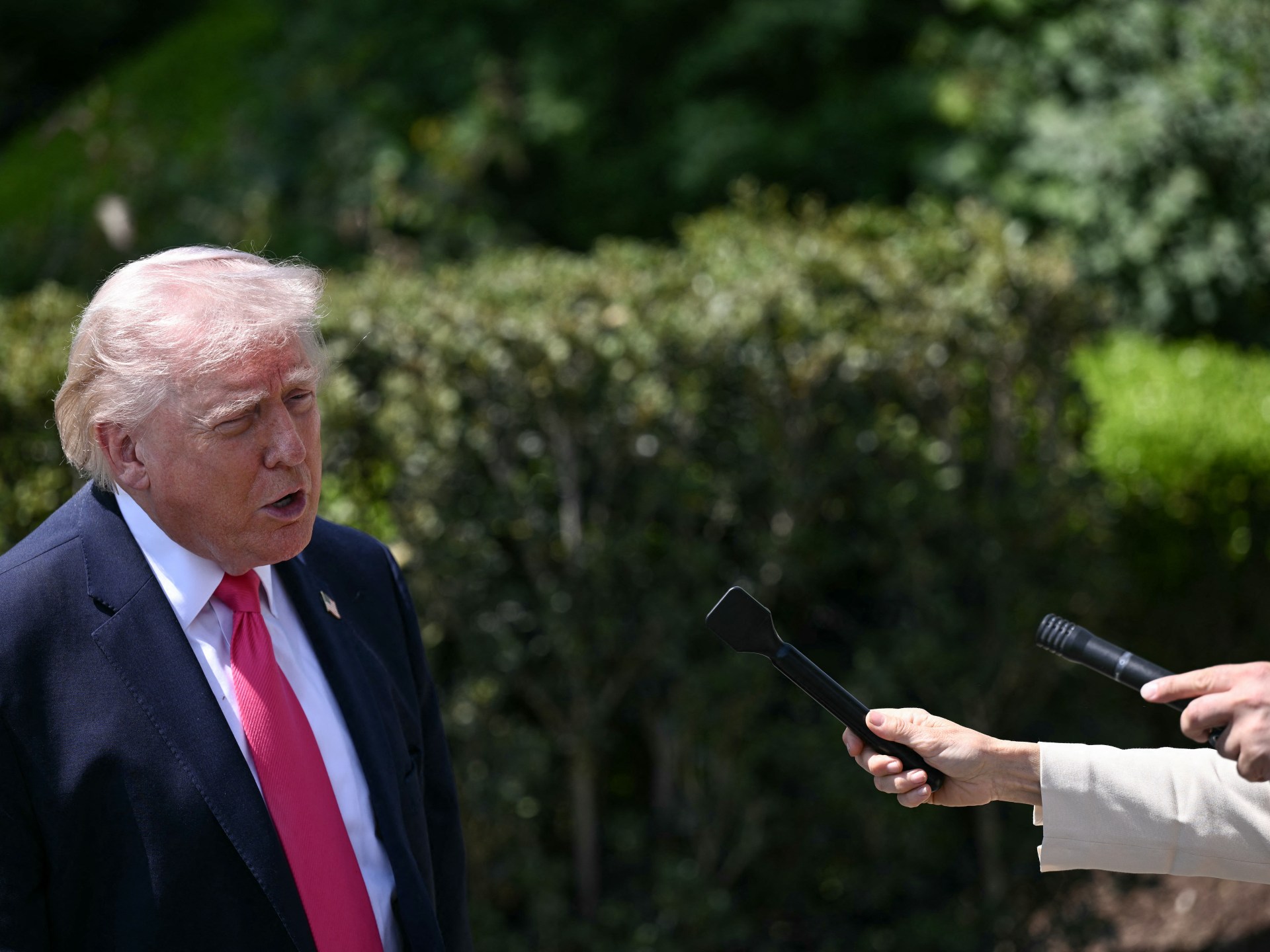
Pakistan’s prime minister is visiting a third Middle Eastern nation in three days, while the army chief is in Iran, and Trump says he might visit Islamabad to sign a deal.US President Donald Trump speaks to reporters before walking to board Marine One as he departs from the South Lawn of the White House in Washington, DC, on April 16, 2026 [AFP]Published On 17 Apr 2026Islamabad, Pakistan – Standing on the South Lawn of the White House before boarding his helicopter for Las Vegas on Thursday, United States President Donald Trump offered his most optimistic assessment yet of the war with Iran.“We’re very close to making a deal with Iran,” he told reporters. “They’ve totally agreed to that [no nuclear weapons]. They’ve agreed to almost everything, so maybe if they can get to the table, there’s a difference.”Recommended Stories list of 4 itemslist 1 of 4No date set for US-Iran talks, as Pakistan pushes to keep diplomacy alivelist 2 of 4How the US-Iran talks in Islamabad unfoldedlist 3 of 4Pakistan sets modest goal for US-Iran summit: A deal to keep talks goinglist 4 of 4How Pakistan managed to get the US and Iran to a ceasefireend of listHe went further, saying Iran had agreed to hand over its stockpile of enriched uranium, material that, if further enriched, can be used to build a nuclear weapon.“They’ve agreed to give us back the nuclear dust that’s way underground because of the attack we made with the B-2 bombers,” he said, referring to US strikes in June last year.A deal, he added, could come “over the weekend”. Trump said he would consider travelling to Islamabad himself if an agreement was signed there. “If the deal is signed in Islamabad, I might go. They want me to go.”Iran’s Ministry of Foreign Affairs presented a different picture. Spokesperson Esmaeil Baghaei confirmed that messages were being exchanged through Pakistan, but was unequivocal on enrichment.Iran, he said, “based on its needs, must be able to continue enrichment”. No Iranian official has confirmed agreeing to surrender the country’s enriched uranium stockpile. Tehran’s public position, that enrichment is a sovereign right, remains unchanged.Asif Durrani, a former Pakistani diplomat who served as Islamabad’s ambassador to Tehran from 2016 to 2018, said framing the situation as a gap between the two sides was misleading.“There are no gaps, really. If Trump has read the NPT, he would know that every country has the right to access nuclear technology for peaceful purposes,” he told Al Jazeera. “Iran has said multiple times that it does not want a weapon. What it wants is civil nuclear use, within the framework of both the NPT and the JCPOA.”The NPT, or Treaty on the Non-Proliferation of Nuclear Weapons, aims to prevent the spread of nuclear weapons while promoting peaceful nuclear energy and disarmament.The JCPOA, or Joint Comprehensive Plan of Action, was the 2015 agreement between Iran and six world powers that capped Tehran’s uranium enrichment and placed its facilities under international supervision in exchange for sanctions relief.The United States withdrew from the deal in 2018 during Trump’s first term, reimposing sanctions and setting in motion the gradual erosion of its limits on Iran’s nuclear programme.Seyed Mojtaba Jalalzadeh, an international relations analyst, said the reality was more complex than public statements suggest.“We should avoid simplistic binaries such as ‘one side is lying’,” he told Al Jazeera. “The gap visible between Trump’s remarks and the position of Iran’s foreign ministry is more a reflection of the complex, multilayered, and still unfinished nature of the negotiations.”When Trump speaks of “total agreement”, Jalalzadeh said, “he is most likely offering the most maximalist possible reading of the negotiating process.”It remains unclear whether Trump’s remarks reflect genuine backchannel progress or are a pressure tactic in advance of the April 22 ceasefire deadline, but Trump and Iran’s descriptions paint completely different pictures of the same negotiations.Pakistan’s diplomatic orchestraForeign Minister of Türkiye Hakan Fidan calls on Prime Minister Muhammad Shehbaz Sharif in Antalya on Thursday, April 16, 2026 [Handout/Prime Minister’s Office]The most active diplomacy on Thursday ran through Tehran, where Pakistan’s army chief, Field Marshal Asim Munir, held a series of high-level meetings.Munir met Iranian Parliament Speaker Mohammad Bagher Ghalibaf, who led Iran’s delegation at the Islamabad talks with the US last Saturday, followed by a meeting with President Masoud Pezeshkian.He also met Major-General Ali Abdollahi, commander of Iran’s Khatam al-Anbiya Central Headquarters, the operational command of the Islamic Revolutionary Guard Corps.Al Jazeera reported on Wednesday that Pakistani officials were expecting a “major breakthrough” on Iran’s nuclear programme “in days to come”, with messages continuing to pass between Washington and Tehran.While Munir engaged Iranian leaders in Tehran, Prime Minister Shehbaz Sharif pursued a parallel track, meeting Gulf leaders in Saudi Arabia and Qatar before arriving at Turkiye’s Antalya Diplomacy Forum on Thursday evening.Pakistan’s central role has been acknowledged by both sides.White House spokesperson Karoline Leavitt said any further in-person talks would most likely take place in Islamabad.“The Pakistanis have been incredible mediators throughout this process, and we really appreciate their friendship and their efforts to bring this deal to a close, so they are the only mediator in this negotiation,” she said.Durrani cautioned that Pakistan’s role has limits.“Pakistan is facilitating this meeting, and the most it can do is suggest certain things that mediators can offer in their capacity,” he said. “But ultimately, it all depends on the political will of the two parties.”That political will now faces a ceasefire deadline set to expire on April 22.Official sources told Al Jazeera that nearly 100 visa applications from journalists have been received in the past week, while authorities have begun tightening security in the capital in anticipation of a possible high-level event — the potential visit of US President Donald Trump, or at the very least, another round of high-level talks led by senior officials from Tehran and Washington.Hardline signals from TehranAlongside diplomatic movement, Iran’s hardline establishment struck a sharper tone.Iranian Parliament Speaker Mohammad Bagher Ghalibaf, right, welcoming Pakistan’s Army Chief Asim Munir before their meeting in Tehran on Thursday, April 16 [Handout/Iranian Parliament Public Relations Office]Mohsen Rezaei, a former IRGC commander and now a military adviser to Supreme Leader Mojtaba Khamenei, said on a state-owned television channel that he did not support extending the ceasefire.“Unlike the Americans who are afraid of continuous war, we are fully prepared and familiar with a long war,” he said, according to Tasnim News Agency.Abdollahi, speaking during his meeting with Munir and quoted by state news agency IRNA, said the conflict stemmed from a “miscalculation” by adversaries about Iran’s public support and military strength. He added that Iran’s forces remain ready for “comprehensive defence”.Durrani dismissed suggestions of internal divisions.“I don’t think there is any real division. Abdollahi is a military man and will speak as one; you cannot expect a military chief to say his country will not defend itself,” he said. “The Iranian system is functioning, and the supreme leader is the final authority.”Jalalzadeh offered a more nuanced reading.“Iran comes to the negotiating table with its finger on the trigger,” he said.The Tehran-based analyst described the messaging as “significant, but not necessarily destabilising” for negotiations, adding that it appeared aimed at applying pressure and managing domestic opinion rather than signalling a split that could derail talks.On the US side, Secretary of Defense Pete Hegseth used a Pentagon news conference on Thursday morning to reinforce Washington’s coercive posture.The US naval blockade of Iranian ports would continue “as long as it takes,” he said, adding that Washington remained “locked and loaded” on Iran’s energy infrastructure.Lebanon factor and regional linkagesA development on the Lebanon front on Thursday offered a potential opening.Trump on Thursday announced a 10-day ceasefire between Israel and Lebanon, a move that could influence broader negotiations.Iran has consistently maintained that any agreement with the US must address the situation in Lebanon.Iranian Parliament Speaker Ghalibaf, in a phone call with his Lebanese counterpart Nabih Berri on Thursday, details of which he posted on Telegram, said a ceasefire in Lebanon “is as important to Iran as a ceasefire in Iran itself”.Grace Wermenbol, a former US national security official and senior visiting fellow at the German Marshall Fund, said the development, while significant, carried familiar caveats.“The ceasefire is an important first step. But we have been here before; the key question is whether it will hold or whether it will, just like in Gaza, be a ceasefire in name only,” she told Al Jazeera.Left to right: US State Department Counselor Michael Needham, US Ambassador to the UN Mike Waltz, US Secretary of State Marco Rubio, US Ambassador to Lebanon Michel Issa, Lebanon’s Ambassador to the US Nada Hamadeh Moawad, and Israeli Ambassador to the US Yechiel Leiter stand together before meeting at the State Department in Washington, DC, on April 14, 2026 (Oliver Contreras/AFP]“This is not the ending [Israeli Prime Minister] Benjamin Netanyahu wanted. Once again, just like in Gaza, Yemen, and Iran, he has promised but failed to provide a long-term solution to Israeli security concerns through brute military action alone,” she said.Pakistan’s Ministry of Foreign Affairs spokesperson Tahir Andrabi reinforced the link between the two ceasefires – between the US and Iran, and between Israel and Lebanon – on Thursday.“Peace in Lebanon is essential for US-Iran peace talks,” he said, adding that “signs of improvement on the Israel-Lebanon front over the past two days are encouraging.”Shifting goalpostsThe confusion around the nuclear issue comes against a backdrop of evolving US objectives.When the US and Israel launched strikes on Iran on February 28, the stated aims were sweeping.On March 6, Trump wrote on Truth Social: “There will be no deal with Iran except UNCONDITIONAL SURRENDER.”A 15-point proposal delivered by Pakistan to Tehran on March 25 called for ending Iran’s nuclear programme, curbing its missile capabilities, reopening the Strait of Hormuz, and halting support for regional proxy groups.What is now being discussed bears little resemblance to those demands.Missiles and proxies have largely been dropped from the public agenda. Instead, discussions focus on enrichment limits, monitoring mechanisms, and Iran’s estimated 440kg (970 pounds) of highly enriched uranium.The US has proposed a 20-year freeze on enrichment, while Iran has countered with a five-year offer, according to reports.Sahar Khan, a Washington DC-based independent analyst and nonresident fellow at the Institute for Global Affairs, argued the shift was less dramatic than it appeared.“It’s not really a shift but more or less back to the JCPOA status quo, which had put a cap at enrichment levels and created a schedule for supervision,” she said.She said the dispute over “zero enrichment” was largely definitional.“Iran would be OK with ‘zero enrichment’ if it means it can produce its own nuclear fuel and maintain its centrifuges,” she said, “because it would mean that Iran does not have to depend on external suppliers, who will halt supply if Iran is put under sanctions again,” the analyst said.Durrani attributed the shift to changing realities on the ground.“The US was dictated to by Israel. It was Israel that pushed the US into this war,” he said.“But now Israel has had a shock, and the US has also come to realise that it all comes down to the endurance of your opponent. Iran has demonstrated that endurance, it has shown it can sustain the pain,” the former envoy said.He added that despite its military power, the US was unwilling to deploy ground troops. “That kind of staying power is not something you find on the US and Israeli side.”The April 22 deadline now looms over the process.Speaking in Las Vegas on Thursday evening, Trump said the war was going “swimmingly” and would “end pretty soon”, adding that talks could resume “over the weekend”.Whether a second round materialises in Islamabad, and what minimum understanding the two sides might accept, remains unclear.Khan said any agreement may hinge on deliberate ambiguity.“Both sides need a ‘win’ on the nuclear issue, and something they can sell to their respective public,” she said.
SRCAl Jazeera
LANGEN
LEANCenter
WORDS1 981
ENT8
FRI · 2026-04-17 · 14:54 GMTBRIEF NSR-2026-0417-70360
NSR-2026-0417-70360News Report·EN·Diplomatic
Can Pakistan secure Iran-US nuclear compromise, as Trump says deal ‘close’?
In April 2026, amidst Pakistani diplomatic efforts, US President Trump stated that a deal with Iran regarding its nuclear program was close, potentially to be signed in Islamabad. Trump claimed Iran had agreed to limit nuclear weapons development and surrender enriched uranium.
Abid HussainAl JazeeraFiled 2026-04-17 · 14:54 GMTLean · CenterRead · 8 min
Al JazeeraFIG 01
Reading time
8min
Word count
1 981words
Sources cited
3cited
Entities identified
8entities
Quality score
100%
§ 01
Briefing Summary
AI-generatedNEWSAR · AI
In April 2026, amidst Pakistani diplomatic efforts, US President Trump stated that a deal with Iran regarding its nuclear program was close, potentially to be signed in Islamabad. Trump claimed Iran had agreed to limit nuclear weapons development and surrender enriched uranium. However, Iran's Foreign Ministry confirmed communication through Pakistan but maintained its right to enrichment based on its needs. No Iranian official has confirmed agreeing to surrender the country’s enriched uranium stockpile. Pakistan's prime minister is visiting Middle Eastern nations, and the army chief is in Iran, as Pakistan attempts to mediate a compromise between the US and Iran. Trump indicated he might travel to Islamabad if a deal is reached.
Confidence 0.80Sources 3Claims 5Entities 8
§ 02
Article analysis
Model · rule-basedFraming
Diplomatic
National Security
Tone
Mixed Tone
AI-assessed
CalmNeutralAlarmist
Factuality
0.60 / 1.00
Mixed
LowHigh
Sources cited
3
Well sourced
FewMany
§ 03
Key claims
5 extracted01
Former Pakistani diplomat Asif Durrani stated that framing the situation as a gap between the US and Iran is misleading, as Iran has the right to peaceful nuclear technology under the NPT and JCPOA.
quoteAsif Durrani
Confidence
1.00
02
Iran's Ministry of Foreign Affairs spokesperson confirmed messages are being exchanged through Pakistan but stated Iran must be able to continue enrichment based on its needs.
quoteEsmaeil Baghaei
Confidence
1.00
03
Trump claimed Iran has agreed to hand over its stockpile of enriched uranium.
quoteDonald Trump
Confidence
1.00
04
US President Donald Trump stated that the US is very close to making a deal with Iran regarding nuclear weapons.
quoteDonald Trump
Confidence
1.00
05
No Iranian official has confirmed agreeing to surrender the country’s enriched uranium stockpile.
factual
Confidence
0.90
§ 04
Full report
8 min read · 1 981 words§ 05
Entities
8 identifiedKey playerOppositionContextPositiveNeutralNegative
People3
§ 06
Keywords & salience
9 termsiran-us nuclear deal
1.00
nuclear weapons
0.80
pakistan
0.70
enriched uranium
0.70
diplomacy
0.60
negotiations
0.50
trump
0.50
nuclear technology
0.50
islamabad
0.40
§ 07
Topic connections
Interactive graph No topic relationship data available yet. This graph will appear once topic relationships have been computed.