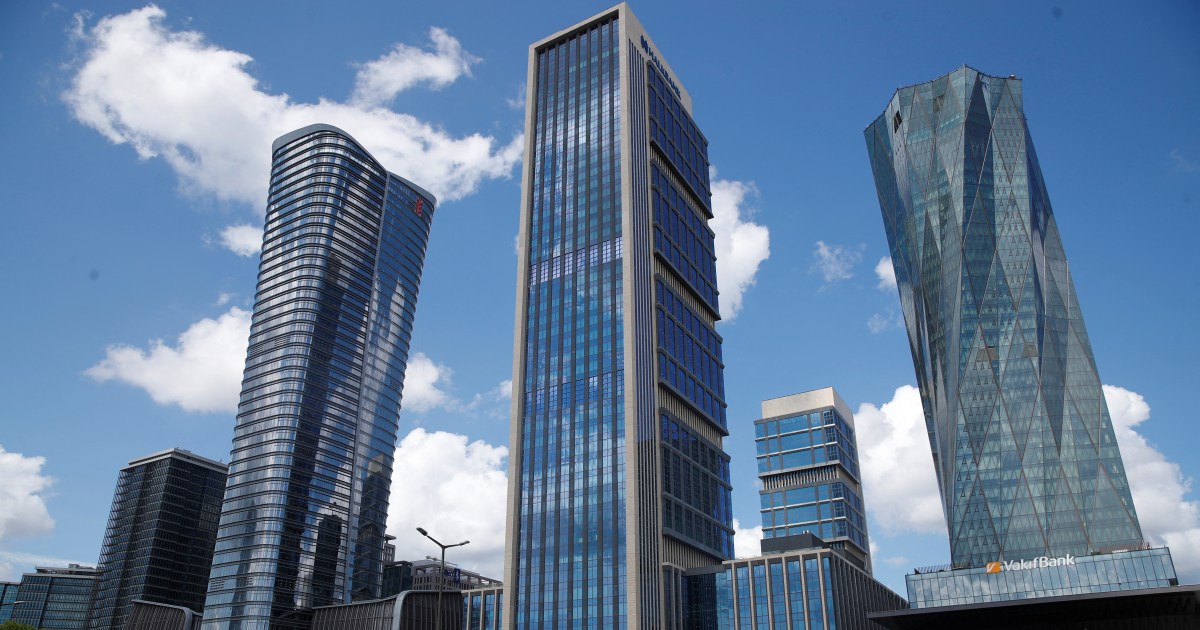
Turkish officials are promoting Istanbul as a regional financial hub amid the war’s fallout on the Gulf economies.The Istanbul Financial Center in Istanbul, Turkey, on July 25, 2024 [File: Dilara Senkaya/Reuters]Published On 18 Apr 2026For Turkiye’s government, the Iran war has complicated efforts to turn around an economy still reeling from one of the worst financial crises in the country’s history.But even as the conflict has driven up Turkiye’s fuel prices and forced authorities to dip into their precious foreign currency reserves to defend the lira, it has also presented an opportunity.Recommended Stories list of 4 itemslist 1 of 4Turkiye’s Roketsan eyes top 10 exporter rank amid Middle East conflictlist 2 of 4Iran war’s big winners: Wall Street, weapons firms, AI and green energylist 3 of 4Can Pakistan secure Iran-US nuclear compromise, as Trump says deal ‘close’?list 4 of 4Why oil prices aren’t what you think – and what it means for global supplyend of listAs the fallout of the war has reverberated across the Middle East, Ankara has jumped at the chance to promote Turkiye as a model of security and stability for businesses and investors.While Iranian missiles and drones have inflicted significant damage on infrastructure in the United Arab Emirates, Saudi Arabia and Qatar, Turkiye, which is protected by NATO air defences, has emerged largely unscathed from aerial attacks blamed on Tehran.‘New doors’Turkish officials have made little secret of their desire to capitalise on the shadow that the conflict – which is officially on pause until Wednesday under a two-week ceasefire between the United States and Iran – has cast over regional business hubs such as Dubai, Doha and Riyadh.In remarks earlier this month, Turkish President Recep Tayyip Erdogan, who last month met with 40 global CEOs to discuss ways to boost his country’s competitiveness, cast the war as a boon to Ankara’s ambitions to transform Istanbul into one of the world’s leading financial centres.“Just as in the pandemic period, we wholeheartedly believe that this global crisis, too, will open new doors before our country,” Erdogan said in a statement posted on social media.Turkiye’s President Recep Tayyip Erdogan [File: Marco Simoncelli/AFP]Turkish Treasury and Finance Minister Mehmet Simsek confirmed soon afterwards that the government was preparing “radical” incentives to lure foreign capital.Turkiye’s improving economic stability in the wake of its 2018 debt crisis and various financial incentives have helped to reposition the country as a regional hub and “safe haven”, said Bilal Bagis, head of the economics department at Fatih Sultan Mehmet Vakıf University in Istanbul.“A liberal investment environment, ease of entry and new comprehensive incentive packages should help boost its position,” Bagis told Al Jazeera.While Ankara has yet to confirm the measures in the pipeline, they are likely to involve tax breaks for companies that sell goods through Turkish entities without importing them into the country, said Guney Yildiz, a Turkish-born adviser at Anthesis Group who has clients in the Gulf.“So you’d have a commodities trader or a logistics company booking transactions through Istanbul and getting a meaningful tax benefit for it,” Yildiz told Al Jazeera.“That’s a direct play for the kind of intermediation business that Dubai has owned for two decades,” he said, adding that “the timing is obviously shaped by the war.”Turkiye’s Ministry of Treasury and Finance did not respond to questions about the measures under consideration, but its plans follow a series of recent initiatives aimed at luring foreign investment, including the opening of the Istanbul Financial Center (IFC) in 2023.The special economic zone offers tax incentives to financial institutions, including a 100 percent exemption from corporate tax on export earnings until 2031.An IFC spokesperson said the district has recently seen “growing and concrete” engagement from both foreign governments and private institutions.“There is a particularly strong strategic focus from Far Eastern institutions,” the spokesperson told Al Jazeera.“This is not limited to private sector companies; we are also seeing engagement at the government level. We remain in close contact with Japan and South Korea, while our discussions with the United Kingdom continue,” the spokesperson said, adding that Istanbul has a “powerful triple advantage built on geography, innovation and economic depth.“From Istanbul, institutions can reach around 1.3 billion people and a 30 trillion-dollar economy within a four-hour flight,” the spokesperson said.The Dubai skyline after sunset on December 31, 2024 [File: Fadel Senna/AFP]‘Math gets complicated fast’Still, Istanbul faces a steep climb to seriously compete with hubs such as Dubai.Istanbul currently ranks 101st on the latest Global Financial Centres Index, compiled by Z/Yen Partners in collaboration with the China Development Institute, far behind Dubai (7), Abu Dhabi (21), Doha (48) and Riyadh (61).Turkiye’s economy has been plagued by double-digit inflation and a depreciating currency since the onset of the 2018 crisis. “The lira loses roughly a fifth of its value against the dollar every year,” Yildiz said.“For a financial firm that earns in multiple currencies and pays staff in lira-denominated salaries, the math gets complicated fast. You’re constantly managing FX exposure in a way you simply don’t have to in a pegged-currency jurisdiction like the UAE or Singapore.”Critics have also accused Erdogan’s administration of economic mismanagement by keeping interest rates low despite fears of inflation. But the government says the move is aimed at boosting the economy and ending foreign currency manipulation.While the IFC has reported growing interest from firms, less than half of its office space has been filled, though officials say they expect occupancy to reach 75 percent by the end of this year.“When we look at surveys of European firms with a subsidiary in Turkiye, their main complaints are unpredictability of economic policy, political instability, legal uncertainty, high bureaucracy, high inflation and imported inflation,” Meryem Gokten, an economist at The Vienna Institute for International Economic Studies, told Al Jazeera.“None of these issues can be resolved in the short term … Turkiye has not been a financial hub so far, and I do not see it becoming one without addressing these structural issues,” Gokten added.The Istanbul Financial Center in Istanbul, Turkiye, April 3, 2026 [File: Umit Bektas/Reuters]Selim Koru, a doctoral researcher who specialises in public policy at the University of Nottingham, expressed similar scepticism.“Part of Dubai’s attractiveness was that it’s a tabula rasa of sorts. There is no firmly established cultural, legal, political climate, and foreign parties can have a say in what they want it to be,” Koru told Al Jazeera.“That’s not the case with Istanbul, or anywhere else in Turkiye, really.”For some analysts, whether Istanbul can directly challenge Dubai is not the right question.Hasan Dincer, a finance professor at Istanbul Medipol University, said Turkiye’s bid to draw investment from overseas should be viewed as a “gradual positioning rather than direct short-term competition”.“In emerging financial systems, investor confidence is primarily driven by predictability, transparency,” Dincer told Al Jazeera.“And the credibility of long-term economic policies initiatives, such as the Istanbul Financial Center, represent important strategic steps whose long-term impact will depend on sustained implementation and institutional alignment,” he said.
SRCAl Jazeera
LANGEN
LEANCenter
WORDS1 152
ENT10
SAT · 2026-04-18 · 11:52 GMTBRIEF NSR-2026-0418-70561
NSR-2026-0418-70561News Report·EN·Economic Impact
Turkiye woos investors amid Iran war fallout in Gulf economies
Amidst the ongoing Iran war and its impact on Gulf economies, Turkiye is actively seeking to attract investors by promoting Istanbul as a secure and stable regional financial hub. Turkish officials are highlighting the country's relative safety, protected by NATO air defenses, compared to the damage inflicted on infrastructure in the UAE, Saudi Arabia, and Qatar.
John PowerAl JazeeraFiled 2026-04-18 · 11:52 GMTLean · CenterRead · 5 min
Al JazeeraFIG 01
Reading time
5min
Word count
1 152words
Sources cited
3cited
Entities identified
10entities
Quality score
100%
§ 01
Briefing Summary
AI-generatedNEWSAR · AI
Amidst the ongoing Iran war and its impact on Gulf economies, Turkiye is actively seeking to attract investors by promoting Istanbul as a secure and stable regional financial hub. Turkish officials are highlighting the country's relative safety, protected by NATO air defenses, compared to the damage inflicted on infrastructure in the UAE, Saudi Arabia, and Qatar. President Erdogan sees the conflict as an opportunity to boost Istanbul's competitiveness and transform it into a leading global financial center. The Turkish government, led by Treasury and Finance Minister Simsek, is preparing incentives to attract foreign capital, capitalizing on Turkiye's improving economic stability since its 2018 debt crisis. This initiative aims to draw businesses and investors seeking a haven from the regional conflict's fallout.
Confidence 0.90Sources 3Claims 5Entities 10
§ 02
Article analysis
Model · rule-basedFraming
Economic Impact
Political Strategy
Tone
Measured
AI-assessed
CalmNeutralAlarmist
Factuality
0.70 / 1.00
Factual
LowHigh
Sources cited
3
Well sourced
FewMany
§ 03
Key claims
5 extracted01
The government was preparing “radical” incentives to lure foreign capital.
quoteMehmet Simsek
Confidence
0.90
02
Turkish officials are promoting Istanbul as a regional financial hub amid the war’s fallout on the Gulf economies.
factualArticle
Confidence
0.90
03
The Iran war has complicated efforts to turn around an economy still reeling from one of the worst financial crises in the country’s history.
factualArticle
Confidence
0.80
04
This global crisis, too, will open new doors before our country.
quoteRecep Tayyip Erdogan
Confidence
0.70
05
A liberal investment environment, ease of entry and new comprehensive incentive packages should help boost its position.
predictionBilal Bagis
Confidence
0.60
§ 04
Full report
5 min read · 1 152 words§ 05
Entities
10 identifiedKey playerOppositionContextPositiveNeutralNegative
Organizations1
§ 06
Keywords & salience
9 termsiran war
0.90
turkish economy
0.80
foreign investment
0.70
gulf economies
0.70
financial hub
0.70
istanbul financial center
0.60
middle east conflict
0.60
economic stability
0.50
fuel prices
0.40
§ 07
Topic connections
Interactive graph Network visualization showing 50 related topics
View Full Graph Person Organization Location Event|Click node to navigate|Edge numbers = shared articles