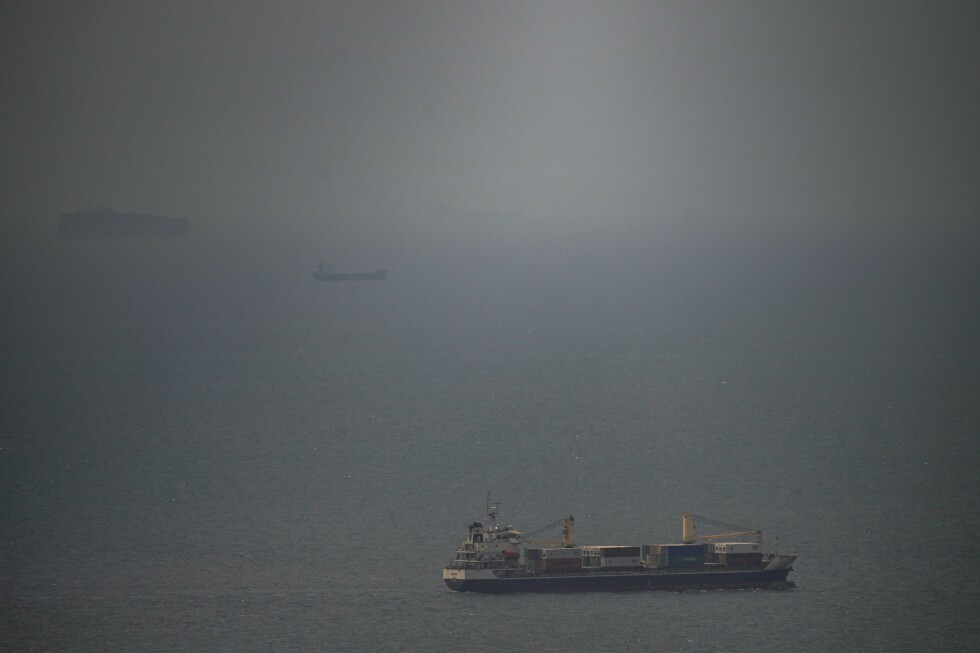
2 ships attacked in Strait of Hormuz, complicating diplomatic efforts to resume talks 1 of 2 | When the United States and Israel attacked Iran on February 28, Iran retaliated with attacks that effectively closed the Strait of Hormuz. Oil prices spiked worldwide – and the importance of the strait became clear. 2 of 2 | Tankers and bulk carriers anchored in the Strait of Hormuz, Saturday, April 18, 2026. (AP Photo) 1 of 2 When the United States and Israel attacked Iran on February 28, Iran retaliated with attacks that effectively closed the Strait of Hormuz. Oil prices spiked worldwide – and the importance of the strait became clear. Add AP News on Google Add AP News as your preferred source to see more of our stories on Google. 2 of 2 Tankers and bulk carriers anchored in the Strait of Hormuz, Saturday, April 18, 2026. (AP Photo) Add AP News on Google Add AP News as your preferred source to see more of our stories on Google. Updated [hour]:[minute] [AMPM] [timezone], [monthFull] [day], [year] Dubai, United Arab Emirates (AP) — A second ship came under attack Wednesday in the Strait of Hormuz, the British military said, just a short time after Iran’s paramilitary Revolutionary Guard opened fire on a container ship.The British military’s United Kingdom Maritime Trade Operations center did not immediately identify who shot at the second ship. However, suspicion immediately fell on Iran, whose paramilitary Revolutionary Guard earlier opened fire on the container ship.In the second attack, the cargo ship said it had been fired upon and was stopped in the water. It said there was no reported damage to the vessel.The attacks come days after the U.S. seized an Iranian container ship after shooting it this past weekend and boarded an oil tanker associated with Iran’s oil trade in the Indian Ocean.THIS IS A BREAKING NEWS UPDATE. AP’s earlier story follows below. Dubai, United Arab Emirates (AP) — Iran fired on a container ship in the Strait of Hormuz on Wednesday, damaging the vessel and complicating efforts to bring the United States and Iran together in Pakistan for talks to end the war. The morning attack by Iran’s paramilitary Revolutionary Guard came after U.S. President Donald Trump said the U.S. would indefinitely extend the ceasefire with Iran, which had been due to expire on Wednesday, to give Tehran time to come up with a “unified proposal” ahead of possible negotiations. Iran has offered no formal acknowledgment of Trump’s ceasefire extension.Pakistan’s Prime Minister Shehbaz Sharif thanked Trump for agreeing to the extension, saying it would buy time for ongoing diplomatic efforts. “With the trust and confidence reposed in us, Pakistan shall continue its earnest efforts for a negotiated settlement of the conflict,” he wrote on X.Trump said the U.S. would continue its blockade of Iranian ports, which Iran has called “unacceptable,” and has indicated was a reason it had not yet agreed to join talks in Islamabad. The Revolutionary Guard vowed Wednesday to “deliver crushing blows beyond the enemy’s imagination to its remaining assets in the region.” Iran claims ship ignored warnings before attackedWednesday’s attack in the Strait of Hormuz came after the U.S. seized an Iranian container ship after shooting it this past weekend and boarded an oil tanker associated with Iran’s oil trade in the Indian Ocean.The United Kingdom Maritime Trade Operations Centre, a monitoring agency run by the British military that first reported the 7:55 a.m. attack, said a Revolutionary Guard gunboat did not hail the ship before firing. It added that nobody was hurt in the attack. Iran’s Nour News, however, reported that the Guard only opened fire on the ship after it had “ignored the warnings of the Iranian armed forces.” Iran’s semiofficial Fars news agency described the attack as Iran “lawfully enforcing its control over the Strait of Hormuz.In peacetime, about 20% of the world’s oil and natural gas transits the strategic waterway, which leads from the Persian Gulf to the open oceans and was fully open until the U.S. and Israel attacked Iran on Feb. 28 to start the war. Since then Tehran has throttled shipping traffic through the strait, causing oil prices to skyrocket and impacting global economies. In early trading on Wednesday, Brent crude oil, the international standard, was trading at close to $98 a barrel, up more than 30% since the day the war started. Pakistan forges ahead with diplomatic effortsPakistan has been working tirelessly to bring both sides together for a second round of talks. So far, Iran has not committed but Pakistani officials there have expressed confidence that Tehran will send a delegation to resume negotiations. The first round April 11 and 12 ended without an agreement.Over the weekend, Iran said that it had received new proposals from Washington, but also suggested that a wide gap remains between the sides. Issues that derailed the previous round of negotiations included Iran’s nuclear enrichment program, its regional proxies and the strait.Following Trump’s announcement of the ceasefire extension, U.N. Secretary-General António Guterres said he hoped it would create “critical space for diplomacy and confidence-building between Iran and the United States,” according to his spokesman, Stephane Dujarric. Since the war started, at least 3,375 people have been killed in Iran, according to authorities. More than 2,290 people has been killed in Lebanon, 23 people have died in Israel and more than a dozen have died in Gulf Arab states. Fifteen Israeli soldiers in Lebanon and 13 U.S. service members throughout the region have been killed.___Rising reported from Bangkok. Melanie Lidman in Tel Aviv, Israel contributed to this report. Gambrell is the news director for the Gulf and Iran for The Associated Press. He has reported from each of the Gulf Cooperation Council countries, Iran and other locations across the world since joining the AP in 2006. Rising covers regional Asia-Pacific stories for The Associated Press. He has worked around the world, including covering the wars in Iraq, Afghanistan and Ukraine, and was based for nearly 20 years in Berlin before moving to Bangkok.
SRCAssociated Press (AP)
LANGEN
LEANCenter
WORDS1 005
ENT11
WED · 2026-04-22 · 05:53 GMTBRIEF NSR-2026-0422-71438
NSR-2026-0422-71438News Report·EN·National Security
Iran fires on container ship in Strait of Hormuz
Iran fired on a container ship in the Strait of Hormuz on Wednesday, damaging the vessel. The attack was carried out by Iran's paramilitary Revolutionary Guard, according to the British military.
By
JON GAMBRELL and DAVID RISINGAssociated Press (AP)Filed 2026-04-22 · 05:53 GMTLean · CenterRead · 5 min
Associated Press (AP)FIG 01
Reading time
5min
Word count
1 005words
Sources cited
2cited
Entities identified
11entities
Quality score
100%
§ 01
Briefing Summary
AI-generatedNEWSAR · AI
Iran fired on a container ship in the Strait of Hormuz on Wednesday, damaging the vessel. The attack was carried out by Iran's paramilitary Revolutionary Guard, according to the British military. This incident comes days after the US seized an Iranian container ship and boarded an oil tanker associated with Iran's oil trade in the Indian Ocean. The attacks have complicated diplomatic efforts to resume talks between the US and Iran in Pakistan. The ceasefire between the two countries was set to expire on Wednesday, but US President Donald Trump extended it indefinitely to give Iran time to come up with a unified proposal ahead of possible negotiations. The incident has raised concerns about the security of shipping lanes in the region.
Confidence 0.90Sources 2Claims 4Entities 11
§ 02
Article analysis
Model · rule-basedFraming
National Security
Tone
Measured
AI-assessed
CalmNeutralAlarmist
Factuality
0.80 / 1.00
Factual
LowHigh
Sources cited
2
Limited
FewMany
§ 03
Key claims
4 extracted01
Iran has offered no formal acknowledgment of Trump’s ceasefire extension.
factualnull
Confidence
1.00
02
The U.S. seized an Iranian container ship after shooting it this past weekend and boarded an oil tanker associated with Iran’s oil trade in the Indian Ocean.
factualAP's earlier story
Confidence
1.00
03
Iran fired on a container ship in the Strait of Hormuz, damaging the vessel.
factualAP's earlier story
Confidence
1.00
04
U.S. President Donald Trump said the U.S. would indefinitely extend the ceasefire with Iran, which had been due to expire on Wednesday, to give Tehran time to come up with a “unified proposal” ahead of possible negotiations.
quoteTrump
Confidence
0.80
§ 04
Full report
5 min read · 1 005 words§ 05
Entities
11 identifiedKey playerOppositionContextPositiveNeutralNegative
Organizations2
§ 06
Keywords & salience
7 termsstrait of hormuz
0.80
iran
0.70
container ship
0.60
ceasefire
0.50
united states
0.50
maritime trade operations
0.40
oil prices
0.40
§ 07
Topic connections
Interactive graph Network visualization showing 51 related topics
View Full Graph Person Organization Location Event|Click node to navigate|Edge numbers = shared articles