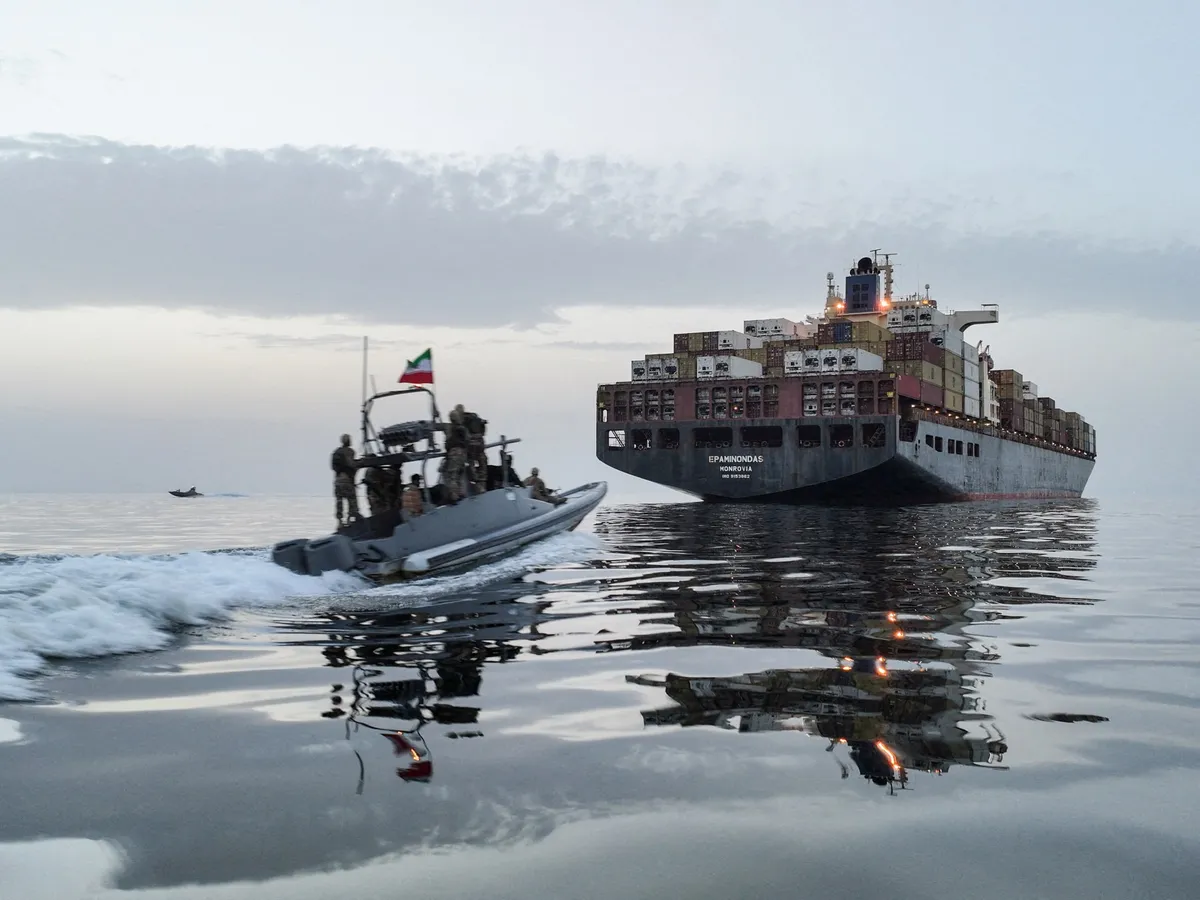
EXPLAINERHow long before insurance companies consider Hormuz transits safe again – even once navies claim they have cleared the mine there?The Epaminondas ship is seen during seizure by the Islamic Revolutionary Guard Corps in the Strait of Hormuz, Iran, on April 24, 2026 [Meysam Mirzadeh/Tasnim/WANA via Reuters]Published On 28 Apr 2026Since the start of the US-Israel war on Iran nine weeks ago, the Strait of Hormuz, through which 20 percent of the world’s oil and liquefied natural gas (LNG) is shipped during peacetime, has become the chokepoint of the global economy.The tremors from the effective closure of the strait – a narrow artery linking oil and gas producers in the Gulf to the open seas – are being felt across the world, stoking fears of a global recession.About 2,000 ships remain stranded in the Gulf, waiting to be allowed through. But even if the strait is reopened to all traffic, there will still be obstacles to shipping. The United States has said it will take six months to clear mines it believes have been laid by Iran. Indeed, this was one of the main reasons that maritime insurers cancelled “war risk” insurance for tankers travelling through the strait in March.Even if the strait reopens, a high level of risk will remain for ships crossing through, which could push premiums up by about 0.25 percent of hull value before the war to as much as 5 percent now, shipping insurers told Al Jazeera this week.So, what would it take for insurers to underwrite the Strait of Hormuz as safe?Iranian soldiers stand guard in Tehran on April 9, 2026, under a large portrait of Supreme Leader Mojtaba Khamenei during a memorial to mark the 40th day since his father, Ayatollah Ali Khamenei, was killed in US-Israeli joint strikes [Majid Saeedi/Getty Images]What’s happening in the Strait of Hormuz?The Iranian military shut the strait, which is shared between the territorial waters of Iran and Oman, following the February 28 strikes on Tehran that killed Supreme Leader Ayatollah Ali Khamenei. His son, Mojtaba Khamenei, has taken over the top job in Tehran since.Tehran used access to the strait as its most powerful leverage in talks between the US and Iran in Islamabad, Pakistan, on April 11, but these failed to yield results.Two days later, US President Donald Trump announced a naval blockade of Iranian ports and the Strait of Hormuz to put economic pressure on Tehran, which had until then been able to ship its own exports through the passage. Washington has since captured or turned back ships linked to Iran – both in the Gulf and in the Indo-Pacific region – which Tehran has denounced as “piracy”.While Tehran was previously allowing ships from countries it deemed “friendly” or which paid a toll – mostly from India, Pakistan, Turkiye and China – to pass the strait, it has now closed it to all foreign-flagged ships until the US lifts its naval blockade.Meanwhile, Iran has published a map showing parts of the strait that it said had been mined, and an alternative route for approved ships earlier this month. This route brings ships much closer to the coast of Iran, whereas they previously passed closer to Oman. Iran said this was to help tankers avoid the danger of mines.On Thursday, Trump ordered the US military to “shoot and kill any boat, small boats though they may be (Their naval ships are ALL, 159 of them, at the bottom of the sea!), that is putting mines in the waters of the Strait of Hormuz” in a social media post, emphasising “There is to be no hesitation”.“Additionally, our mine ‘sweepers’ are clearing the Strait right now. I am hereby ordering that activity to continue, but at a tripled up level!” he wrote in a post on his Truth Social platform.Halting traffic in the Strait of Hormuz has caused “the largest oil supply disruption in the history” of the global market – bigger than the 1970s oil shocks – according to the International Energy Agency.The MSC Francesca is seen during a seizure by the IRGC in the Strait of Hormuz [File: Meysam Mirzadeh/Tasnim/WANA via Reuters]How long would it take to clear mines in the Strait of Hormuz?On April 11, the US military said it had begun operations to clear mines in the strait. Two US Navy guided-missile destroyers – USS Frank E Peterson and USS Michael Murphy – conducted the operations. They were later reportedly joined by underwater drones to detect mines.On April 21, Pentagon officials informed the US House Armed Services Committee that it could take six months to fully clear the Strait of Hormuz of mines deployed by the Iranian military.They added that any such operation is unlikely to be carried out until the war ends. “We feel confident in our ability, in the correct period of time, to clear any mines that we identify,” Pete Hegseth, the US defence secretary, told reporters on Friday.However, analysts warn that sweeping the Strait of Hormuz clear of mines with complete certainty could be a near-impossible task. Furthermore, if there is any risk of mines remaining, this will deter insurers and halt traffic, maritime insurers told Al Jazeera.This uncertainty pays off for Tehran’s asymmetric warfare. “If the situation changes by the hour, the risk becomes almost impossible to price responsibly,” said Oscar Seikaly, CEO of NSI Insurance Group, based in Florida, US. “The market can insure volatility, but it struggles to insure uncertainty.”“War-risk insurers are not looking for a risk-free environment; they are looking for a risk they can quantify, price, and spread across enough capacity,” he added. Without any certainty about the number of mines in the strait, this is impossible.Jakob Larsen, head of maritime security for BIMCO, the largest international association representing shipowners, warned that even after peace is brokered, “the mine threat is of particular concern” when it comes to returning to pre-conflict traffic patterns.“Given the Iranian indications that mines have been laid in parts of the Strait of Hormuz, a mine clearance effort will most likely be needed to fully reopen the Strait,” Larsen said in a statement.“Shipping will be restricted to using routes close to Iran and Oman. Due to their confined nature, these routes cannot safely accommodate the normal volumes of shipping through the Strait of Hormuz,” he noted.What level of safety is acceptable to insurance companies?Maritime war and insurance experts told Al Jazeera that a lasting commitment by all parties to maintain peace along the sea route is the least they will require to consider the Strait of Hormuz safe again.“There must be an explicit commitment by all parties to enforce freedom of navigation through established and internationally recognised shipping channels,” said Munro Anderson, director of marine strategy and operations at Vessel Protect, a specialist underwriter of marine war risks, based in London, UK.Anderson told Al Jazeera that the insurance market is in a position to facilitate cover if the transit of a vessel has been approved by the Iranian authorities.Still, a degree of residual risk will remain in transiting the Strait of Hormuz when reopened, he added. “The level to which that is acceptable is a matter for each insurer according to their own appetite,” Anderson said.“Risk is often multifaceted” for the vessels trying to transit the sea route, he noted.“The main risks result from a significant lack of command and control within Iranian forces, which has resulted in vessels being approved for transit yet still being attacked,” Anderson added, in a reference to the attack on an Indian-flagged ship, the Sanmar Herald, on April 18.The Indian-flagged oil tanker was fired upon by Iranian military boats in the sea route. In the audio from the incident, the ship’s captain can be heard saying: “Sepah Navy! This is motor tanker Sanmar Herald. You gave me clearance to go. My name is second on your list. You gave me clearance to go. You are firing now! Let me turn back!”
SRCAl Jazeera
LANGEN
LEANCenter
WORDS1 316
TUE · 2026-04-28 · 11:18 GMTBRIEF NSR-2026-0428-72214
NSR-2026-0428-72214Analysis·EN·Economic Impact
When will Strait of Hormuz be ‘safe’ for commercial shipping again?
The Strait of Hormuz, a vital global shipping route for 20% of the world's oil and LNG, has become a chokepoint due to its closure by Iran. This closure, initiated nine weeks ago following US-Israel strikes on Tehran that killed Supreme Leader Ayatollah Ali Khamenei, has stranded approximately 2,000 ships and is fueling fears of a global recession.
Yashraj SharmaAl JazeeraFiled 2026-04-28 · 11:18 GMTLean · CenterRead · 6 min
Al JazeeraFIG 01
Reading time
6min
Word count
1 316words
Sources cited
3cited
Entities identified
0entities
Quality score
75%
§ 01
Briefing Summary
AI-generatedNEWSAR · AI
The Strait of Hormuz, a vital global shipping route for 20% of the world's oil and LNG, has become a chokepoint due to its closure by Iran. This closure, initiated nine weeks ago following US-Israel strikes on Tehran that killed Supreme Leader Ayatollah Ali Khamenei, has stranded approximately 2,000 ships and is fueling fears of a global recession. Maritime insurers canceled "war risk" insurance in March, citing concerns over mines potentially laid by Iran, which the US estimates will take six months to clear. Even if reopened, high risk will persist, significantly increasing insurance premiums. Failed talks between the US and Iran in Islamabad on April 11 did not resolve the situation, leading to a US naval blockade of Iranian ports and the strait.
Confidence 0.90Sources 3Claims 5
§ 02
Article analysis
Model · rule-basedFraming
Economic Impact
Conflict
Tone
Mixed Tone
AI-assessed
CalmNeutralAlarmist
Factuality
0.80 / 1.00
Factual
LowHigh
Sources cited
3
Well sourced
FewMany
§ 03
Key claims
5 extracted01
Twenty percent of the world’s oil and liquefied natural gas (LNG) is shipped through the Strait of Hormuz during peacetime.
statistic
Confidence
1.00
02
Iran has closed the Strait of Hormuz to all foreign-flagged ships until the United States lifts its naval blockade.
factual
Confidence
0.95
03
About 2,000 ships remain stranded in the Gulf, waiting to be allowed through the Strait of Hormuz.
factual
Confidence
0.90
04
Shipping insurance premiums for crossing the strait could rise to as much as 5 percent of hull value.
predictionshipping insurers
Confidence
0.80
05
It will take six months to clear mines believed to have been laid by Iran in the Strait of Hormuz.
predictionUnited States
Confidence
0.70
§ 04
Full report
6 min read · 1 316 words§ 06
Keywords & salience
10 termsstrait of hormuz
1.00
commercial shipping
0.90
insurance
0.80
us-israel war on iran
0.70
global economy
0.70
iran
0.60
mines
0.60
naval blockade
0.50
oil and liquefied natural gas (lng)
0.50
risk
0.40
§ 07
Topic connections
Interactive graph Network visualization showing 51 related topics
View Full Graph Person Organization Location Event|Click node to navigate|Edge numbers = shared articles