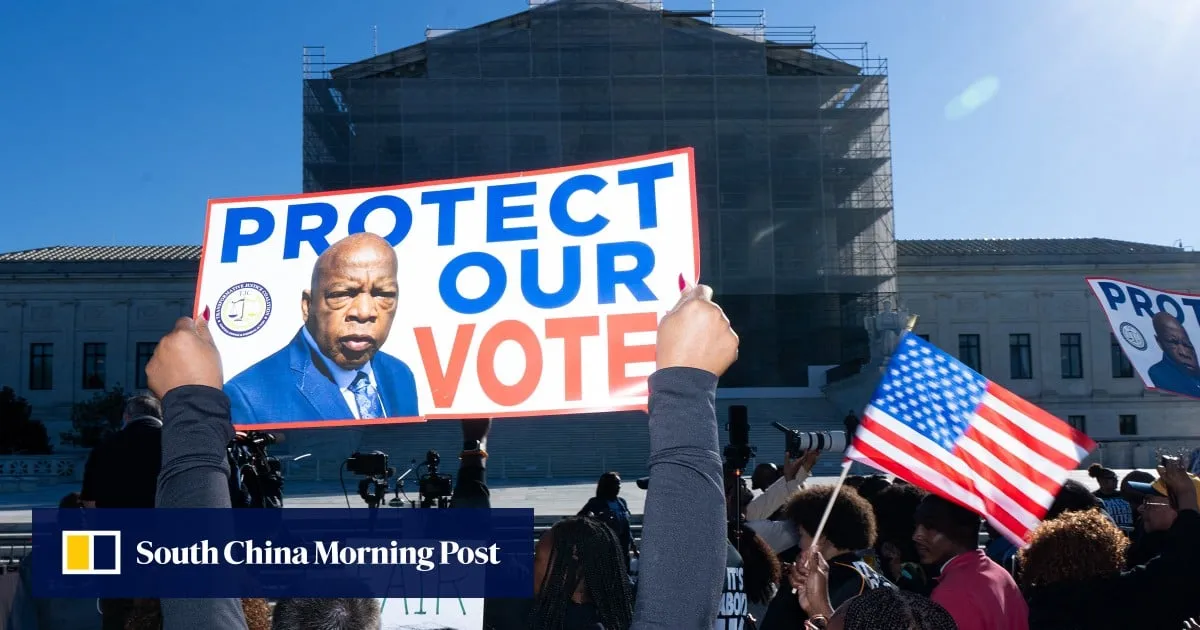
The US Supreme Court on Wednesday sharply limited the use of race in drawing electoral districts, in a decision that could reshape congressional maps nationwide and boost Republican prospects ahead of midterm elections.In a 6-3 ruling split along ideological lines, the conservative-dominated court struck down a map that creates a second majority-black district in Louisiana, finding it amounted to an unconstitutional racial gerrymander despite being drawn to comply with the 1965 Voting Rights Act (VRA).The decision leaves the core of the VRA intact but narrows how it can be applied, and will be seen by civil rights activists as a blow to a landmark law that has already been weakened by previous rulings over the past decade.
SRCSouth China Morning Post
LANGEN
LEANCenter-Right
WORDS117
WED · 2026-04-29 · 17:59 GMTBRIEF NSR-2026-0429-72535
NSR-2026-0429-72535News Report·EN·Legal & Judicial
US Supreme Court curbs race-based voting maps in landmark ruling
The US Supreme Court, in a 6-3 ruling, has significantly restricted the use of race in drawing electoral districts. The decision, made on Wednesday, struck down a Louisiana map that created a second majority-black congressional district, deeming it an unconstitutional racial gerrymander.
Agence France-PresseSouth China Morning PostFiled 2026-04-29 · 17:59 GMTLean · Center-RightRead · 1 min
South China Morning PostFIG 01
Reading time
1min
Word count
117words
Sources cited
0cited
Entities identified
0entities
Quality score
75%
§ 01
Briefing Summary
AI-generatedNEWSAR · AI
The US Supreme Court, in a 6-3 ruling, has significantly restricted the use of race in drawing electoral districts. The decision, made on Wednesday, struck down a Louisiana map that created a second majority-black congressional district, deeming it an unconstitutional racial gerrymander. While the core of the 1965 Voting Rights Act remains, its application has been narrowed. This ruling could lead to nationwide changes in congressional maps and potentially benefit Republican candidates in upcoming elections. Civil rights advocates view this as a setback for voting rights protections.
Confidence 0.85Claims 4
§ 02
Article analysis
Model · rule-basedFraming
Legal & Judicial
Political Strategy
Tone
Measured
AI-assessed
CalmNeutralAlarmist
Factuality
0.80 / 1.00
Factual
LowHigh
Sources cited
0
No named sources
FewMany
§ 03
Key claims
4 extracted01
The court struck down a map that creates a second majority-black district in Louisiana as an unconstitutional racial gerrymander.
factual
Confidence
1.00
02
The US Supreme Court limited the use of race in drawing electoral districts in a 6-3 ruling split along ideological lines.
factual
Confidence
1.00
03
The ruling leaves the core of the 1965 Voting Rights Act intact but narrows how it can be applied.
factual
Confidence
0.90
04
The decision could reshape congressional maps nationwide and boost Republican prospects ahead of midterm elections.
prediction
Confidence
0.70
§ 04
Full report
1 min read · 117 words§ 06
Keywords & salience
8 termsus supreme court
1.00
race-based voting maps
1.00
voting rights act
0.90
racial gerrymander
0.80
electoral districts
0.70
congressional maps
0.60
civil rights activists
0.50
midterm elections
0.40
§ 07
Topic connections
Interactive graph Network visualization showing 20 related topics
View Full Graph Person Organization Location Event|Click node to navigate|Edge numbers = shared articles