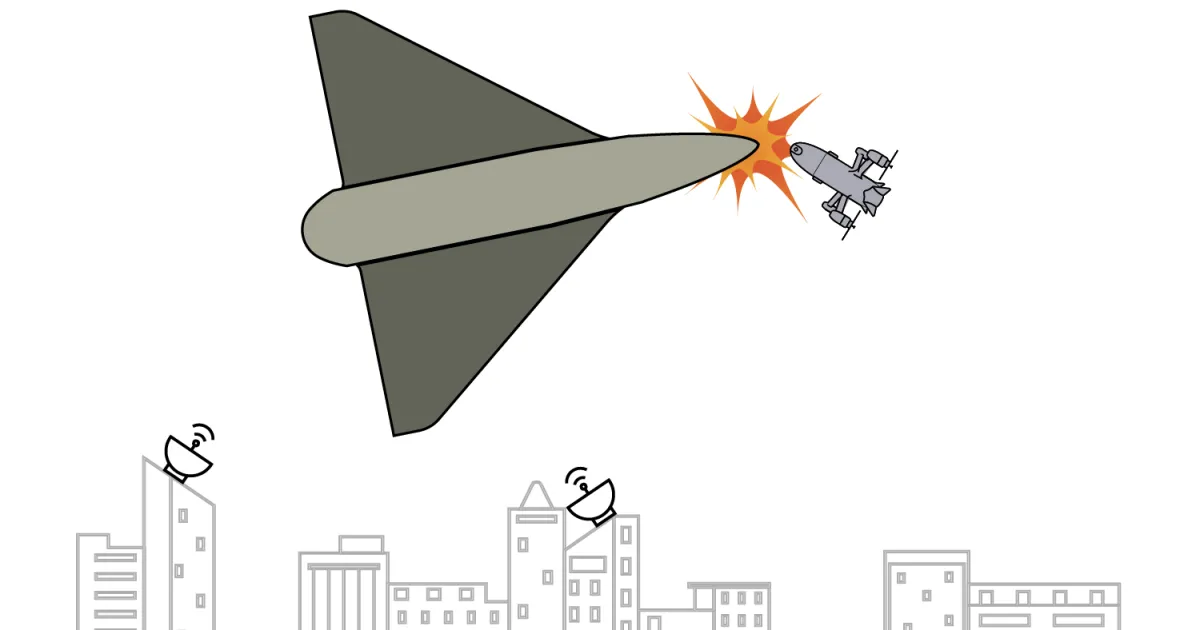
Ukraine’s battle-tested system uses thousands of acoustic sensors and interceptors to find and destroy incoming drones.Published On 4 May 2026Cheap, mass-produced one-way drones have played a major role in the conflict between the United States, Israel and Iran since the first attacks on Tehran on February 28. As Iran uses these drones to target energy facilities, airbases and other strategic sites across the Gulf and Israel, the US and Israel use expensive interceptor missiles for defence.To counter the drone threat, Gulf states and their US partners have turned to Ukrainian-made anti-drone technology, battle-tested against Russian drone attacks.In late March, Ukrainian President Volodymyr Zelenskyy visited Saudi Arabia, the UAE and Qatar to offer counter-drone expertise, signing 10-year defence agreements with all three countries. He later confirmed that Ukrainian forces took part in active operations using domestically produced interceptor drones, shooting down Iranian Shaheds in several Gulf countries.According to the Reuters news agency, the US military has also deployed Sky Map, a Ukrainian command-and-control platform used to detect incoming drones, at Prince Sultan Air Base in Saudi Arabia, with Ukrainian officers travelling to the base to train US warfighters on the software.In this visual explainer, Al Jazeera unpacks how Ukraine’s anti-drone systems work, what types of interceptors they use, and what types of drones they are being deployed against.What are Iran’s Shahed drones and how do they work?The Shahed-136 is an Iranian one-way attack drone that came to global prominence after Russia began using it in Ukraine in 2022.The triangular-shaped aircraft is about 3.5 metres (11.5ft) long and has a 2.5-metre (8.2ft) wingspan.The key to these drones’ effectiveness lies in the numbers. Each drone costs between $20,000 and $50,000 – compared with the US Patriot interceptor missiles used to shoot them down, which cost about $4m each.Because it uses a simple piston engine, similar to a lawnmower, the drone is very loud. While this makes it easy to hear, its low altitude and small radar signature make it difficult for traditional automated systems to lock on until it is very close.The drones are GPS-guided and pre-programmed with coordinates to strike fixed targets, though newer variants incorporate anti-jamming technology after adversaries learned to disrupt their navigation.The word “Shahed” is of Arabic origin and means “witness”. While the word is originally Arabic, it is also fully integrated into the Persian language, Farsi, in which it carries the same meaning.The graphic below shows several types of Iranian drones, including their munitions, range and payload capacity.The design is so effective and replicable that several militaries have adopted it, including Iran’s original Shahed, Russia’s Geran‑2 and the US LUCAS (Low-cost Uncrewed Combat Attack System), while other countries have developed Shahed‑like loitering munitions and smaller strike drones inspired by that form factor.(Al Jazeera)What are interceptor drones?Interceptor drones are built to chase and shoot down attack drones before they’re able to hit their target. They are also capable of delivering a wide range of payloads and do not self-destruct, unlike one-way drones.Ukrainian interceptor drones range in price from about $1,000 to $3,000. Popular interceptor drones include:The Sting: This Ukrainian-made quadcopter is about the size of a large thermos or typically 30-45cm (12-18in) in length. It can reach speeds of up to 342 kilometres per hour (213 miles per hour), making it one of the fastest interceptors. It can cruise at an altitude of 3,000 metres (about 10,000ft) and relies on thermal imaging cameras to hit targets with its domed head carrying the camera system and explosive payload. It can return to base if a target is not located.P1-Sun: Similar in design to the Sting, it is a 3D-printed interceptor produced by the weapons company Skyfall, and can fly at up to 300km/h (186mph).ODIN Win_Hit: Developed by Ukrainian defence company ODIN, this is another bullet-shaped drone built for short-duration, high-intensity missions. It has a maximum speed of up to 300km/h (186mph) and can fly up to 5km (3.1 miles) for 7-10 minutes at a time.Octopus 100: This Ukrainian-designed interceptor is capable of flying at speeds of more than 300km/h (186mph) and has an altitude of up to 4.5km (2.8 miles). It is mass-produced in the United Kingdom.Bagnet: A high-speed interceptor drone launched in 2024 with a maximum speed of 250km/h (155mph). Bagnet is classified as a fast-response UAV interceptor and can strike loitering drones and reconnaissance targets.Merops: A US-developed, AI-guided, GPS-jam-resistant interceptor drone that has a higher development cost of about $15,000.VB140 Flamingo: Capable of operating at an altitude of up to 4.5km (2.8 miles) and over a range of up to 50km (31 miles).How does Ukraine’s Sky Map system work?Sky Map is Ukraine’s command-and-control software platform, which can identify incoming drone attacks and counter them with its own anti-drone interceptors.Sky Fortress, the company behind Sky Map, was established in 2022 and is funded by Ukraine’s military. According to Reuters, the company placed more than 10,000 acoustic sensors around Ukraine so that they could detect incoming drone attacks. These sensors are essentially high-sensitivity microphones deployed across the country to listen for the distinct engine signatures of drones.Sky Map links acoustic sensors, radar and AI systems to detect threats and guide air defence systems.Each interceptor is operated by a trained pilot, tracking the drone’s camera feed in real time on a monitor or via first-person-view (FPV) goggles close to the area of engagement.The technology is becoming increasingly autonomous, with onboard sensors and AI-assisted inertial navigation systems which allow the drones to perform rapid, midair alterations, track moving targets and maintain accurate flight paths even if GPS signals are jammed.The graphic below summarises how the system works.According to the Defense Council of Ukraine, shooting down one Shahed with an interceptor drone is more than 25 times cheaper than using a Western-model air defence missile.Analysts have said the drones can counter a range of attacks but cannot intercept ballistic missiles.Last month, the Pentagon said it was committing $350m to its counter-drone unit with cameras, sensors and interceptors to provide support against drone attacks in the current conflict.Air defence systems currently used by the US struggle to eliminate barrages of one-way drone attacks, since they are too fast for these systems and often evade detection. In addition, the cost of air defences is often too high to be deployed against the quantity of drones coming in.
SRCAl Jazeera
LANGEN
LEANCenter
WORDS1 042
ENT12
MON · 2026-05-04 · 11:27 GMTBRIEF NSR-2026-0504-73572
NSR-2026-0504-73572News Report·EN·Technology
What is the Ukrainian anti-drone system Sky Map being used in the Gulf?
Gulf states and their US partners are deploying Ukrainian anti-drone technology, specifically the Sky Map system, to counter Iranian drone attacks. This system, battle-tested against Russian drones in Ukraine, utilizes acoustic sensors and interceptors to detect and destroy incoming unmanned aerial vehicles.
AJLabsAl JazeeraFiled 2026-05-04 · 11:27 GMTLean · CenterRead · 5 min
Al JazeeraFIG 01
Reading time
5min
Word count
1 042words
Sources cited
2cited
Entities identified
12entities
Quality score
100%
§ 01
Briefing Summary
AI-generatedNEWSAR · AI
Gulf states and their US partners are deploying Ukrainian anti-drone technology, specifically the Sky Map system, to counter Iranian drone attacks. This system, battle-tested against Russian drones in Ukraine, utilizes acoustic sensors and interceptors to detect and destroy incoming unmanned aerial vehicles. Ukrainian President Zelenskyy recently signed 10-year defense agreements with Saudi Arabia, the UAE, and Qatar, confirming Ukrainian forces are actively using domestically produced interceptor drones in the region. The US military has also deployed Sky Map at Prince Sultan Air Base in Saudi Arabia, with Ukrainian officers training American personnel on its use. This deployment addresses the threat posed by Iran's inexpensive, mass-produced Shahed drones, which are difficult for traditional defense systems to intercept due to their low altitude and small radar signature.
Confidence 0.90Sources 2Claims 5Entities 12
§ 02
Article analysis
Model · rule-basedFraming
Technology
National Security
Tone
Measured
AI-assessed
CalmNeutralAlarmist
Factuality
0.80 / 1.00
Factual
LowHigh
Sources cited
2
Limited
FewMany
§ 03
Key claims
5 extracted01
Shahed drones cost between $20,000 and $50,000 each, while US Patriot interceptor missiles cost about $4m each.
statistic
Confidence
0.90
02
Ukrainian President Volodymyr Zelenskyy signed 10-year defence agreements with Saudi Arabia, UAE, and Qatar, offering counter-drone expertise.
factualVolodymyr Zelenskyy
Confidence
0.90
03
Iran uses one-way attack drones, like the Shahed-136, to target energy facilities, airbases, and strategic sites across the Gulf and Israel.
factual
Confidence
0.90
04
Ukraine's Sky Map anti-drone system uses thousands of acoustic sensors and interceptors to find and destroy incoming drones.
factual
Confidence
0.90
05
The US military has deployed Sky Map, a Ukrainian command-and-control platform, at Prince Sultan Air Base in Saudi Arabia.
factualReuters
Confidence
0.80
§ 04
Full report
5 min read · 1 042 words§ 05
Entities
12 identifiedKey playerOppositionContextPositiveNeutralNegative
Organizations2
§ 06
Keywords & salience
10 termsanti-drone system
1.00
sky map
0.90
ukrainian technology
0.80
shahed drones
0.70
drone threat
0.70
us military
0.60
gulf states
0.60
interceptor drones
0.50
acoustic sensors
0.50
defense agreements
0.40
§ 07
Topic connections
Interactive graph Network visualization showing 51 related topics
View Full Graph Person Organization Location Event|Click node to navigate|Edge numbers = shared articles