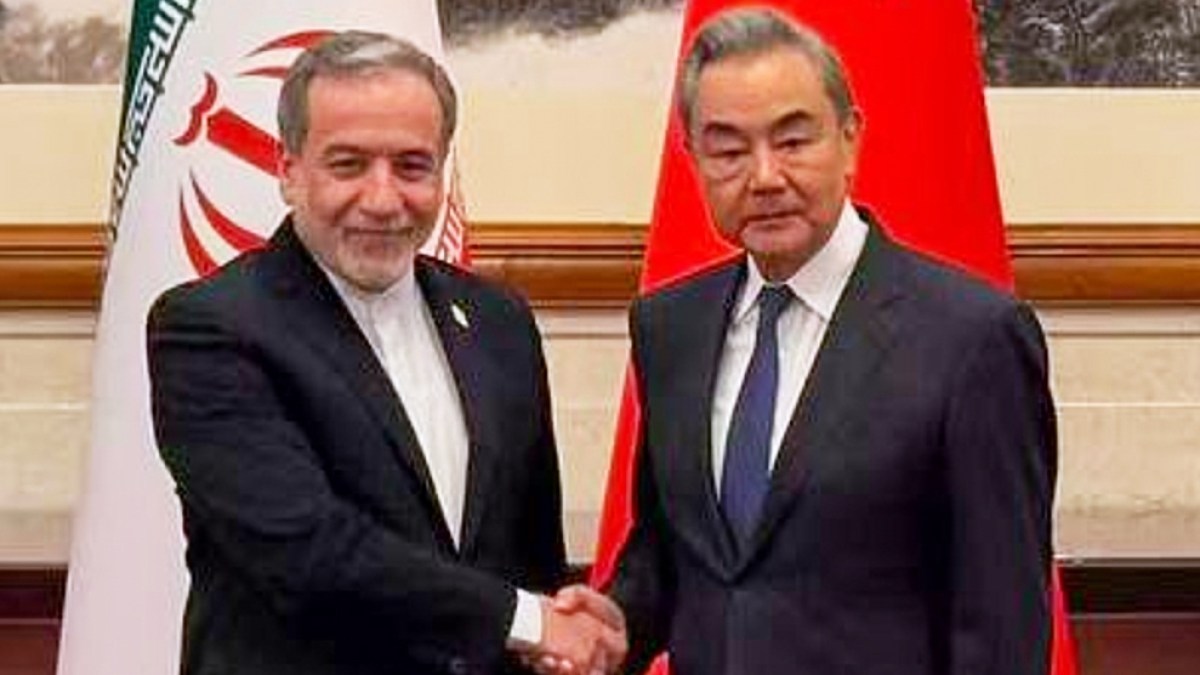
EXPLAINERAnalysts say shared US and Chinese interests in reopening the Strait of Hormuz could create a path towards peace.Iranian Foreign Minister Abbas Araghchi and China's Foreign Minister Wang Yi meet in Beijing, China, on Wednesday, May 6, 2026 [Telegram channel of the Iranian Foreign Minister via AP]Published On 6 May 2026Iranian Foreign Minister Abbas Araghchi met his Chinese counterpart Wang Yi in Beijing on Wednesday, as efforts to broker a peace deal between Tehran and Washington pick up pace amid the United States president’s announcement of a pause on attempts to forcibly open the Strait of Hormuz.The visit — and its timing — underscore what analysts say are China’s significant stakes in the Iran-war" class="entity-link entity-event" data-entity-id="107864" data-entity-type="event">US-Iran war, and the role Beijing could play in influencing the direction of the conflict.Recommended Stories list of 4 itemslist 1 of 4Sudan blames Ethiopia, UAE for recent drone attacks: What we knowlist 2 of 4Low US hotel bookings paint grim hospitality picture at the World Cuplist 3 of 4Lessons from the war: A call for strategic reckoning in West Asialist 4 of 4Canary Islands refuses to allow cruise ship with hantavirus to dockend of list“We believe that a comprehensive ceasefire brooks no delay, a resumption of hostilities is inadvisable, and persisting with negotiations is particularly important,” Wang told Araghchi at the start of their meeting, according to footage released by Hong Kong-based Phoenix TV.The visit comes a week before Trump is due to meet Chinese President Xi Jinping in Beijing on May 14 and 15. Earlier, US Secretary of State Marco Rubio urged China to press Iran to ease its blockade of the Strait of Hormuz, through which roughly one-fifth of the world’s oil and gas passes.The meeting comes against a backdrop of mounting tensions between Tehran and Washington over the strategic waterway. Iran moved to restrict shipping through the Strait of Hormuz after the war began, while the US imposed its own blockade on Iranian ports following the April ceasefire in an effort to force Tehran to accept Washington’s terms in negotiations.The disruption to shipping through the strait, which has sent shockwaves through the global economy, has at times also deepened tensions between Washington and Beijing, with China particularly affected by the disruption of Gulf energy flows to East Asia.But with the US also feeling an economic downturn, including rising domestic fuel prices ahead of the midterm elections, analysts say the shared interest between the two global powers in reopening the Strait of Hormuz and securing a ceasefire creates space for Beijing to play a crucial diplomatic role in any peace deal.China’s balancing actThroughout the conflict, China has tried to balance criticism of the US with calls for regional stability.During Wednesday’s meeting, Wang again condemned US and Israeli military actions against Iran as “illegitimate”, according to Iran’s semiofficial Tasnim News Agency. Beijing has repeatedly framed the conflict as a violation of international law while stopping short of fully endorsing every Iranian move.China has also criticised the killing of Iran’s Supreme Leader Ayatollah Ali Khamenei as a dangerous escalation that risked returning international politics to “the law of the jungle”. Alongside Russia, Beijing has vetoed efforts at the United Nations Security Council to condemn Iran’s actions in the Strait of Hormuz.At the same time, China has resisted growing US pressure over its economic ties with Tehran. Washington has sanctioned Chinese firms accused of purchasing Iranian oil. Beijing responded by instructing Chinese companies not to comply with the sanctions.However, US Treasury Secretary Scott Bessent still publicly urged China to use its influence with Tehran to help de-escalate the crisis, signs of the recent thaw in US-China relations following a preliminary trade agreement reached late last year.Jodie Wen, a researcher at the Center for International Security and Strategy (CISS) at Tsinghua University in Beijing, said China’s messaging has largely focused on preventing further instability around the Strait of Hormuz, a vital route for Chinese energy imports and trade.“I think China will try its best to persuade Iran back to the negotiating table and let the Strait of Hormuz become as open as before,” Wen said.What does Iran want from China?China remains Tehran’s most important economic lifeline after years of US sanctions left Iran deeply dependent on Chinese trade and investment.China buys the vast majority of Iran’s oil exports, often at discounted prices, while Iranian revenues are largely channelled into purchasing Chinese goods and services. That dependence has only deepened since the two countries signed a 25-year strategic partnership agreement in 2021 covering infrastructure, trade and security cooperation.Against that backdrop, analysts say Araghchi’s visit is also aimed at securing diplomatic backing from Beijing at a critical moment in the conflict.Chris Doyle, director of the Council for Arab-British Understanding, told Al Jazeera that Tehran is likely seeking clarity over how far China is willing to support Iran if it agrees to ease tensions in the Strait of Hormuz.“The Iranian foreign minister is possibly in Beijing to seek clarity from Beijing and reassurance that if they do choose to open the strait, Beijing will perhaps continue to support it diplomatically, and continue to support it at the United Nations,” Doyle said.Tehran would likely need Chinese backing at the UN to block any additional sanctions linked to the Strait of Hormuz. Iranian officials are also believed to be seeking reassurances over the position Beijing will take during Xi’s talks with Trump next week, and whether China could make concessions to Washington that might unsettle Tehran.Doyle said the timing of the visit was significant, with Washington increasingly pressuring Beijing to use its influence over Iran.“We have Trump coming next week, and the Trump administration has in recent days been putting more pressure on Beijing to use its influence with Iran to exert pressure, and really pressure Iran to come to the table to end the war, and certainly end its closure of the Strait of Hormuz,” he said.US media reports have also suggested China has considered increasing military support for Iran. CBS News reported that Pentagon intelligence analysts assessed Beijing was weighing whether to provide Tehran with advanced radar and air defence systems, although it remains unclear whether any transfers have taken place.Analysts say Iran’s immediate priority is likely securing assurances that China will continue supporting it diplomatically if Tehran agrees to scale back its actions in the strait.What does China want from Iran?One of China’s core interests is stability in the region and favourable conditions for an economy that continues to grow faster than many of its Western counterparts. The free movement of goods through the Strait of Hormuz is central to that, as prolonged disruption threatens both China’s economy and wider global markets, as well as energy security.Beijing is therefore expected to push Tehran towards keeping shipping routes open and returning to negotiations, say analysts.At the same time, China sees Iran as an important regional counterweight to US influence in the Middle East and does not want to see the Iranian government weakened significantly.Iran also provides strategic benefits for China beyond energy. Tehran has increasingly promoted the use of the Chinese yuan in oil transactions, supporting Beijing’s broader efforts to expand the currency’s international role amid US dollar hegemony.Analysts say China may also view the crisis as an opportunity to strengthen its image as a global diplomatic power capable of brokering agreements beyond East Asia.Pakistan has already called on Beijing to play a larger mediation role in regional tensions, with officials telling Al Jazeera that China is viewed as a credible actor capable of helping stabilise US-Iran talks.
SRCAl Jazeera
LANGEN
LEANCenter
WORDS1 247
ENT12
WED · 2026-05-06 · 13:47 GMTBRIEF NSR-2026-0506-74174
NSR-2026-0506-74174Analysis·EN·Diplomatic
Araghchi in Beijing: How China could shape the direction of the US-Iran war
Iranian Foreign Minister Abbas Araghchi met with Chinese Foreign Minister Wang Yi in Beijing on May 6, 2026, amid escalating US-Iran tensions over the Strait of Hormuz. The meeting highlights China's significant interest in the conflict, particularly concerning the disruption of global oil and gas flows.
Caolán MageeAl JazeeraFiled 2026-05-06 · 13:47 GMTLean · CenterRead · 5 min
Al JazeeraFIG 01
Reading time
5min
Word count
1 247words
Sources cited
3cited
Entities identified
12entities
Quality score
100%
§ 01
Briefing Summary
AI-generatedNEWSAR · AI
Iranian Foreign Minister Abbas Araghchi met with Chinese Foreign Minister Wang Yi in Beijing on May 6, 2026, amid escalating US-Iran tensions over the Strait of Hormuz. The meeting highlights China's significant interest in the conflict, particularly concerning the disruption of global oil and gas flows. Wang Yi emphasized the urgency of a ceasefire and continued negotiations. The visit precedes a meeting between US President Trump and Chinese President Xi Jinping, where the US has urged China to pressure Iran to ease its blockade of the strait. Both the US and China are experiencing economic impacts from the shipping disruptions, suggesting a shared interest in reopening the Strait of Hormuz.
Confidence 0.90Sources 3Claims 5Entities 12
§ 02
Article analysis
Model · rule-basedFraming
Diplomatic
Economic Impact
Tone
Measured
AI-assessed
CalmNeutralAlarmist
Factuality
0.60 / 1.00
Mixed
LowHigh
Sources cited
3
Well sourced
FewMany
§ 03
Key claims
5 extracted01
US Secretary of State Marco Rubio urged China to pressure Iran to ease its blockade of the Strait of Hormuz.
factualMarco Rubio
Confidence
1.00
02
Wang Yi stated that a comprehensive ceasefire is urgent, resuming hostilities is inadvisable, and negotiations are crucial.
quoteWang Yi
Confidence
1.00
03
Iranian Foreign Minister Abbas Araghchi met with Chinese Foreign Minister Wang Yi in Beijing.
factualarticle
Confidence
1.00
04
China has tried to balance criticism of the US with calls for regional stability throughout the conflict.
factualarticle
Confidence
0.90
05
Analysts suggest shared US and Chinese interests in reopening the Strait of Hormuz could foster peace.
predictionanalysts
Confidence
0.70
§ 04
Full report
5 min read · 1 247 words§ 05
Entities
12 identifiedKey playerOppositionContextPositiveNeutralNegative
People4
Organizations1
Locations6
§ 06
Keywords & salience
8 termsstrait of hormuz
1.00
us-iran war
1.00
china
0.90
peace deal
0.80
diplomacy
0.70
global economy
0.60
energy flows
0.50
blockade
0.40
§ 07
Topic connections
Interactive graph Network visualization showing 51 related topics
View Full Graph Person Organization Location Event|Click node to navigate|Edge numbers = shared articles