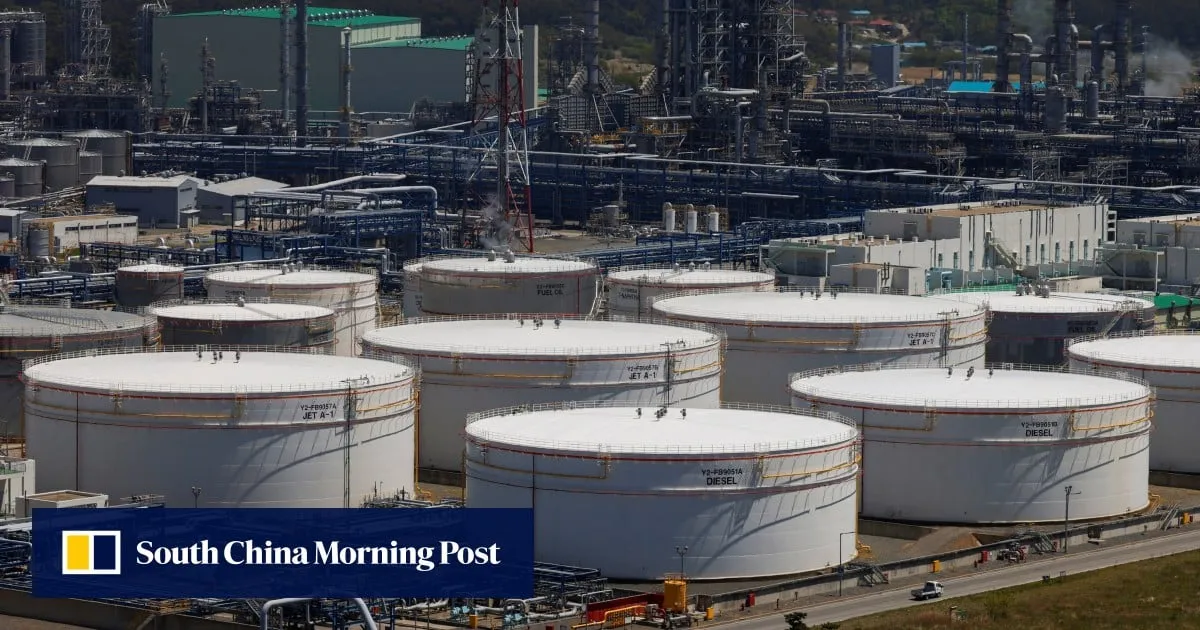
South Korea is drawing growing interest from Middle Eastern oil producers seeking to store crude oil at the country’s petroleum reserve bases, the world’s sixth largest, amid a prolonged blockade of the Strait of Hormuz, a South Korean official and an expert on the matter have said.The strait’s closure in the wake of the US-Israel war on Iran has taken a toll not only on South Korea and other nations dependent on oil imports but also oil-producing countries whose storage tanks are filling up with nowhere to ship, according to Yang Gi Uk, head of the Ministry of Trade, Industry and Energy’s Industry and Resource Security Office.“Several countries have approached South Korea with inquiries and requests for consultations” about whether they can store crude oil at South Korean oil reserve bases, Yang told reporters last month, though he declined to name them.For such countries as Saudi Arabia, Kuwait and the United Arab Emirates, “crude oil exports account for a massive share of their economies, and they have concluded that they can significantly reduce risks by storing oil outside the Strait of Hormuz to sell at a later time”.The proposed moves by several Gulf countries come as their oil storage facilities approach maximum capacity for lack of export outlets since the Strait of Hormuz was closed after the start of hostilities in late February.South Korea’s oil reserve bases, with a combined capacity of 146 million barrels, were built after the oil crises in 1973 and 1979 hit the country’s economy, according to the state-owned Korea National Oil Corporation.
SRCSouth China Morning Post
LANGEN
LEANCenter-Right
WORDS257
ENT11
SAT · 2026-05-09 · 05:14 GMTBRIEF NSR-2026-0509-74820
NSR-2026-0509-74820News Report·EN·Economic Impact
South Korea draws Gulf oil storage interest as Hormuz stays closed
Middle Eastern oil-producing nations are showing increased interest in utilizing South Korea's petroleum reserve bases for crude oil storage. This trend is driven by the prolonged blockade of the Strait of Hormuz, which has disrupted global oil exports.
KyodoSouth China Morning PostFiled 2026-05-09 · 05:14 GMTLean · Center-RightRead · 2 min
South China Morning PostFIG 01
Reading time
2min
Word count
257words
Sources cited
2cited
Entities identified
11entities
Quality score
100%
§ 01
Briefing Summary
AI-generatedNEWSAR · AI
Middle Eastern oil-producing nations are showing increased interest in utilizing South Korea's petroleum reserve bases for crude oil storage. This trend is driven by the prolonged blockade of the Strait of Hormuz, which has disrupted global oil exports. Several Gulf countries, including Saudi Arabia, Kuwait, and the United Arab Emirates, have approached South Korea to explore storage options. Their economies heavily rely on oil exports, and with storage facilities nearing capacity due to export limitations, they seek to mitigate risks by storing oil outside the Strait for later sale. South Korea's extensive oil reserve bases, with a capacity of 146 million barrels, were established following past oil crises.
Confidence 0.90Sources 2Claims 5Entities 11
§ 02
Article analysis
Model · rule-basedFraming
Economic Impact
Conflict
Tone
Measured
AI-assessed
CalmNeutralAlarmist
Factuality
0.80 / 1.00
Factual
LowHigh
Sources cited
2
Limited
FewMany
§ 03
Key claims
5 extracted01
South Korea's oil reserve bases have a combined capacity of 146 million barrels.
statisticKorea National Oil Corporation
Confidence
1.00
02
The blockade of the Strait of Hormuz is causing oil storage tanks in producing countries to fill up.
factualYang Gi Uk
Confidence
0.95
03
Several countries have approached South Korea to inquire about storing crude oil at its reserve bases.
quoteYang Gi Uk
Confidence
0.90
04
South Korea is attracting interest from Middle Eastern oil producers for crude oil storage.
factualSouth Korean official and expert
Confidence
0.90
05
Storing oil outside the Strait of Hormuz can significantly reduce risks for oil-exporting economies.
quoteYang Gi Uk
Confidence
0.85
§ 04
Full report
2 min read · 257 words§ 05
Entities
11 identifiedKey playerOppositionContextPositiveNeutralNegative
People1
Organizations2
§ 06
Keywords & salience
9 termsstrait of hormuz
1.00
oil storage
1.00
south korea
0.90
middle eastern oil producers
0.90
crude oil exports
0.80
oil reserve bases
0.70
economic impact
0.60
geopolitical risk
0.50
us-israel war on iran
0.40
§ 07
Topic connections
Interactive graph Network visualization showing 51 related topics
View Full Graph Person Organization Location Event|Click node to navigate|Edge numbers = shared articles