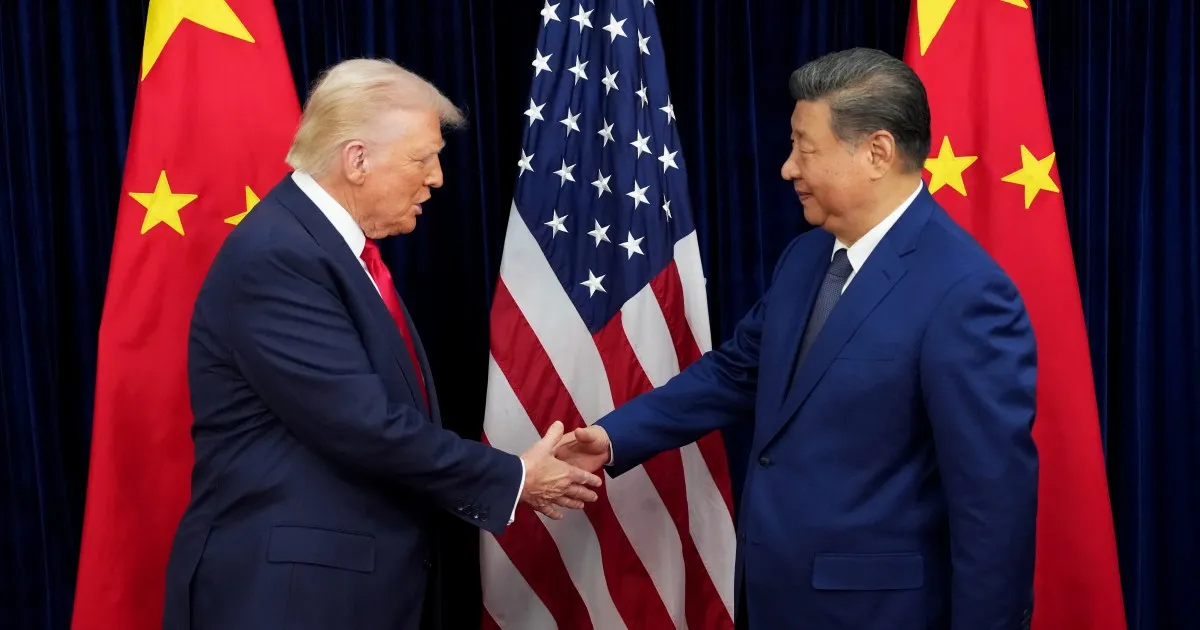
EXPLAINERUS President Donald Trump and Chinese President Xi Jinping have met six times since 2017.US President Donald Trump greets Chinese President Xi Jinping before a bilateral meeting at Gimhae Air Base on October 30, 2025 in Busan, South Korea [Andrew Harnik/Getty Images]Published On 12 May 2026United States President Donald Trump’s visit to China this week will mark his seventh face-to-face meeting with Chinese President Xi Jinping.The visit will also be the first trip by a US leader to China since 2017.Recommended Stories list of 4 itemslist 1 of 4Last passengers from hantavirus-hit ship evacuated; American tests positivelist 2 of 4Bolivia issues warrant for Evo Morales’s arrest after court no-showlist 3 of 4Lebanese in south refuse to flee again despite escalating Israeli strikeslist 4 of 4California ex-mayor admits acting as agent of China, US authorities sayend of listTrump and Xi’s three-day summit, which kicks off on Wednesday, is expected to focus on the US-Israel war on Iran, trade, and the status of Taiwan, among other issues.Here’s a rundown of the past meetings between the leaders of the world’s two most powerful nations:April 2017 in Palm Beach, USThe two first met at Trump’s private Mar-a-Lago resort on April 6, 2017, just a few months into his first term.At the time of their meeting, Trump was coming off a presidential campaign that had heavily criticised China’s trade practices and their impact on the US economy.Trump had also angered China by accepting a congratulatory phone call from then-Taiwanese President Tsai Ing-wen, breaking decades of diplomatic precedent set in 1979 when Washington cut off relations with Taipei.During their Mar-a-Lago meeting, Trump appeared to build a personal rapport with Xi and said the two sides had made “tremendous progress” towards improving US-China relations.The summit was largely overshadowed, however, by Trump’s decision to launch airstrikes on Syria, then led by Beijing-backed Bashar al-Assad, during Xi’s visit.July 2017 in Hamburg, GermanyXi and Trump met on the sidelines of the G20 Summit on July 8, 2017, beginning a pattern of engagement that would see the leaders repeatedly cross paths at major international gatherings.Their meeting focused heavily on North Korea’s nuclear programme and economic ties.A month later, the Trump Administration fired its first shot in the US-China trade war by launching an investigation into alleged theft of US intellectual property.By invoking Section 301 of the Trade Act of 1974, the White House would lay the groundwork to impose punitive tariffs on China.Chinese President Xi Jinping and First Lady Peng Liyuan attend a dinner hosted by US President Donald Trump at his Mar-a-Lago estate in West Palm Beach, Florida, on April 6, 2017 [Carlos Barria/Reuters]November 2017 in Beijing, ChinaTrump landed in China on November 8, 2017 for a three-day visit, joined by a delegation of American CEOs and business leaders.Trump’s itinerary included watching a Peking opera with Xi and his wife, visits to the Forbidden City and Palace Museum, a formal reception at the Great Hall of the People, a state banquet, and, finally, a private meeting with the Chinese leader.Trump left China touting $250m in “business deals” spanning energy, agriculture, and technology, although some of the agreements were tentative or covered projects already under way.The summit’s positive tone did not stop Trump from imposing tariffs on China a few months later.December 2018 in Buenos Aires, ArgentinaTrump and Xi held a dinner on December 1, 2018, on the sidelines of the G20 Summit.Months earlier, the Trump administration had imposed tariffs on $250bn worth of Chinese goods and banned US government agencies from using Chinese firms Huawei and ZTE, prompting Beijing to hit back with tariffs on $110bn worth of US goods.Despite the tensions, the White House hailed the meeting as “highly successful”, and the sides agreed to begin negotiations on outstanding issues, including intellectual property protection and cybertheft.June 2019 in Osaka, JapanTrump and Xi came face-to-face at the G20 Summit on June 29, 2019.During their talks, the leaders agreed to a host of measures to de-escalate their rivalry, including a halt to new US tariffs, more open-ended trade negotiations, an easing of restrictions on Huawei, and a Chinese commitment to buy more US agricultural exports.The US and China would months later sign a “phase one” trade deal, under which Washington agreed to roll back a number of tariffs and Beijing pledged to buy $200bn worth of US goods and services.China ultimately did not meet its purchase commitments during the required timeframe, which overlapped with the collapse of global trade due to the COVID-19 pandemic.US President Donald Trump attends a bilateral meeting with China’s President Xi Jinping during the G20 leaders summit in Osaka, Japan, on June 29, 2019 [Kevin Lamarque/Reuters]October 2025 in Busan, South KoreaTrump and Xi held their first meeting in six years on the sidelines of the 2025 APEC summit on October 30, 2025.The leaders met to extend a truce in a spiralling tariff war that briefly saw the US and China impose duties of 145 percent and 125 percent, respectively.Despite the trade truce, the Trump administration imposed sector-specific tariffs on China and restrictions on Chinese technology exports in the run-up to the summit, while Beijing tightened export controls on rare earth minerals.After their talks, Trump and Xi announced a one-year pause in their trade war.Among other measures, the US eased its tariffs, while China agreed to drop some of its export restrictions on rare earths and resume purchases of US agricultural exports.
SRCAl Jazeera
LANGEN
LEANCenter
WORDS894
ENT12
TUE · 2026-05-12 · 08:08 GMTBRIEF NSR-2026-0512-75562
NSR-2026-0512-75562News Report·EN·Diplomatic
Trump and Xi: The history of encounters between two superpower leaders
US President Donald Trump and Chinese President Xi Jinping have met six times since 2017, with their seventh meeting scheduled for May 2026 in China. This upcoming summit will be the first US leader visit to China since 2017 and is expected to address issues including the US-Israel war on Iran, trade, and Taiwan.
Erin HaleAl JazeeraFiled 2026-05-12 · 08:08 GMTLean · CenterRead · 4 min
Al JazeeraFIG 01
Reading time
4min
Word count
894words
Sources cited
0cited
Entities identified
12entities
Quality score
100%
§ 01
Briefing Summary
AI-generatedNEWSAR · AI
US President Donald Trump and Chinese President Xi Jinping have met six times since 2017, with their seventh meeting scheduled for May 2026 in China. This upcoming summit will be the first US leader visit to China since 2017 and is expected to address issues including the US-Israel war on Iran, trade, and Taiwan. Their initial meeting in April 2017 at Trump's Mar-a-Lago resort aimed to improve relations despite Trump's prior criticisms of China and a US airstrike on Syria during Xi's visit. Subsequent encounters at international events like the G20 summit in July 2017 focused on topics such as North Korea's nuclear program and economic ties, preceding the launch of the US-China trade war.
Confidence 0.90Claims 5Entities 12
§ 02
Article analysis
Model · rule-basedFraming
Diplomatic
Political Strategy
Tone
Measured
AI-assessed
CalmNeutralAlarmist
Factuality
0.80 / 1.00
Factual
LowHigh
Sources cited
0
No named sources
FewMany
§ 03
Key claims
5 extracted01
The Trump Administration fired its first shot in the US-China trade war by launching an investigation into alleged theft of US intellectual property.
factual
Confidence
1.00
02
Trump had also angered China by accepting a congratulatory phone call from then-Taiwanese President Tsai Ing-wen, breaking decades of diplomatic precedent.
factual
Confidence
1.00
03
The two first met at Trump’s private Mar-a-Lago resort on April 6, 2017.
factual
Confidence
1.00
04
US President Donald Trump and Chinese President Xi Jinping have met six times since 2017.
factual
Confidence
1.00
05
Trump and Xi’s three-day summit is expected to focus on the US-Israel war on Iran, trade, and the status of Taiwan.
prediction
Confidence
0.70
§ 04
Full report
4 min read · 894 words§ 05
Entities
12 identifiedKey playerOppositionContextPositiveNeutralNegative
People4
Locations7
§ 06
Keywords & salience
10 termsdonald trump
1.00
xi jinping
1.00
us-china relations
1.00
superpower leaders
0.90
trade war
0.80
taiwan
0.70
international gatherings
0.60
north korea nuclear program
0.50
us-israel war on iran
0.40
intellectual property
0.40
§ 07
Topic connections
Interactive graph Network visualization showing 51 related topics
View Full Graph Person Organization Location Event|Click node to navigate|Edge numbers = shared articles