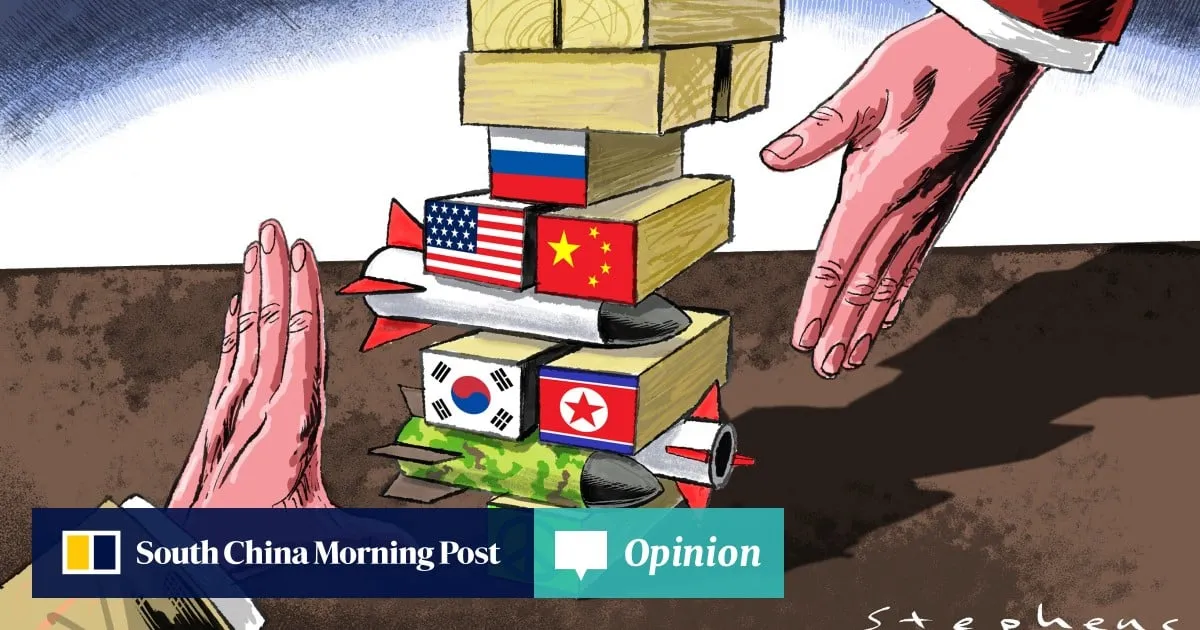
Lee Min-Yong is a visiting professor in the School of Global Service at Sookmyung Women’s University, South Korea and a former adviser (foreign affairs and national security) to the Presidential Office of the Republic of Korea.The US strikes on Iran sent a clear signal to Pyongyang. But rather than retreat or show renewed interest in denuclearisation, North Korea has doubled down on deterrence. In recent weeks, Pyongyang has tightened security around its leadership and continued its missile launches, underscoring its sensitivity to Washington’s military posture.From Pyongyang’s perspective, these moves are meant not only to gauge how far US military pressure could one day extend, but also to signal that North Korea’s deterrent is fundamentally different from anything Iran ever had.Comparisons between North Korea and Iran have important limits. Geopolitically and militarily, the Korean peninsula presents a vastly different environment. Applying military pressure to a nuclear-armed North Korea would be far riskier and less predictable. North Korea is widely believed to possess at least 50 nuclear warheads. That reality puts the peninsula beyond the point where military pressure alone can produce manageable outcomes.
SRCSouth China Morning Post
LANGEN
LEANCenter-Right
WORDS182
ENT10
WED · 2026-05-13 · 21:30 GMTBRIEF NSR-2026-0513-76050
NSR-2026-0513-76050Analysis·EN·National Security
Why stability must come before denuclearisation on the Korean peninsula
Recent US strikes on Iran have prompted North Korea to reinforce its deterrence rather than pursue denuclearization, according to Lee Min-Yong, a visiting professor and former South Korean presidential advisor. North Korea has increased security and continued missile launches, signaling its sensitivity to US military actions and emphasizing the distinct nature of its deterrent capabilities compared to Iran's.
Lee Min-YongSouth China Morning PostFiled 2026-05-13 · 21:30 GMTLean · Center-RightRead · 1 min
South China Morning PostFIG 01
Reading time
1min
Word count
182words
Sources cited
1cited
Entities identified
10entities
Quality score
100%
§ 01
Briefing Summary
AI-generatedNEWSAR · AI
Recent US strikes on Iran have prompted North Korea to reinforce its deterrence rather than pursue denuclearization, according to Lee Min-Yong, a visiting professor and former South Korean presidential advisor. North Korea has increased security and continued missile launches, signaling its sensitivity to US military actions and emphasizing the distinct nature of its deterrent capabilities compared to Iran's. The author argues that the geopolitical and military context of the Korean peninsula, where North Korea is believed to possess at least 50 nuclear warheads, makes military pressure alone an insufficient and risky strategy for achieving manageable outcomes. Therefore, stability, not immediate denuclearization, should be prioritized on the Korean peninsula.
Confidence 0.90Sources 1Claims 5Entities 10
§ 02
Article analysis
Model · rule-basedFraming
National Security
Diplomatic
Tone
Measured
AI-assessed
CalmNeutralAlarmist
Factuality
0.40 / 1.00
Mixed
LowHigh
Sources cited
1
Limited
FewMany
§ 03
Key claims
5 extracted01
Stability must come before denuclearisation on the Korean peninsula.
factual
Confidence
0.90
02
North Korea has doubled down on deterrence rather than retreat or show renewed interest in denuclearisation.
factual
Confidence
0.90
03
Applying military pressure to a nuclear-armed North Korea would be far riskier and less predictable than with Iran.
factual
Confidence
0.80
04
US strikes on Iran sent a clear signal to Pyongyang.
factual
Confidence
0.80
05
North Korea is widely believed to possess at least 50 nuclear warheads.
statistic
Confidence
0.70
§ 04
Full report
1 min read · 182 words§ 05
Entities
10 identifiedKey playerOppositionContextPositiveNeutralNegative
Organizations2
§ 06
Keywords & salience
9 termskorean peninsula
1.00
north korea
1.00
denuclearisation
1.00
stability
0.90
deterrence
0.80
us military pressure
0.70
nuclear warheads
0.60
pyongyang
0.50
iran
0.40
§ 07
Topic connections
Interactive graph Network visualization showing 5 related topics
View Full Graph Person Organization Location Event|Click node to navigate|Edge numbers = shared articles